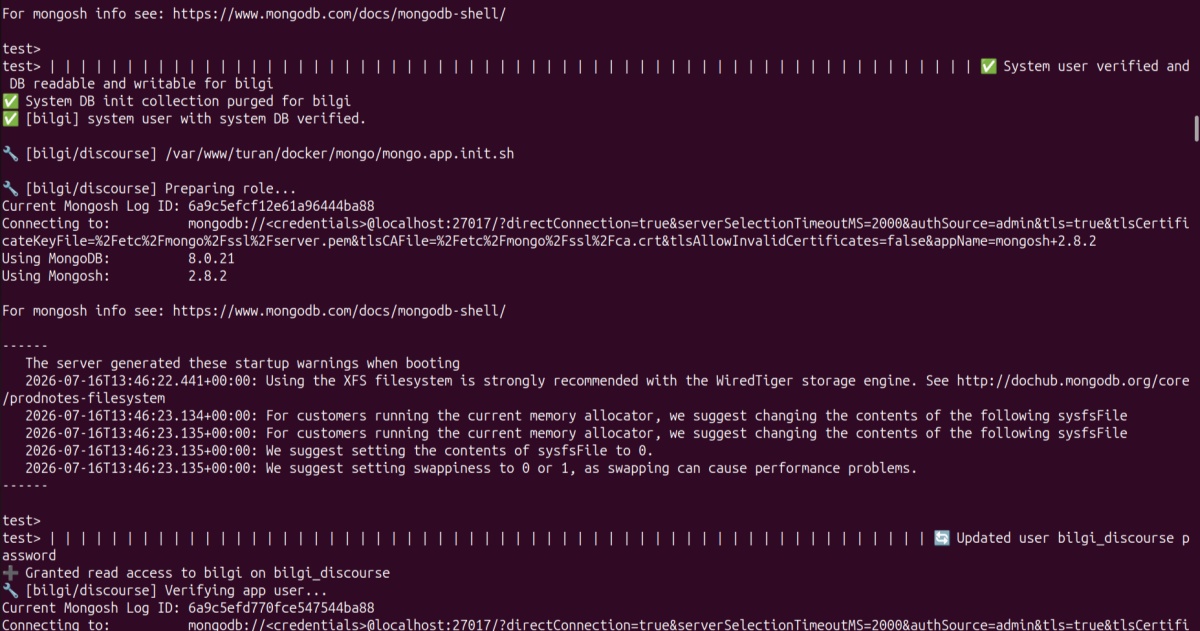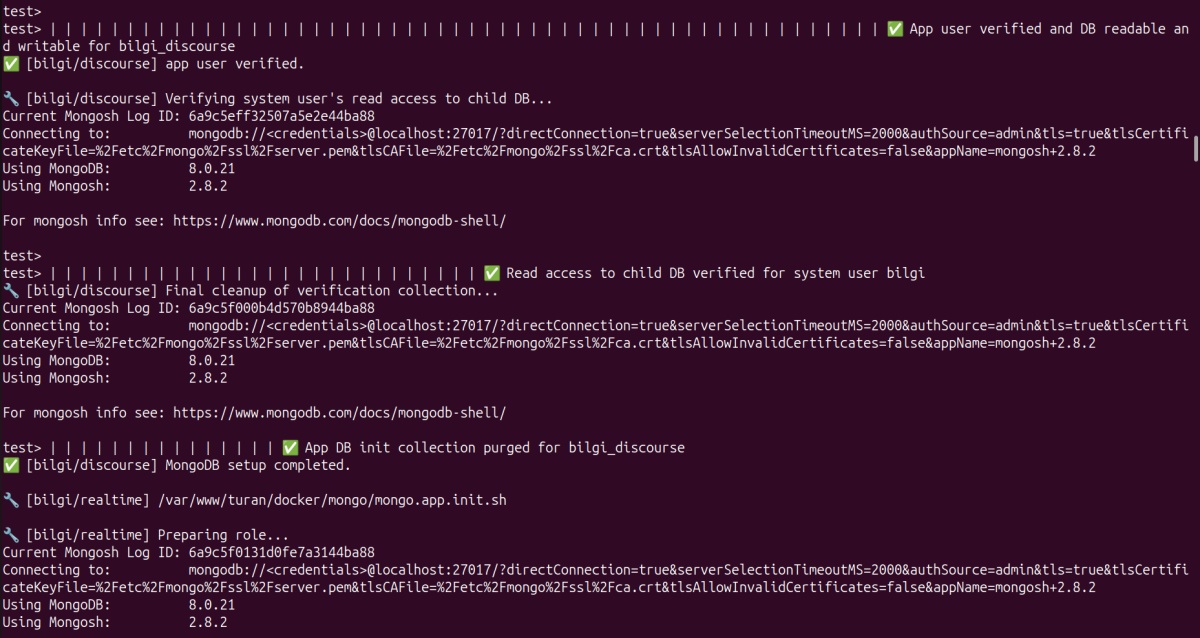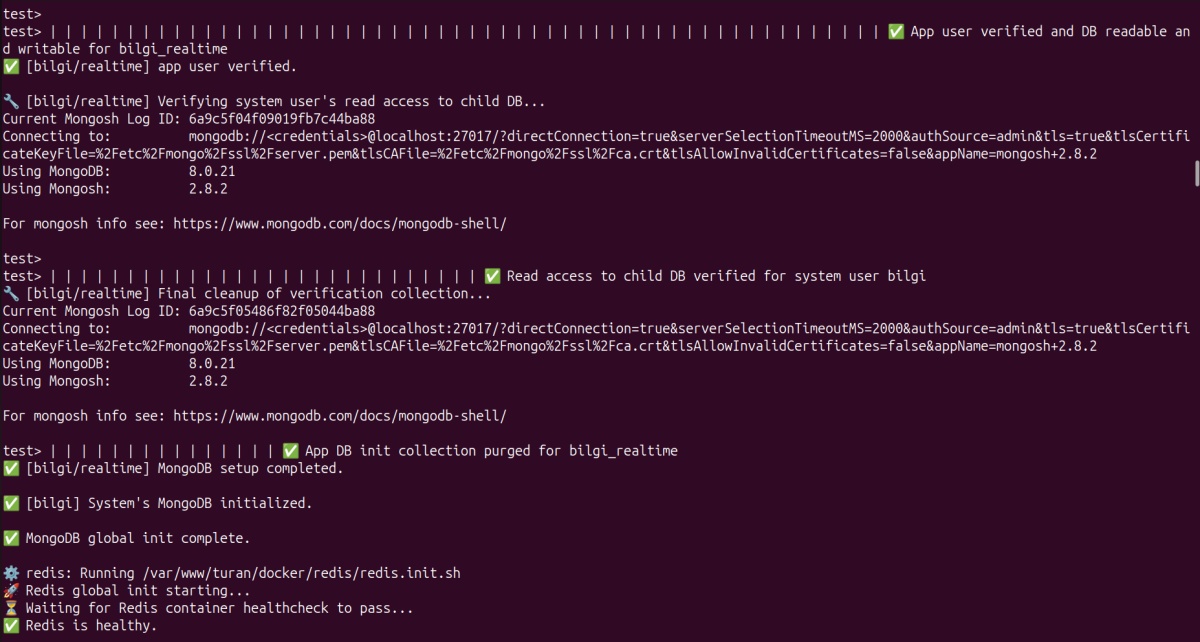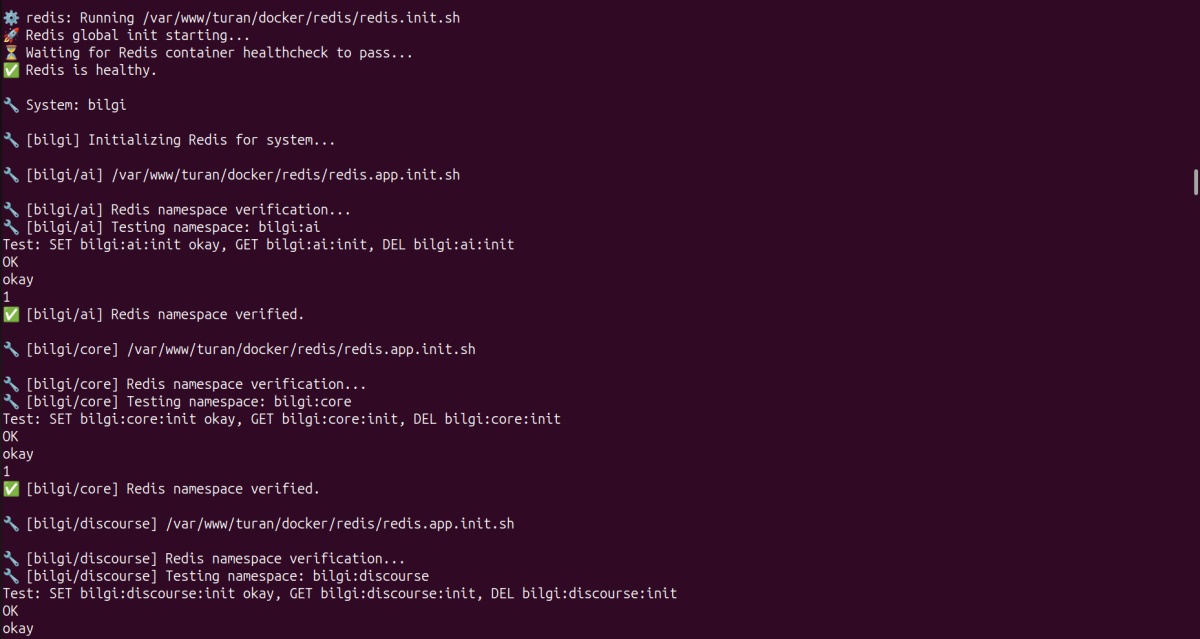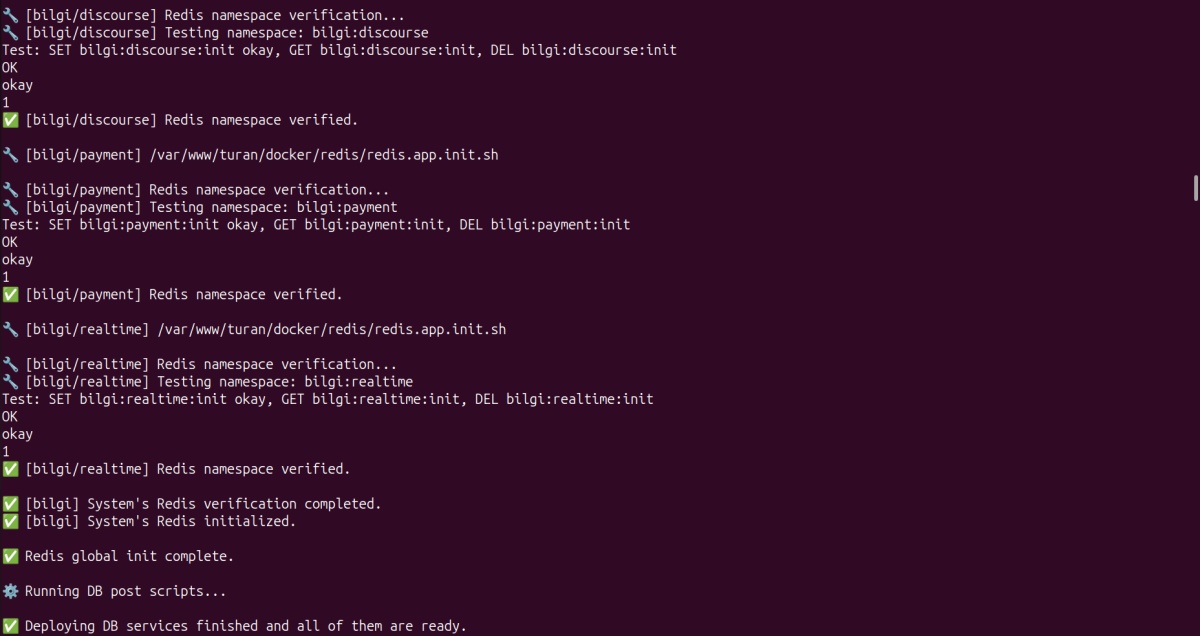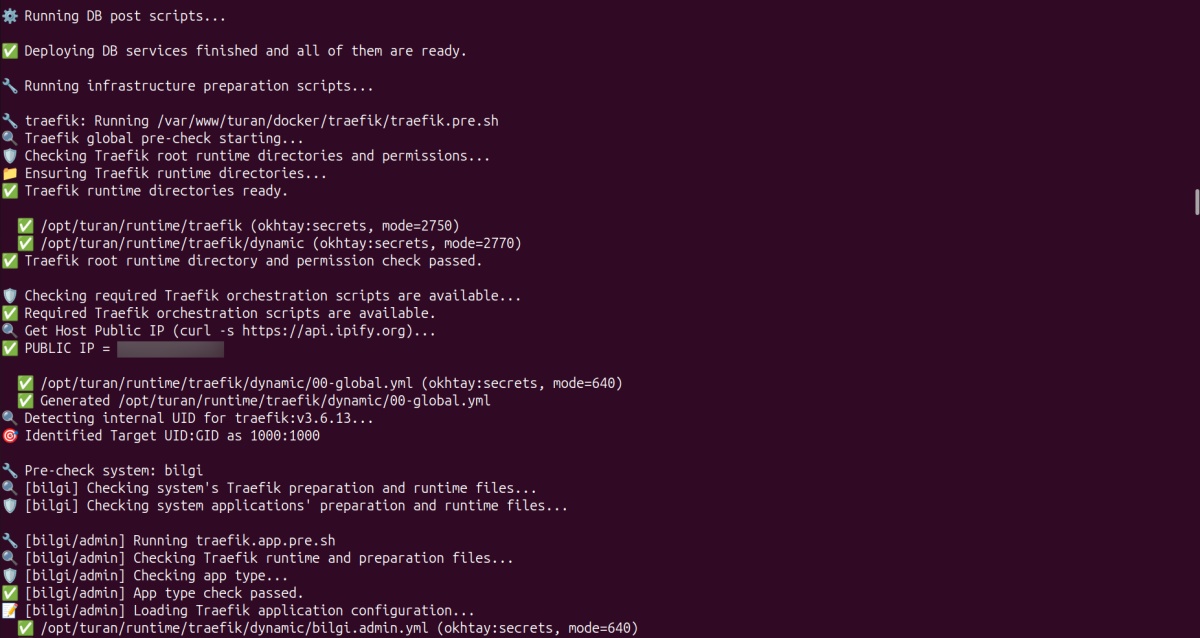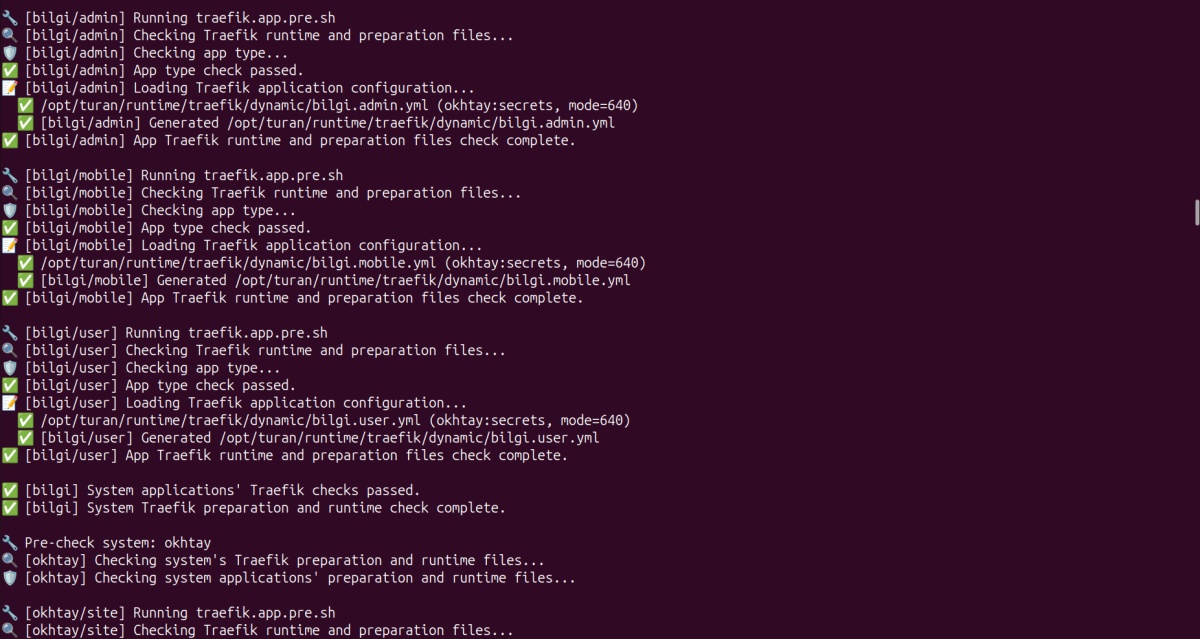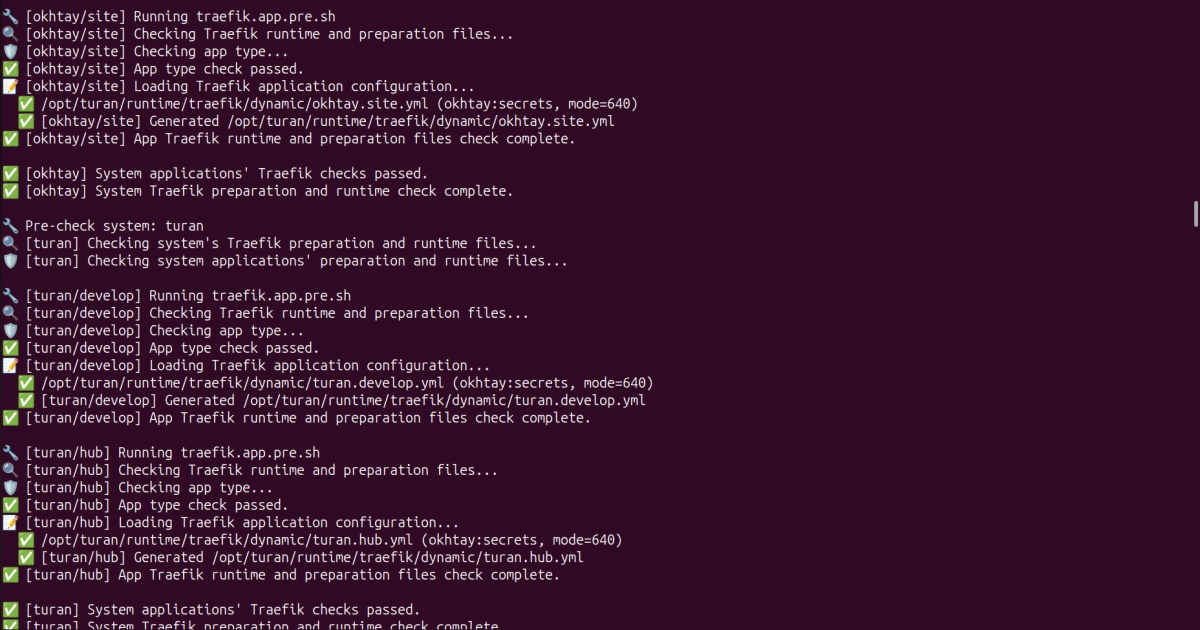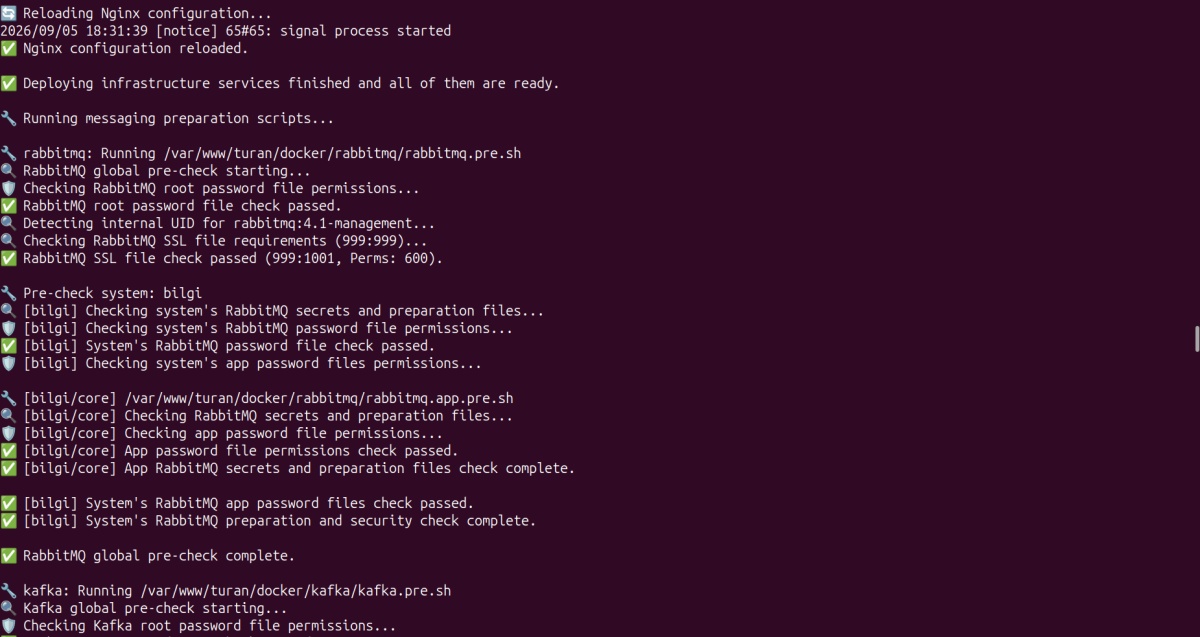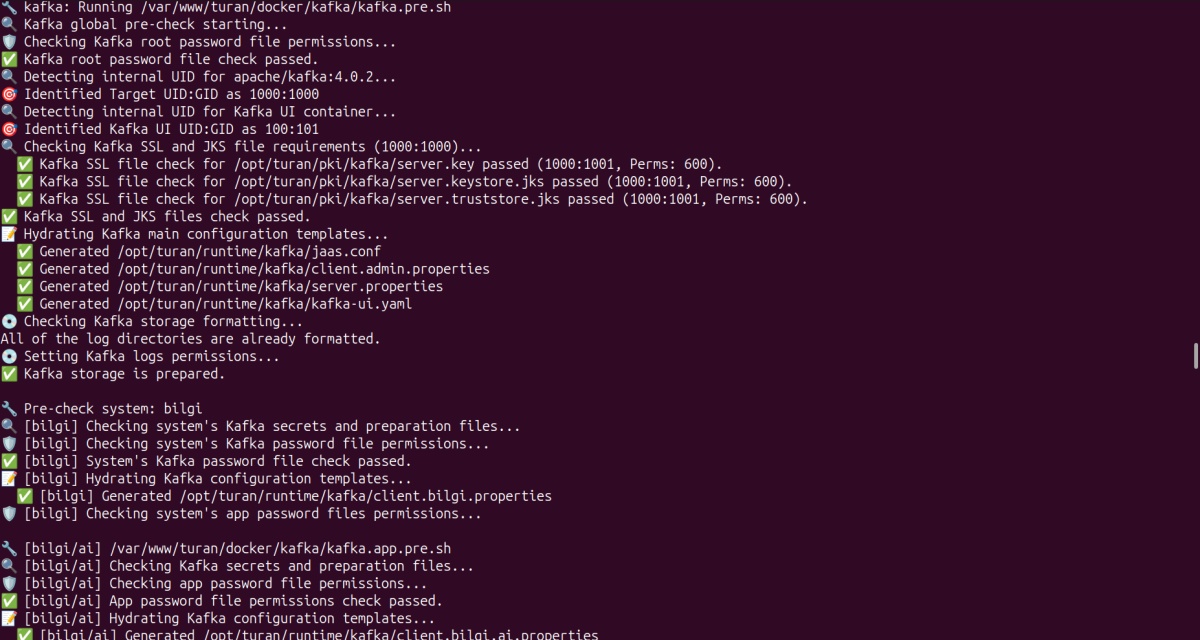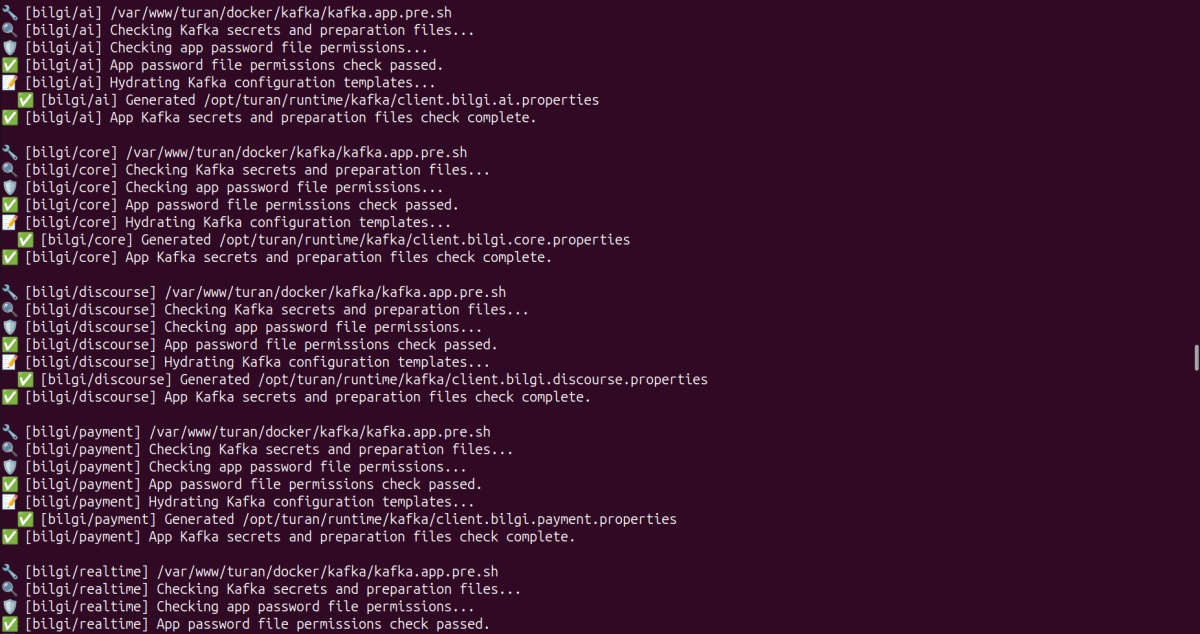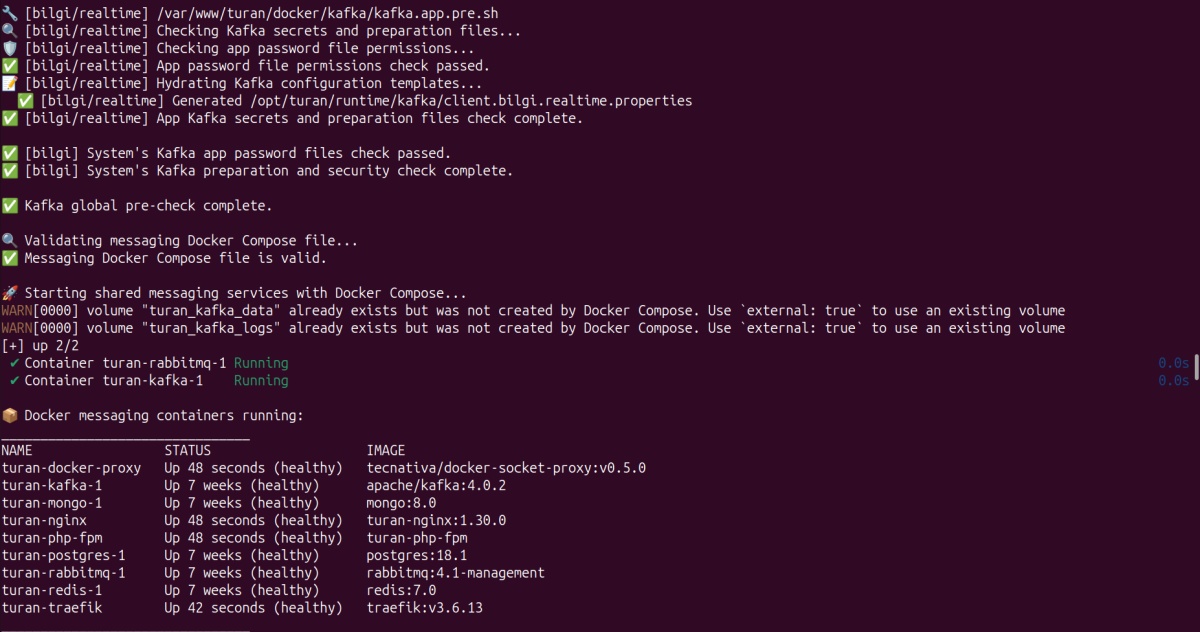
TuranOrdo Infrastructure Platform
An infrastructure operating system for microservices
March 2026 – Present
TuranOrdo is a production-grade, registry-driven infrastructure operating system built on Docker Compose that automatically discovers, provisions, secures, configures, and verifies infrastructure resources for multi-domain application platforms.
It provides a containerized infrastructure platform that integrates databases, messaging systems, gateways, shared application runtimes, observability, monitoring, and application services into a cohesive, reproducible, and operationally safe environment.
Designed not as “just Docker files,” but as a complete infrastructure operating model, TuranOrdo enables complex distributed systems to run reliably across multiple business domains (systems) and their internal applications (apps), with strong isolation, explicit resource ownership, deterministic deployment, and zero external infrastructure dependencies beyond Docker and Linux.
Its primary goals are:
- Secure multi-system architecture (e.g. bilgi, academy, commerce, etc.)
- System-level and app-level isolation
- Registry-driven infrastructure and resource ownership
- Support for containerized, PHP, and static application runtimes
- Shared platform infrastructure without losing application-level ownership
- Zero infrastructure dependency beyond Docker + Linux
- Safe long-term scalability without architectural rewrites
- Production-first observability and failure detection
- Strict secret isolation and file-level security
- Deterministic startup with full verification phases
- Versioned and controlled infrastructure schema evolution
- TLS-enforced communication where applicable
- Strong operational safety through health checks and validation pipelines
📚 Documentation Structure
The detailed architecture is organized into the following sections:
- 🏗 Core Architectural Philosophy
- 🖥️ Infrastructure Operating System
- 🧩 System-Level Isolation
- ⚙ App-Level Isolation Inside Each System
- 🔗 Unified Connectivity Model
- 🔐 Security Model
- 🚀 Deterministic Initialization + Verification
- 🗄️ Database Layer
- 🪣 Storage Layer
- 📨 Messaging Layer
- 🌐 Edge + Traffic Layer
- 🛡️ Private Network Layer
- 📊 Observability Layer
- 🧩 Application Layer
- 🧠 Why This Architecture Matters
- 🔮 Future Extensions & Evolution Roadmap
- 🌍 Disaster Recovery Without Hyperscaler Lock-In
- 🔑 Key Takeaways
- 🎯 Use Cases
- 📜 Licensing
- 📈 Investment & Future Development
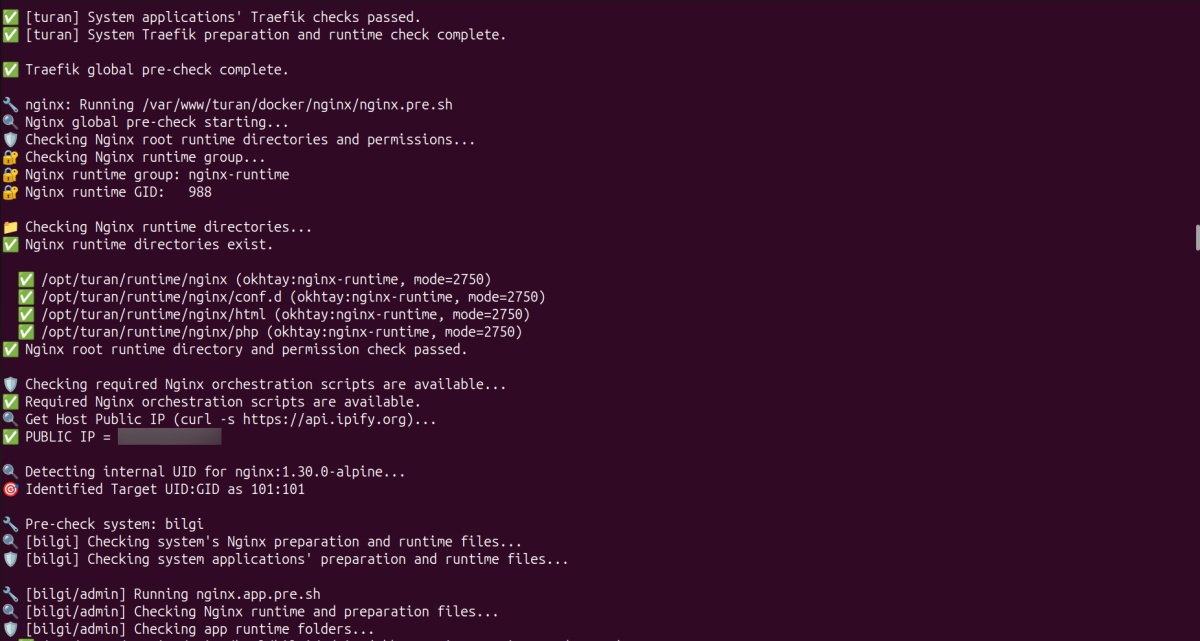
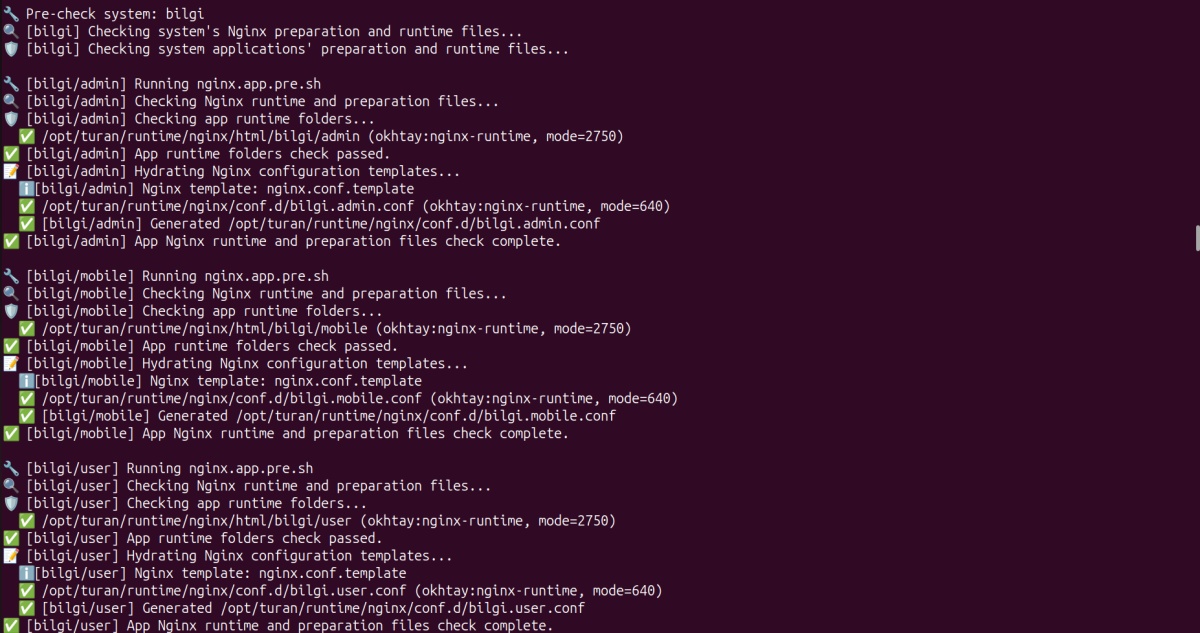
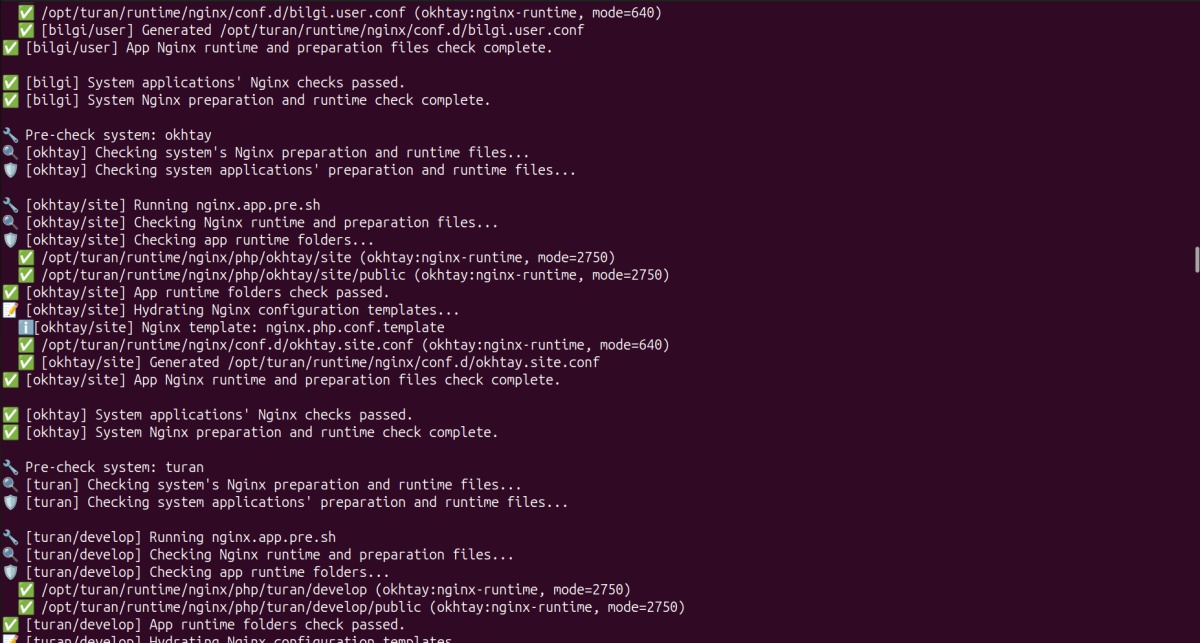
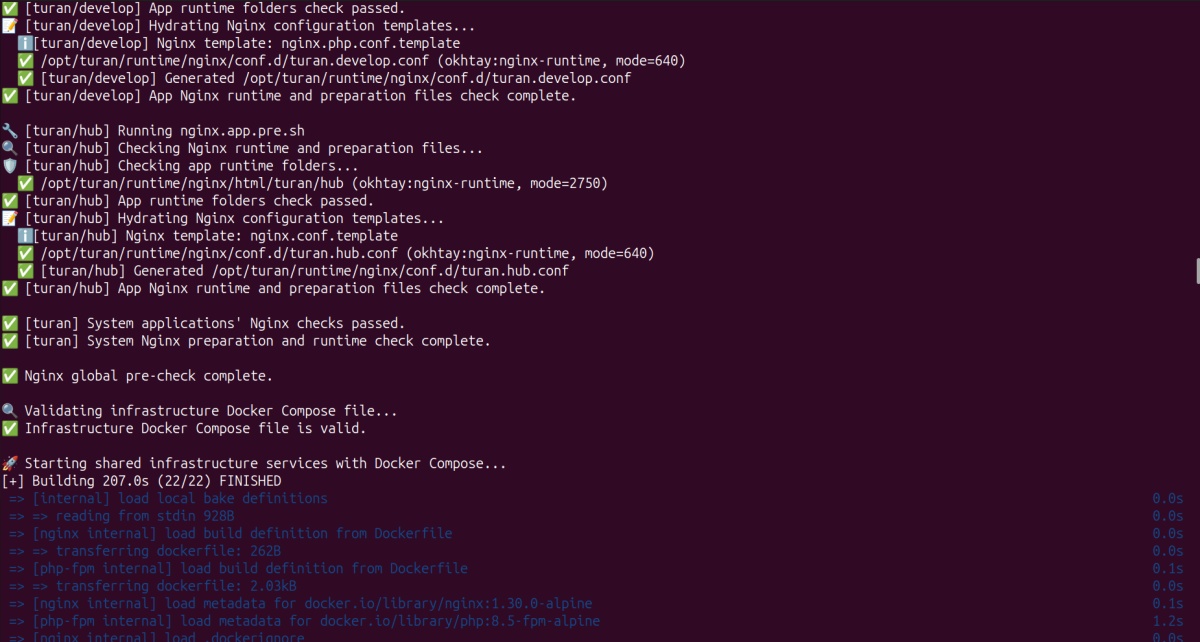
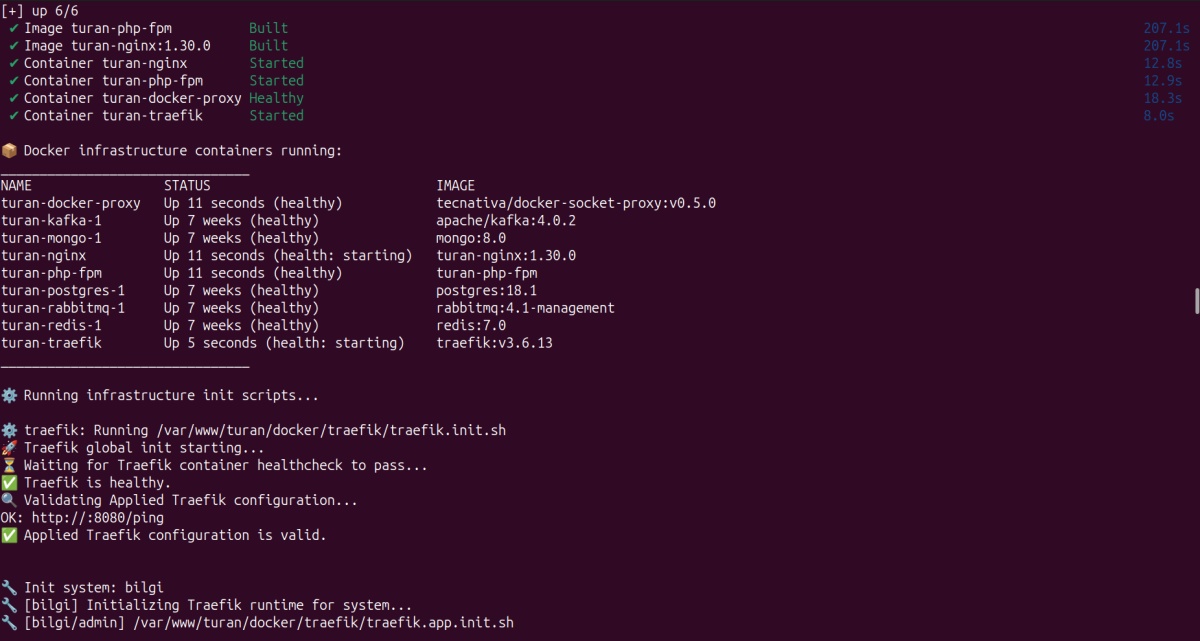
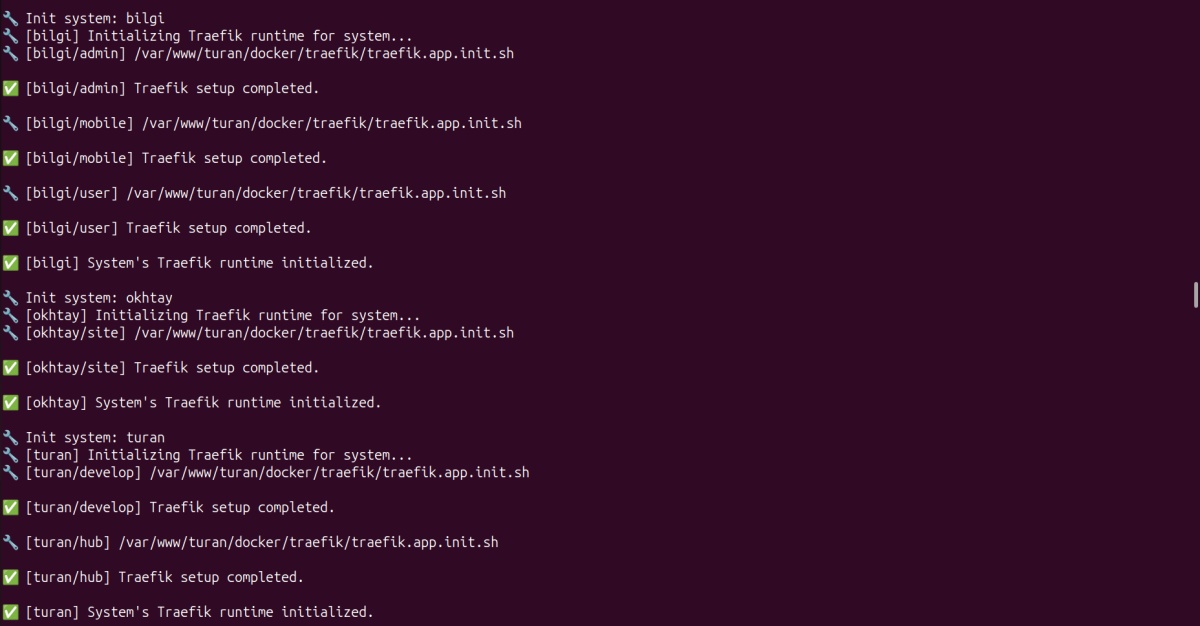
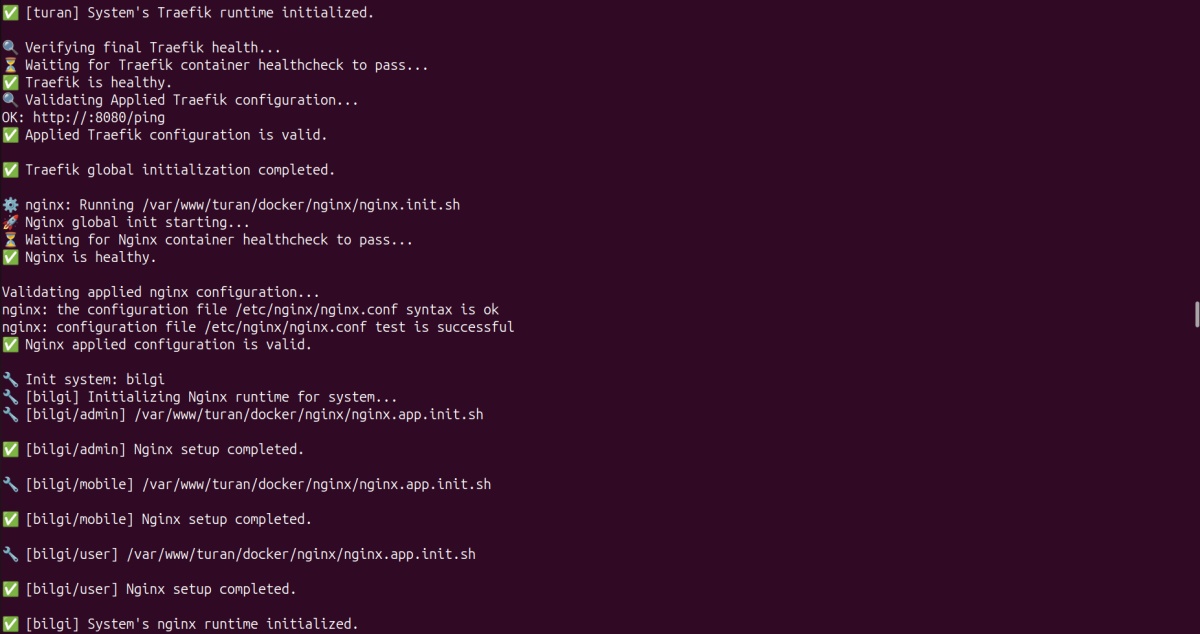
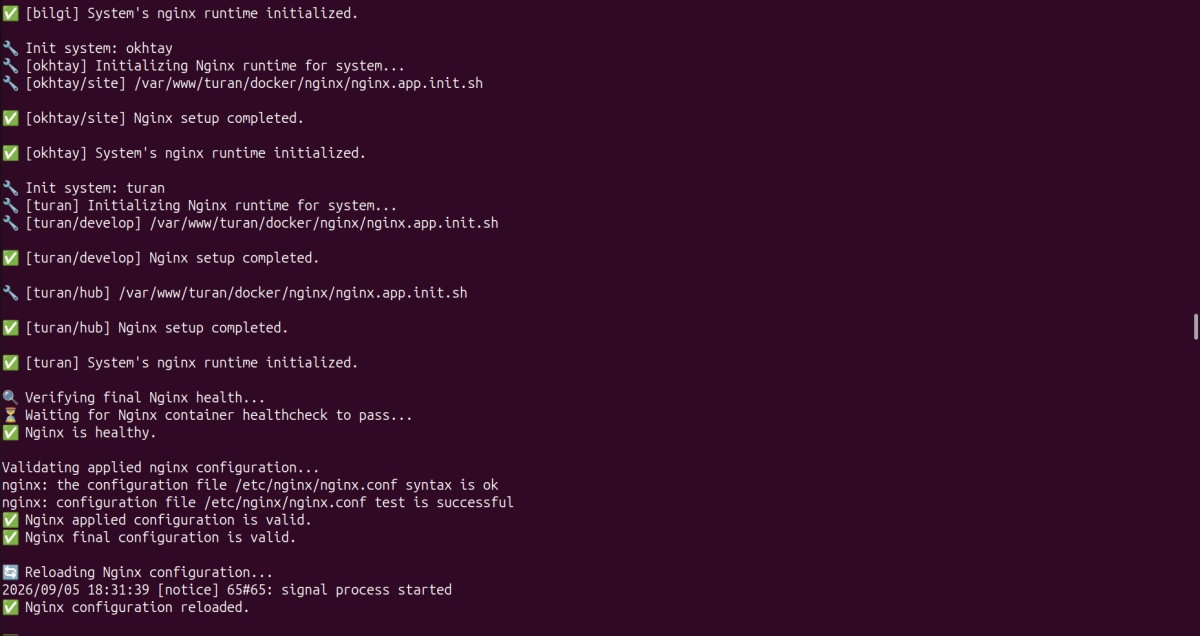
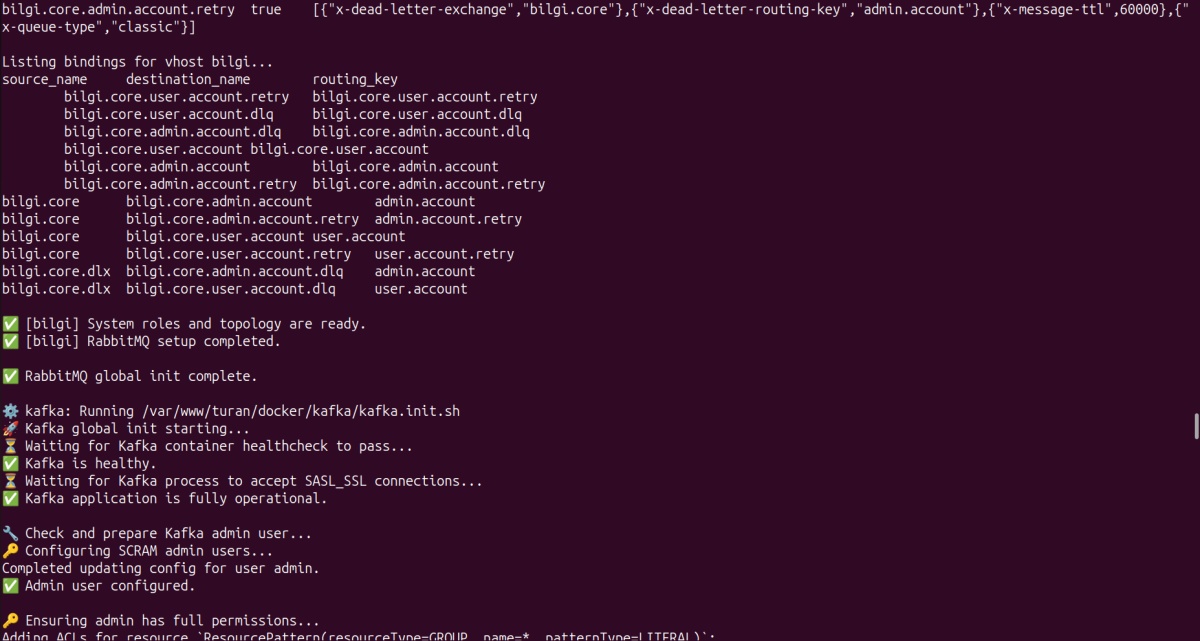
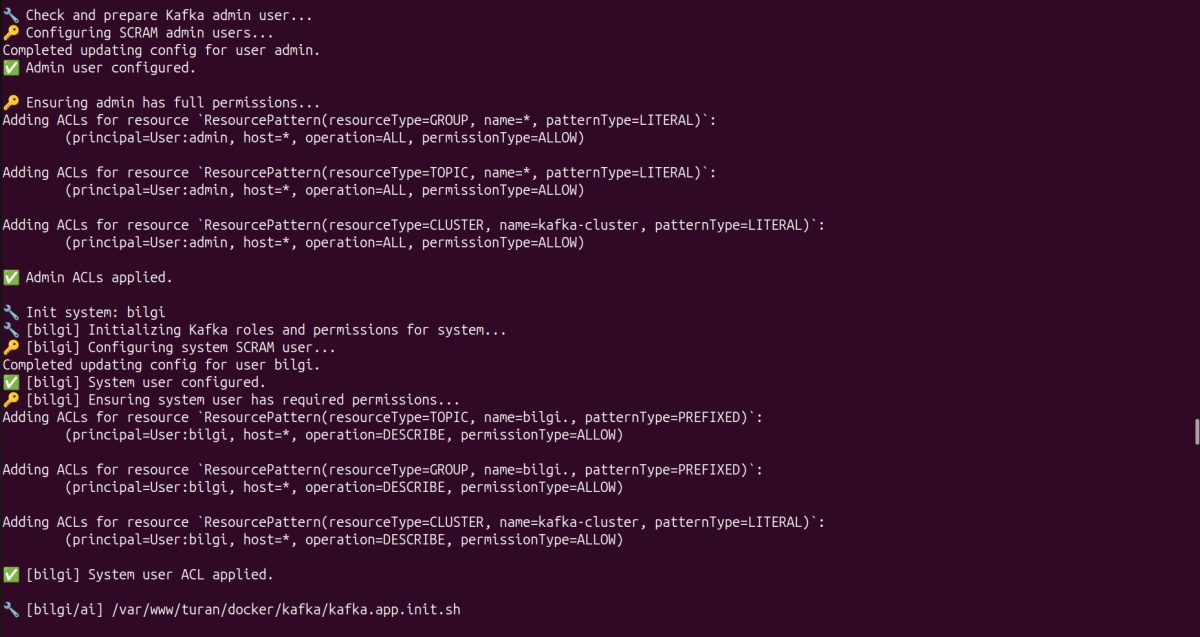
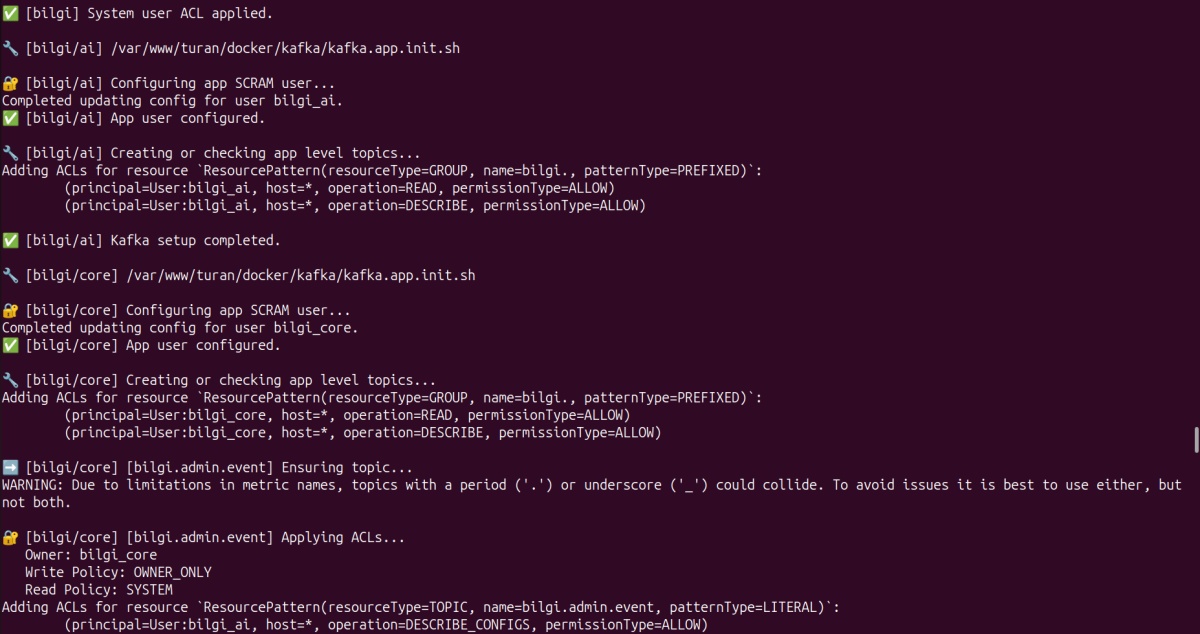
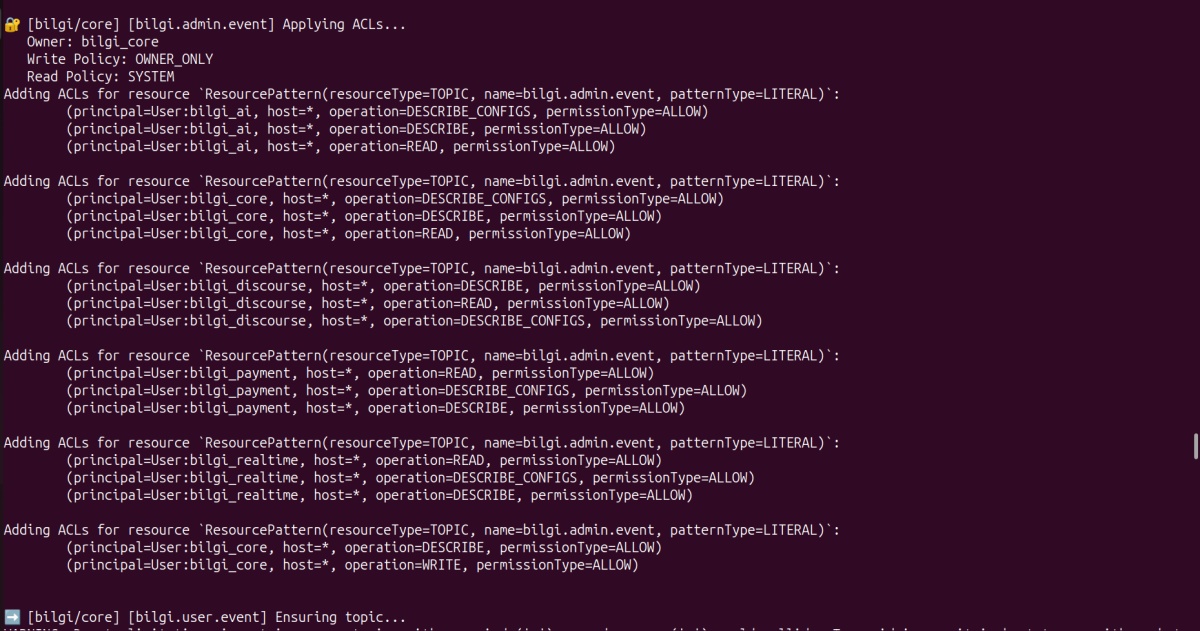
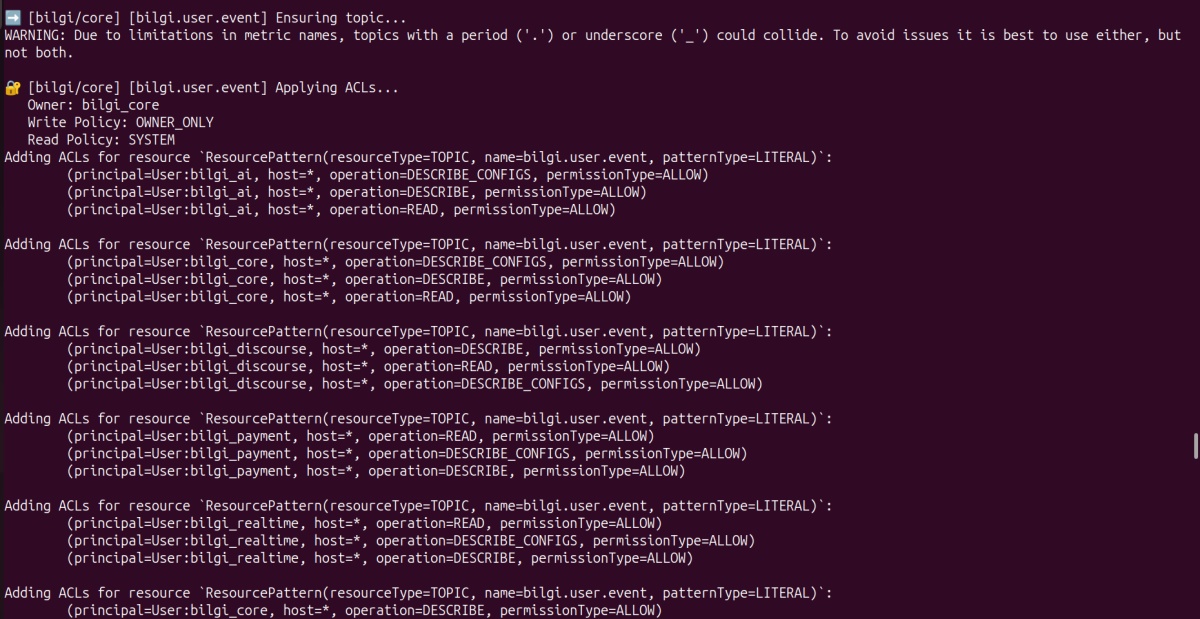
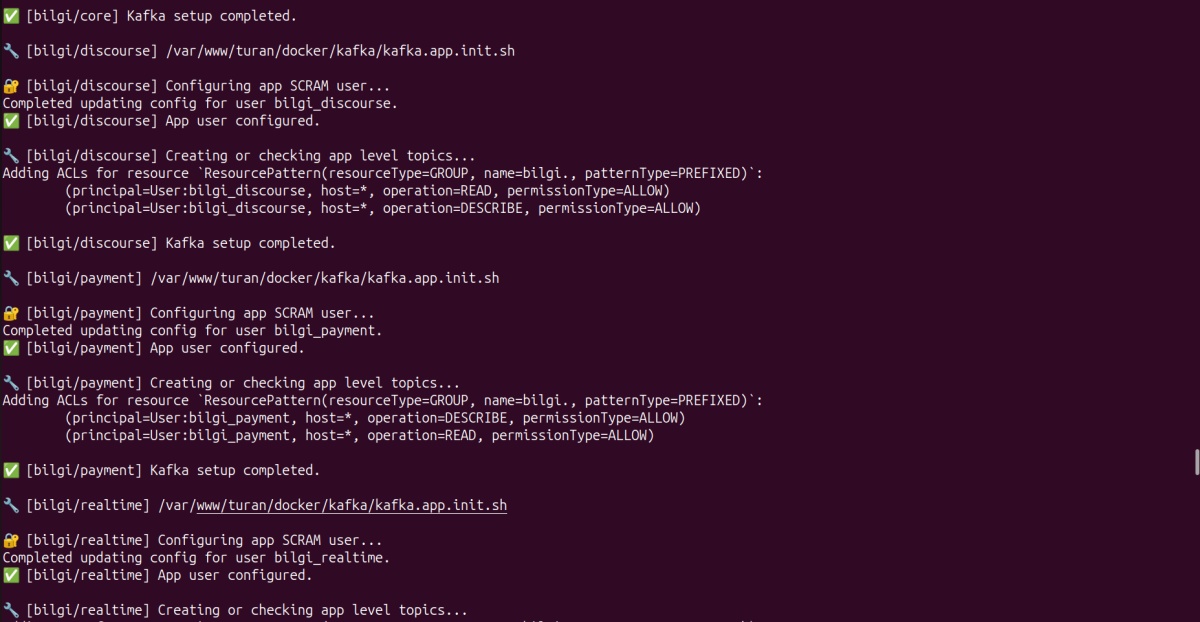
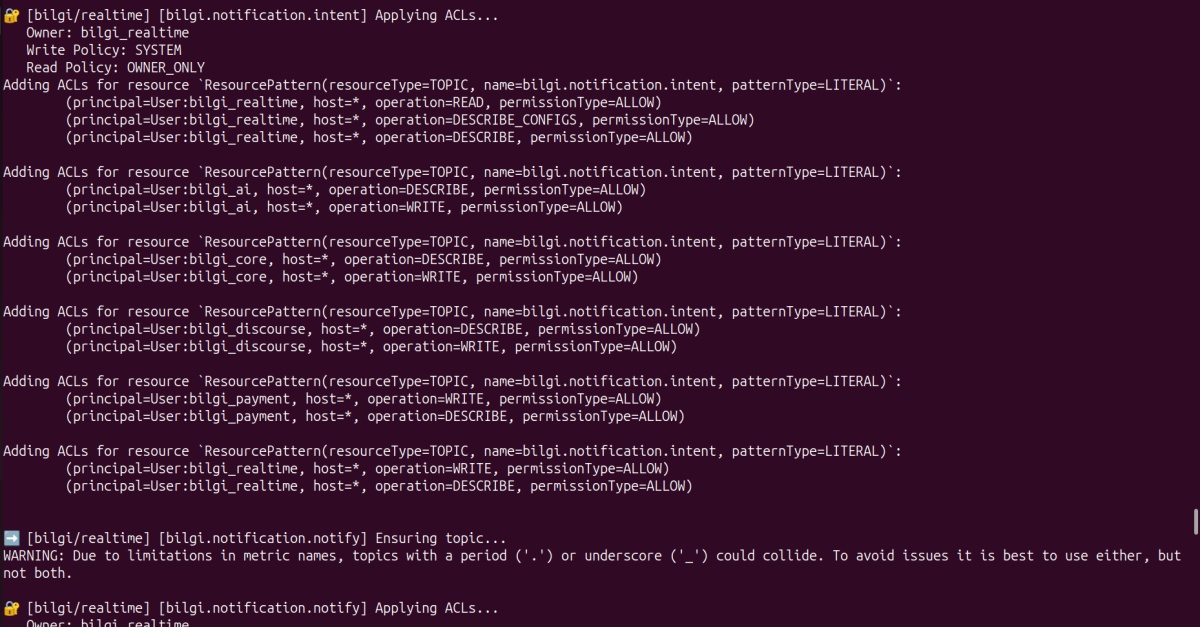
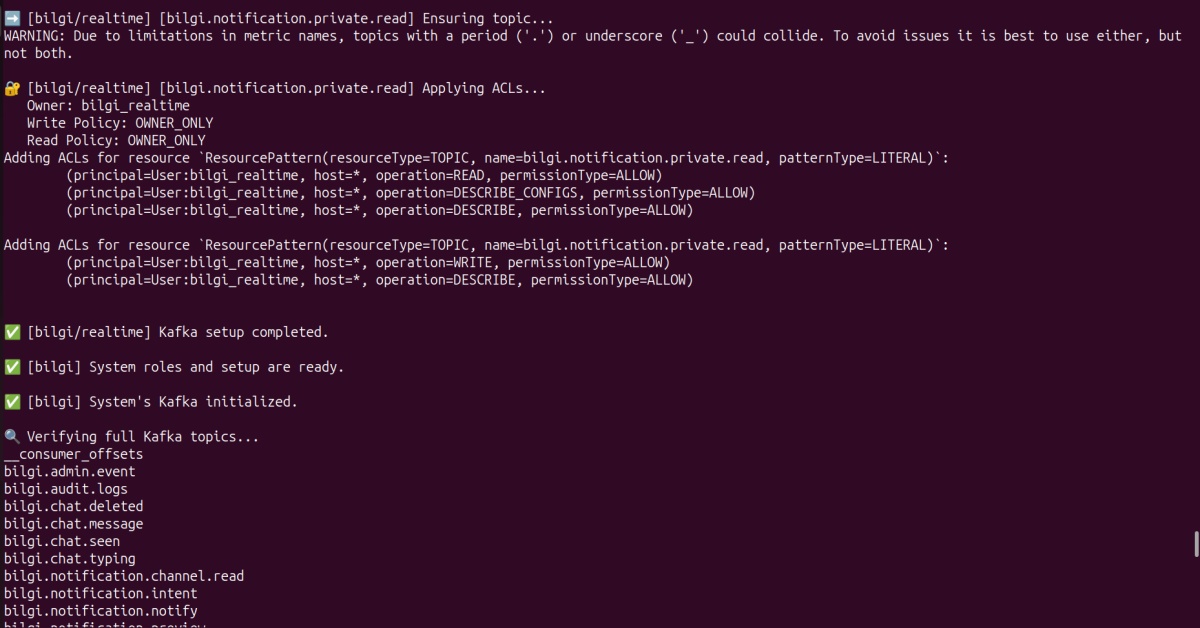
- 📷 TuranOrdo in Action
🏗 Core Architectural Philosophy
Most Docker setups tend to fall into one of two extremes:
- Too simple — easy to understand, but insufficient for production infrastructure.
- Too complex and tightly coupled — powerful, but difficult to operate, maintain, and evolve.
TuranOrdo takes a different approach.
Its architecture is based on a System → App → Resource ownership model, combined with registry-driven infrastructure management.
Instead of treating infrastructure as a collection of globally shared services, TuranOrdo models each business domain as an independent system, and each application within that domain as an independently managed app.
For example:
System: bilgi

Apps:
    - core
    - discourse
    - realtime
    - payment
    - ai
Each app has its own identity, runtime type, infrastructure dependencies, and applicable edge configuration.
This creates clear ownership boundaries while still allowing TuranOrdo to provide shared platform infrastructure where appropriate.
🧩 System → App → Resource Ownership
The ownership model can be summarized as:
System
   │
   ├── App
   │    │
   │    ├── Runtime
   │    ├── Infrastructure Resources
   │    └── Edge Configuration
   │
   ├── App
   │    │
   │    ├── Runtime
   │    ├── Infrastructure Resources
   │    └── Edge Configuration
   │
   └── App
A system therefore provides the business-domain boundary, while an app provides the primary unit of deployment and infrastructure ownership.
Applications declare what they are and what they require. TuranOrdo translates those declarations into infrastructure state.
⚙️ Multiple Application Runtime Models
TuranOrdo does not assume that every application must run as its own application container.
An app can use one of several supported runtime models:
- containerized
- php
- static
A containerized application can run directly behind the Traefik edge:
Traefik
    ↓
Application Container
A static application can use TuranOrdo's shared Nginx runtime:
Traefik
    ↓
Shared Nginx
    ↓
Static Application
A PHP application can use the same shared Nginx infrastructure together with PHP-FPM:
Traefik
    ↓
Shared Nginx
    ↓
PHP-FPM
    ↓
PHP Application
This distinction is important: shared infrastructure does not imply shared ownership.
Nginx and PHP-FPM may be shared platform components, while their application-specific configuration, host routes, and ownership remain associated with individual apps in the TuranOrdo registry.
🧱 Separation of Concerns
TuranOrdo separates infrastructure responsibilities into independently managed layers:
- 🗄️ Database
- 🪣 Storage
- 📨 Messaging
- 🌐 Edge + Traffic
- 🛡️ Private Network
- 📊 Observaility
- 🧩 Application
These layers are independent from an ownership perspective but coordinated through the infrastructure registry.
This allows an application to declare dependencies such as:
App: realtime

Infrastructure requirements:
    - Kafka
    - Kafka topic: audit.logs
while the application itself remains responsible only for its application-level behavior.
🔐 Security by Default
Security is treated as a platform-level concern rather than something each application must implement independently.
Core principles include:
- TLS by default where applicable
- Strict secret handling
- Isolated application resources
- Controlled network boundaries
- Explicit ownership
- Least-privilege infrastructure access
- Fail-fast validation
The platform therefore establishes security boundaries before applications begin using the infrastructure.
🔄 Deterministic and Reproducible Infrastructure
TuranOrdo is designed so that infrastructure initialization can be repeated safely.
Its startup pipeline uses idempotent registration and initialization operations, while the internal registry provides persistent state against which the desired infrastructure configuration can be reconciled.
The same principle applies to the registry itself.
TuranOrdo maintains a versioned SQLite schema consisting of:
Base Schema
    +
Versioned Migrations
    +
Migration History
This allows the infrastructure metadata model to evolve without requiring manual database modifications.
The migration subsystem also reconciles cases where a schema change already exists but its migration history is missing, making upgrades more resilient across existing installations.
🧬 Declarative Infrastructure State
The internal SQLite registry provides TuranOrdo with a persistent representation of the infrastructure topology.
This means TuranOrdo does not merely execute deployment instructions. It maintains an internal model of what infrastructure exists, who owns it, how it is connected, and how its schema should evolve.
📐 Core Design Principles
TuranOrdo therefore follows these principles:
- System → App → Resource ownership
- Explicit application runtime models
- Separation of concerns
- Security by default
- Registry-driven infrastructure management
- Shared platform infrastructure with application-level ownership
- Deterministic and idempotent initialization
- Declarative infrastructure state
- Versioned infrastructure schema migrations
- Self-verifying systems
- Fail-fast validation
- Infrastructure as code
- Reproducible operation across environments
The result is an infrastructure platform that behaves predictably across environments — from local development to VPS deployment — while remaining modular enough to support different application architectures.
The central architectural idea can be summarized as:
Applications declare their requirements. TuranOrdo owns the infrastructure state required to satisfy those requirements.
🖥️ Infrastructure Operating System
TuranOrdo is not merely a collection of Docker Compose files. It behaves as an Infrastructure Operating System that maintains an internal understanding of deployed business systems, applications, infrastructure services, runtime types, traffic configuration, and resource ownership.
At the center of this architecture is an internal SQLite infrastructure registry that acts as the persistent metadata layer of the platform.
The registry maintains the relationship between business systems, applications, infrastructure services, application runtimes, and network entry points. This allows TuranOrdo to reason about the infrastructure as a structured system rather than as a collection of independent containers and configuration files.
The registry stores information such as:
- Registered business systems
- Registered applications within each system
-
Application runtime types, including:
- Containerized applications
- PHP applications
- Static web applications
- Infrastructure services required by each application
- Database ownership and resource mappings
- Redis namespaces
- RabbitMQ queues
- Kafka topics and access policies
- Nginx application configuration
- Nginx host routes
- Traefik application configuration
- Traefik host routes and routing roles
- Infrastructure configuration and ownership metadata
- Schema migration history
This creates a persistent infrastructure model similar to an operating system's internal state.
🗂️ Registry-Driven Infrastructure
Applications do not provision shared infrastructure manually. Instead, an application declares its identity, runtime type, infrastructure dependencies, and traffic requirements through TuranOrdo's shared installation and registration framework.
For example, an application can be registered as:
System: bilgi

Apps:
    - core
    - discourse
    - realtime
    - payment
    - ai

Application runtime types:
    core        → containerized
    discourse   → containerized
    realtime    → containerized
    payment     → containerized
    ai          → containerized
A web application can also use TuranOrdo's shared web runtime instead of owning a dedicated Nginx container:
Static application:
Traefik
    ↓
Shared Nginx
    ↓
Static application files
or PHP application:
Traefik
    ↓
Shared Nginx
    ↓
PHP-FPM
    ↓
PHP application
This allows TuranOrdo to support different application architectures while keeping infrastructure ownership centralized.
👑 Infrastructure Ownership
Once an application is registered, TuranOrdo becomes responsible for translating its declared requirements into infrastructure state.
This includes:
- Resource discovery
- Dependency resolution
- Runtime configuration
- Network configuration
- Permission generation
- Infrastructure initialization
- Edge and host-routing configuration
- Verification
- Reconciliation
- Lifecycle management
For example, a realtime application can declare its messaging requirements:
System: bilgi

App: realtime

Requirements:
    - Kafka

Registration:
    register_app_service("bilgi", "realtime", "kafka", CONTAINERIZED)

    register_kafka_topic(
        "bilgi",
        "realtime",
        "audit.logs",
        OPEN_WRITE
        CLOSED_READ
    )
TuranOrdo can then use the registry to determine which Kafka resources belong to the application and how those resources should be provisioned and exposed.
🧬 Schema Evolution as Part of the Infrastructure OS
The registry itself is treated as managed infrastructure.
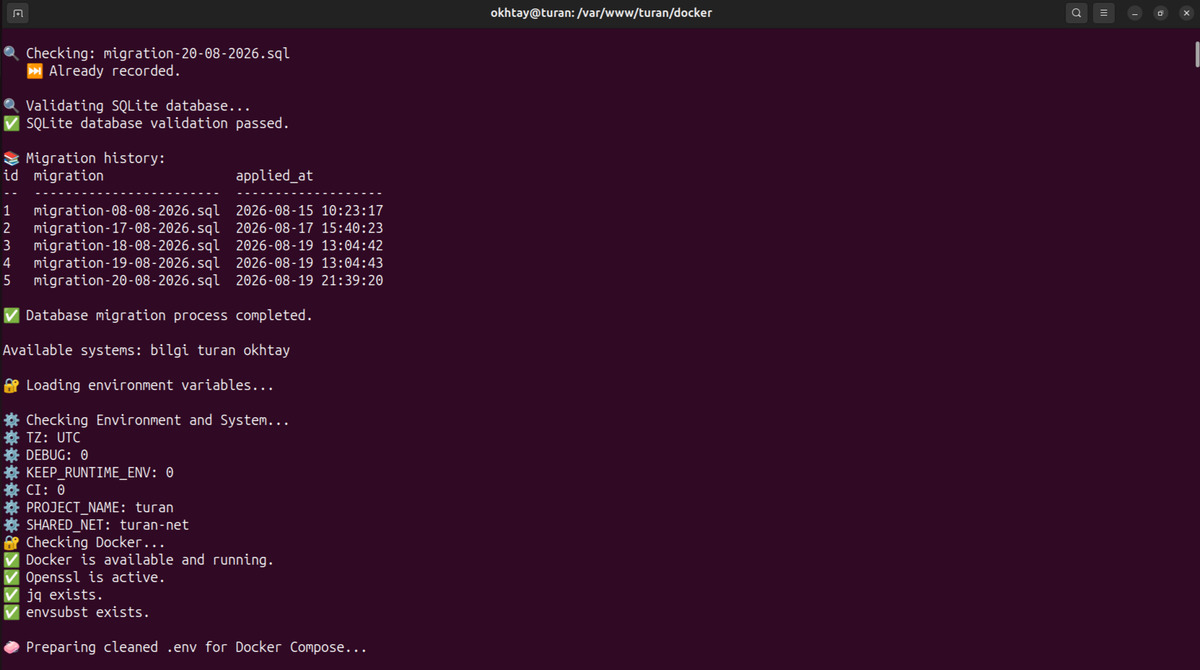
TuranOrdo therefore does not rely on a single immutable SQLite schema. Its database is initialized from a base schema and evolved through versioned migrations.
The process is structured as:
db.schema.sqlite
        │
        ▼
Base Infrastructure Schema
        │
        ▼
db/migrations/
        │
        ├── migration-08-08-2026.sql
        ├── migration-17-08-2026.sql
        ├── migration-18-08-2026.sql
        ├── migration-19-08-2026.sql
        └── migration-20-08-2026.sql
        │
        ▼
schema_migrations
        │
        ▼
Current Infrastructure Schema
During initialization, TuranOrdo's migration runner:
- Ensures that the base schema exists.
- Discovers available migrations.
- Determines which migrations have already been recorded.
- Detects cases where a migration's schema change already exists but its migration history is missing.
- Reconciles migration history when appropriate.
- Applies genuinely pending migrations transactionally.
- Records successfully applied migrations.
- Performs SQLite integrity and foreign-key validation.
This makes infrastructure schema evolution deterministic and repeatable, including upgrades of existing TuranOrdo installations.
The migration subsystem is particularly important because the registry is not temporary configuration. It represents persistent infrastructure state and therefore must itself have controlled lifecycle and schema evolution.
📜 Infrastructure as a Declarative State Model
The resulting architecture can be viewed as:
                 TuranOrdo
                     │
                     ▼
          Infrastructure Registry
                     │
    ┌────────────────┼────────────────┐
    │                │                │
  Systems          Apps          Infrastructure
    │                │                │
    │         ┌──────┼──────┐         │
    │         │      │      │         │
    │      Runtime  Edge  Services    │
    │         │      │      │         │
    │    ┌────┼───┐  │  ┌───┼────┐    │
    │    │    │   │  │  │   │    │    │
    │ Container Static PHP DB Redis Kafka ...
    │                │
    │          ┌─────┴─────┐
    │          │           │
    │       Traefik      Nginx
    │
    └─────────────── Ownership ───────────────┘
Applications describe what they are and what they require. The registry records the resulting infrastructure model. TuranOrdo then uses that model to provision, configure, reconcile, verify, and manage the infrastructure.
This is the fundamental distinction between TuranOrdo and a collection of Docker Compose files:
Docker Compose describes containers. TuranOrdo describes the infrastructure system those containers belong to.
🧩 System-Level Isolation
Each business domain in TuranOrdo is represented as an independent system. A system is the highest-level ownership and isolation boundary inside the platform.
System definitions are not hardcoded into infrastructure scripts. Instead, they are maintained as first-class entities in the TuranOrdo SQLite infrastructure registry.
For example:
System: bilgi

Apps:
    - core
    - discourse
    - realtime
    - payment
    - ai
The registry therefore provides TuranOrdo with a persistent understanding of:
- which systems exist
- which applications belong to each system
- which infrastructure resources belong to each application
- which shared infrastructure resources are associated with a system
- which network and edge configuration belongs to each application
This allows the same infrastructure framework to support multiple independent business domains without requiring system-specific infrastructure scripts.
🏛️ System Ownership Boundary
A system establishes the primary logical ownership boundary for infrastructure resources.
Depending on the infrastructure technology, TuranOrdo implements this boundary using the isolation mechanism appropriate to that technology:
System: bilgi

PostgreSQL / MySQL
    → System and application database / user ownership

MongoDB
    → System and application database / user ownership

Redis
    → System and application namespaces

RabbitMQ
    → Dedicated system vHost

Kafka
    → System-scoped topics + application ACLs

Nginx
    → Application configuration + filesystem ownership

Traefik
    → Application host routes + routing ownership
The isolation mechanism therefore varies by infrastructure component, but the ownership model remains consistent.
This guarantees:
- no cross-system leakage
- predictable naming
- safe onboarding of new systems
- independent scaling
- operational clarity
Each app independently declares its infrastructure needs during installation. This turns infrastructure into a data-driven operating model instead of static shell logic. Adding a new system or app should never require redesign. Only:
    new secrets
    optional new pki keys
    new DNS
    new app deployment
⚙ App-Level Isolation Inside Each System
Inside every system, each application or microservice is treated as an independently managed infrastructure consumer with its own identity, runtime configuration, resource ownership, and access boundaries.
For example:
System: bilgi

Apps:
    - core
    - discourse
    - realtime
    - payment
    - ai
The system provides the business-domain boundary. The app provides the primary unit of infrastructure ownership and access control within that boundary.
An application therefore does not automatically inherit access to resources belonging to sibling applications.
The isolation model applies across databases, Redis namespaces, messaging resources, and application runtimes.
🗄️ PostgreSQL / MySQL
TuranOrdo supports a System DB + App DB ownership strategy for relational databases.
    bilgi          → system DB

    bilgi_core     → app DB
    bilgi_payment  → app DB
    bilgi_ai       → app DB
The system-level database is intended for cross-application concerns such as:
- global system configuration
- cross-app auditing
- system metadata
- controlled system-wide operations
Each application can then own a separate database:
core ≠ payment ≠ ai
Rules:
- The system service owns the parent/system database.
- Each application service owns its own application database.
- An application receives read/write access to its own database.
- Sibling applications do not receive access to one another's databases.
- System-level access to application databases, where required, is explicitly controlled.
- Database permissions are verified after initialization.
This provides actual database-level isolation rather than relying only on database naming conventions.
🍃 MongoDB
MongoDB follows the same ownership model.
Example:
    User: bilgi
    DB: bilgi

    User: bilgi_discourse
    DB: bilgi_discourse

    User: bilgi_realtime
    DB: bilgi_realtime
Rules:
- The system user owns the system database (Cross-app auditing, global system config, and metadata).
- Each application user owns its application database.
- Application users receive read/write access only to their own database.
- Sibling application access is denied.
- System-level read access to application databases is explicitly controlled where required.
- Verification scripts validate the resulting permissions.
The principle remains:
discourse ≠ realtime
without relying solely on naming conventions.
🧠 Redis
Redis provides weaker native isolation than relational and document databases, so TuranOrdo uses explicit namespace boundaries.
The namespace model is:
    system:*
        → Global Governance: Global feature flags, infrastructure health logs, and node coordination

    bilgi:system:*
        → System Governance: System-wide audit counters or cross-service orchestration locks

    bilgi:core:*
        → Core App Namespace: App Governance

    bilgi:discourse:*
        → Discourse App Namespace: App Governance

    bilgi:realtime:*
        → Realtime App Namespace: App Governance

    bilgi:payment:*
        → Payment App Namespace: App Governance

    bilgi:ai:*
        → AI App Namespace: App Governance
These namespaces separate application-owned data such as:
- caches
- sessions
- rate limits
- application queues
- coordination state
Because Redis does not provide the same database/user isolation model as PostgreSQL or MongoDB, namespace ownership is enforced at the application and infrastructure configuration levels.
The important distinction is:
    Shared Redis service
            ≠
    Shared application namespace
The Redis infrastructure may be shared, while ownership of keys remains application-specific.
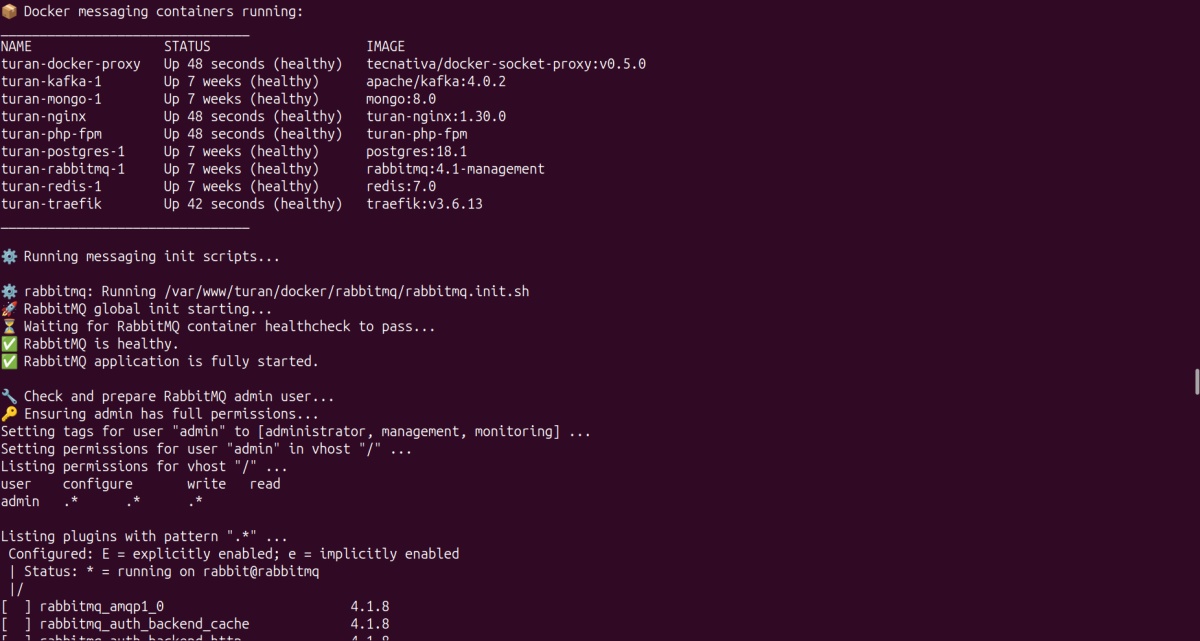
🐇 RabbitMQ
RabbitMQ uses both system-level isolation and application-level ownership. It follows a high-discipline architecture centered on system Isolation and predictable topology.
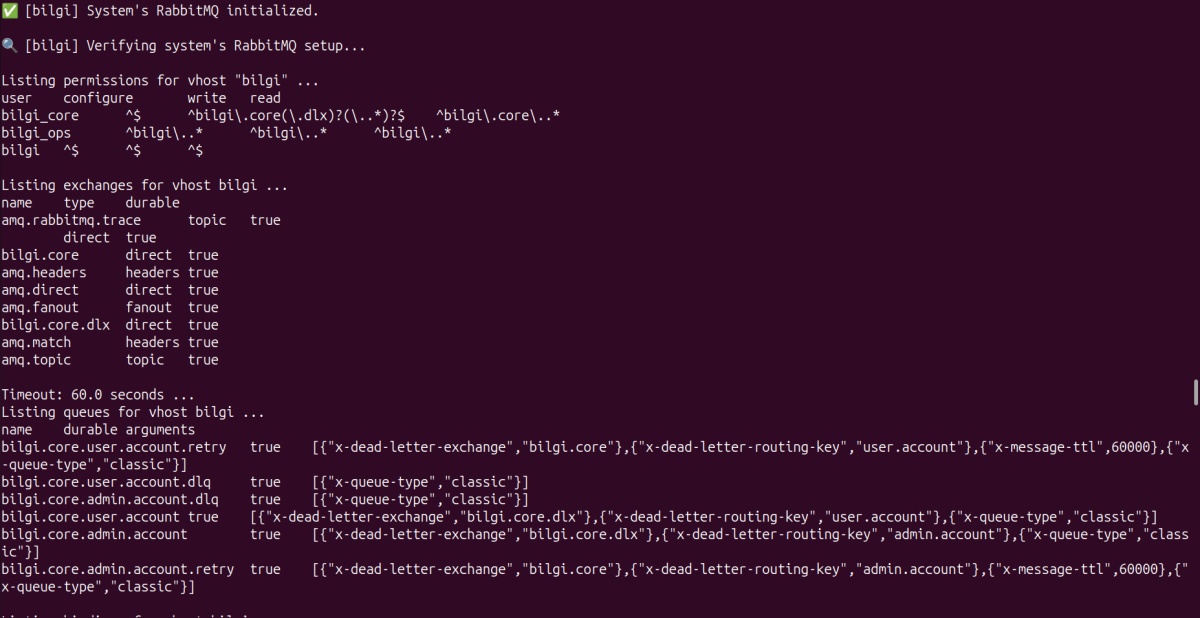
Each system receives a dedicated virtual host, creating a hard logical boundary that prevents cross-system data leakage:
    System: bilgi
    vhost:  /bilgi
A system-level user (e.g. bilgi) acts as the primary monitoring agent for the vHost. It is granted monitoring tags to oversee the health of the messaging plane without possessing permission to read or write to specific application queues, maintaining a "separation of duties."
The virtual host provides the primary boundary between business systems. Inside that vHost, queues, exchanges, and related messaging resources are owned by individual applications.
Example:
    bilgi.core.user.account
    bilgi.realtime.notification
    bilgi.payment.transaction
Application permissions are restricted through dedicated runtime identities and regex-based resource permissions (e.g., ^bilgi\.core\..*), physically preventing services from accessing sibling queues. Access is governed by distinct roles—Admin (Cluster), Ops (Topology Owner), and App (Runtime User).
For example:
bilgi.core.user.account
can be accessible to the bilgi_core application identity without automatically granting access to:
    bilgi.realtime.*
    bilgi.payment.*
This establishes:
- per-system vHost isolation
- per-application queue ownership
- restricted application permissions
- separation between operational and runtime access
This preserves separation of duties between infrastructure operations and application runtime access.
🗂️ Registry-Driven Messaging Topology
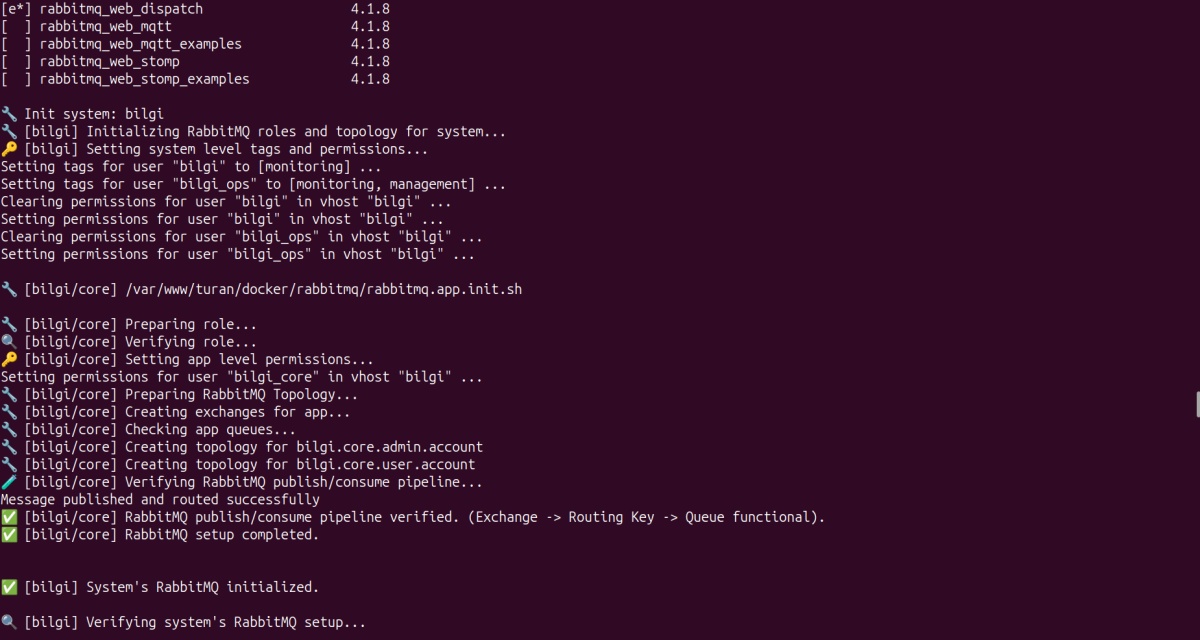
RabbitMQ topology is generated from application registrations stored in TuranOrdo's infrastructure registry. Applications declare required queues and routing structures through shared installation scripts. TuranOrdo then automatically provisions:
- Exchanges
- Queues
- Dead-letter queues
- Retry queues
- Bindings
- Permissions
The application repository therefore does not need to maintain a second copy of the infrastructure topology.
The registry becomes the source of truth for application-owned RabbitMQ resources and ensures consistent messaging patterns across all systems.
✅ Automatic RabbitMQ Topology Verification
Creating messaging resources is only part of the deployment process. TuranOrdo also verifies that the resulting topology is fully functional. After provisioning the messaging infrastructure, TuranOrdo performs an end-to-end verification by creating an isolated temporary exchange, queue, and binding. A test message is published through the temporary exchange and consumed from the temporary queue to verify that routing operates correctly.
The verification confirms:
- exchange creation
- queue creation
- binding configuration
- routing key resolution
- message publishing
- message delivery
- message consumption
After successful verification, the temporary verification resources are automatically removed. This approach validates the complete publish/consume pipeline instead of merely checking that RabbitMQ resources exist. As a result, deployment failures caused by incorrect bindings, routing keys, permissions, or broker configuration are detected immediately during installation rather than later at runtime.
🧹 Automatic RabbitMQ Topology Cleanup
Unlike traditional RabbitMQ deployments where queues and exchanges accumulate after services are renamed or removed, TuranOrdo continuously reconciles the RabbitMQ topology with the infrastructure registry. Every queue declared by an application is registered in TuranOrdo's infrastructure registry. During system initialization, TuranOrdo compares the registry against the queues and exchanges currently present inside the application's virtual host. Resources that no longer exist in the registry are considered orphaned and are automatically removed. This guarantees that the RabbitMQ topology always reflects the current deployment state.
Automatic cleanup eliminates:
- obsolete queues left by removed applications
- renamed queues after refactoring
- unused dead-letter queues
- obsolete retry queues
- abandoned exchanges
- stale messaging infrastructure
Only resources belonging to the current application namespace are evaluated. Built-in RabbitMQ exchanges (such as amq.*) and resources belonging to other applications are ignored. The reconciliation process is completely deterministic and idempotent. Re-running the installer always produces the same messaging topology without leaving orphaned infrastructure behind.
🏛 Apache Kafka
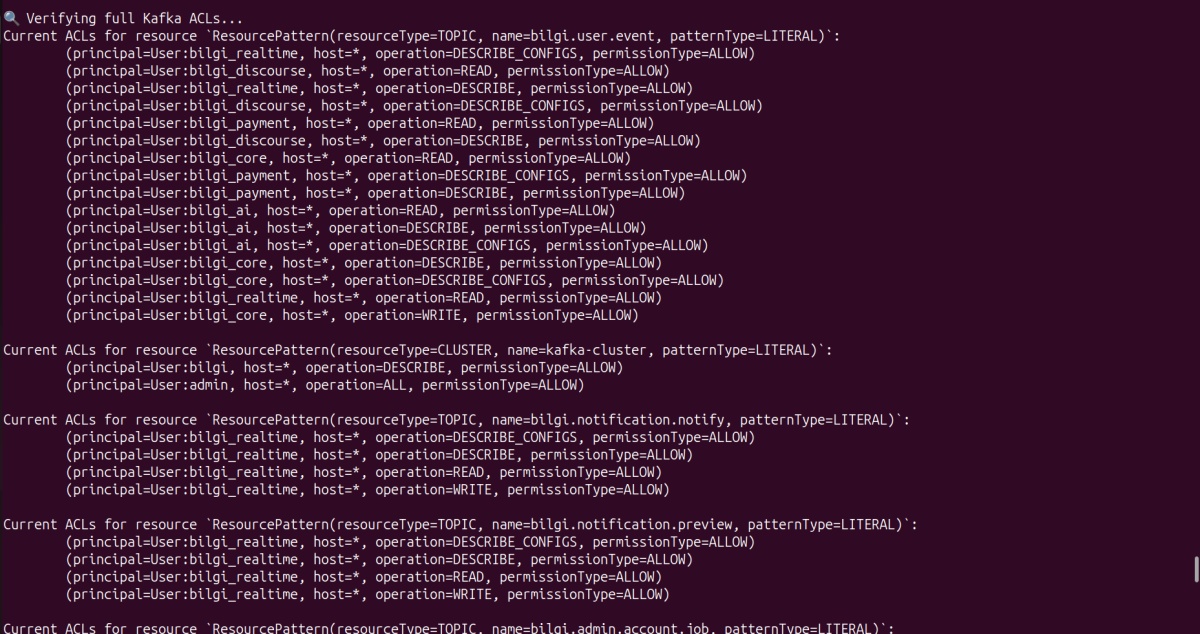
Kafka follows an explicit registry-driven ownership and permission model. Every application receives its own Kafka identity, and every application-owned topic has explicit access policies.
Each topic has:
- Owner application
- Write policy
- Read policy
- Enabled state
- Generated Kafka ACL rules
Kafka permissions are never manually configured. They are generated from TuranOrdo infrastructure registry metadata.
TuranOrdo provides Kafka as an infrastructure-controlled event bus:
- no shared Kafka credentials
- no manually managed ACL files
- no uncontrolled topic access
- application ownership boundaries
- automatic permission generation
Kafka security becomes part of the deployment registry instead of application configuration.
👑 Kafka Ownership Model
Each Kafka topic belongs to exactly one application. The owner application controls the default access boundary.
Example:
    System:
        - bilgi

    Applications:
        - core         (bilgi_core)
        - discourse    (bilgi_discourse)
        - realtime     (bilgi_realtime)
        - payment      (bilgi_payment)
        - ai           (bilgi_ai)

    Topics:
        - bilgi.user.account.job
        - bilgi.actor.event
        - bilgi.chat.message
        - bilgi.notification.intent
        - bilgi.audit.logs

    Ownership:
        - bilgi.user.account.job      (bilgi_core)
        - bilgi.actor.event           (bilgi_core)
        - bilgi.chat.message          (bilgi_realtime)
        - bilgi.notification.intent   (bilgi_realtime)
        - bilgi.audit.logs            (bilgi_realtime)
🔐 Topic Access Policies
Each topic has independent read and write policies.
READ Policy: Consumers can be OWNER_ONLY or SYSTEM.
OWNER_ONLY: Only the owning application can consume. Other applications cannot consume messages.
Example: bilgi.chat.message can only be read by its owner bilgi_realtime.
SYSTEM: All Kafka-enabled applications inside the same system can consume. Useful for system-wide
events.
Example: bilgi.actor.event can be read by all Kafka apps in bilgi system like bilgi_core and
bilgi_realtime.
WRITE Policy: Producers can be OWNER_ONLY or SYSTEM.
OWNER_ONLY: Only the owner application can publish. This protects message ownership.
Example: bilgi.actor.event can only be written by its owner bilgi_core.
SYSTEM: All registered Kafka applications inside the same system can publish. Useful for shared
infrastructure topics.
Example: bilgi.audit.logs can be written by all Kafka apps in bilgi system like bilgi_core and
bilgi_realtime.
This is significantly stronger than standard shared Kafka setups.
🗂️ Registry-Driven Kafka Ownership
Kafka resources are registered through TuranOrdo's infrastructure registry. Applications declare their Kafka requirements during installation.
Registry metadata includes:
- Owner App
- Topic Name
- Open Write Policy
- Open Read Policy
- Enabled State
Example:
    System:
        - bilgi

    Application:
        - realtime

    Registers:
        - notification.notify
        - notification.intent
        - audit.logs

    Topic bilgi.notification.intent:
        - Owner: realtime
        - Read Policy: OWNER_ONLY
        - Write Policy: SYSTEM
⚙️ Automatic Kafka Provisioning
During initialization TuranOrdo automatically:
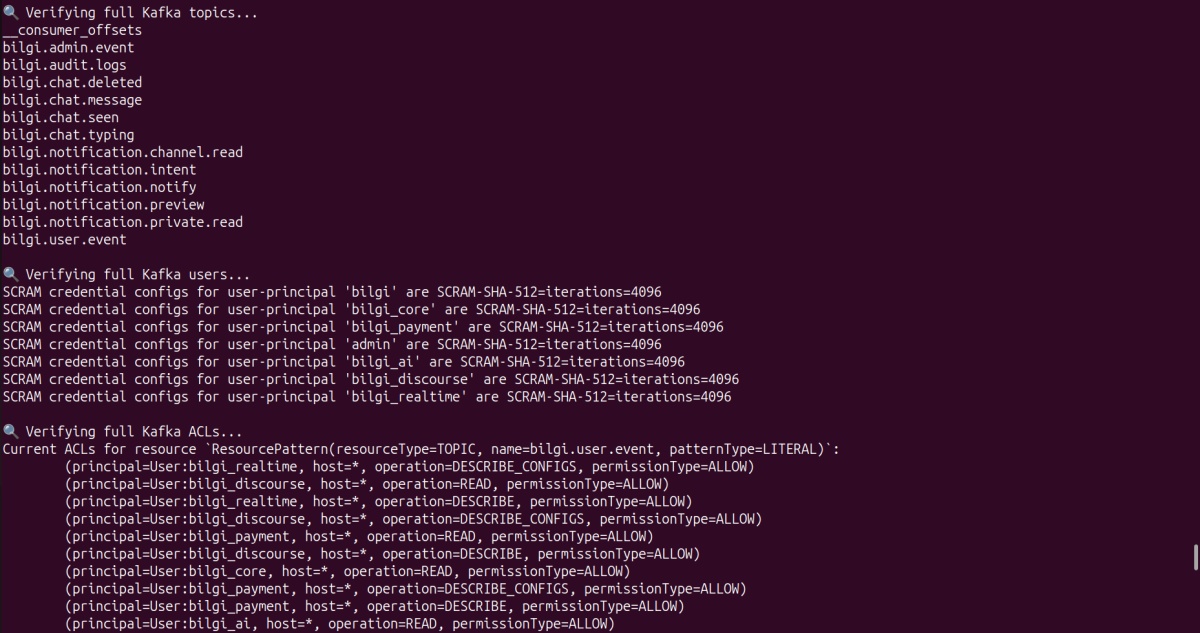
- Creates SCRAM users
- Creates topics
- Generates ACL rules
- Applies ownership policies
- Removes orphaned topics
- Verifies permissions and the resulting Kafka configuration
🔑 Dynamic ACL Generation
Kafka ACLs are generated from registry metadata. No manual ACL configuration exists.
Example:
    Registry:
        Owner: bilgi_realtime

        Topic:
            - notification.intent

        Read Policy: OWNER_ONLY

        Write Policy: SYSTEM

        Generated ACL:
            READ:
                - bilgi_realtime

            WRITE:
                - bilgi_core
                - bilgi_discourse
                - bilgi_realtime
📦 Application Isolation
Every application receives its own Kafka SCRAM identity. Kafka authorization is performed at application level.
Example: bilgi_core user for core application in bilgi system
This prevents:
- accidental topic publishing
- unauthorized consumption
- cross-service message leakage
🧹 Automatic Kafka Topic Cleanup
Unlike traditional Kafka deployments where obsolete topics accumulate over time, TuranOrdo continuously reconciles the Kafka cluster with the infrastructure registry. Every Kafka topic declared by an application is registered in the infrastructure registry. During system initialization, TuranOrdo compares the registry against the topics currently present in the Kafka cluster. Topics that no longer exist in the registry are considered orphaned and are automatically removed. This guarantees that Kafka infrastructure always matches the current deployment state.
Automatic cleanup eliminates:
- obsolete topics left by removed applications
- renamed event topics
- deprecated message contracts
- stale development topics
- abandoned infrastructure resources
Only topics belonging to the current system namespace are evaluated. Internal Kafka topics such as __consumer_offsets are ignored. The cleanup process is registry-driven, making it completely deterministic and idempotent. Re-running the installer produces the same Kafka topology every time without leaving orphaned resources behind.
🌐 Application Runtime Isolation
App-level isolation also extends beyond databases and messaging.
TuranOrdo explicitly models the runtime type of each application.
Supported runtime models include:
- containerized
- php
- static
A containerized application can own its own application container:
Traefik
    ↓
Application Container
A static application can use the shared Nginx runtime:
Traefik
    ↓
Shared Nginx
    ↓
Application Files
A PHP application can use shared Nginx together with PHP-FPM:
Traefik
    ↓
Shared Nginx
    ↓
PHP-FPM
    ↓
Application
Shared runtime infrastructure does not eliminate application ownership.
For example, multiple PHP or static applications may use the same Nginx infrastructure while retaining separate:
- application identities
- web roots
- host routes
- runtime configuration
- permissions
- registry ownership
This establishes an important TuranOrdo principle:
Shared infrastructure is a resource-sharing mechanism, not an ownership boundary.
🧩 Unified App-Level Ownership Model
The resulting model can be summarized as:
System: bilgi
│
├── core
│   ├── Database:  bilgi_core
│   ├── Redis:     bilgi:core:*
│   ├── RabbitMQ:  bilgi.core.*
│   ├── Kafka:     owned topics
│   └── Runtime:   containerized
│
├── discourse
│   ├── Database:  bilgi_discourse
│   ├── Redis:     bilgi:discourse:*
│   ├── RabbitMQ:  bilgi.discourse.*
│   ├── Kafka:     owned topics
│   └── Runtime:   containerized
│
├── realtime
│   ├── Database:  bilgi_realtime
│   ├── Redis:     bilgi:realtime:*
│   ├── RabbitMQ:  bilgi.realtime.*
│   ├── Kafka:     owned topics
│   └── Runtime:   containerized
│
└── ...
The important property is that the same ownership model is applied across otherwise very different infrastructure technologies.
An application is therefore not merely a container name. It is a registry-managed identity with associated:
Identity
   +
Runtime
   +
Resources
   +
Permissions
   +
Network / Edge Configuration
This is what makes app-level isolation a platform capability rather than a convention implemented separately by each application.
System isolation protects business domains from one another. App isolation protects applications from one another inside those domains.
🔗 Unified Connectivity Model (turan-net)
TuranOrdo provides a common internal Docker network, turan-net, through which application
workloads and platform infrastructure communicate.
The network establishes a consistent internal connectivity model across the platform while public exposure remains explicitly controlled through the Edge + Traffic Layer.
The basic connectivity model is:
                    Internet
                       │
                       ▼
                    Traefik
                       │
              Controlled Routes
                       │
          ┌────────────┴────────────┐
          │                         │
   Application Containers      Shared Nginx
                                    │
                              ┌─────┴─────┐
                              │           │
                          Static App   PHP-FPM
          │                         │
          └────────────┬────────────┘
                       │
                   turan-net
                       │
        ┌──────────────┼──────────────┐
        │              │              │
   PostgreSQL       MongoDB         Redis
     TLS              TLS          TLS/TLS*
        │              │              │
     RabbitMQ        Kafka          MinIO
       TLS          TLS/SCRAM        TLS
Applications consume platform infrastructure through turan-net rather than independently provisioning
their own databases, brokers, or supporting services.
This provides:
- consistent internal service connectivity
- Docker-level service discovery
- controlled access to stateful infrastructure
- centralized infrastructure ownership
- reduced dependency on hardcoded service addresses
- consistent application-to-infrastructure communication
- separation between internal infrastructure traffic and explicitly exposed public endpoints
🔐 Connectivity Is Not Authorization
Membership in turan-net does not by itself grant an application access to every platform resource.
Network connectivity and resource authorization are separate controls:
Application
     │
     ▼
 turan-net
     │
     ▼
Network Connectivity
     │
     ▼
Authentication
     │
     ▼
Resource Authorization
     │
     ▼
Allowed Resource
For example, an application may be able to reach PostgreSQL over the internal network while still being unable to authenticate to another application's database.
The same principle applies to:
- PostgreSQL roles
- MySQL users
- MongoDB users
- Redis namespaces
- RabbitMQ vHosts and permissions
- Kafka topics and ACLs
- MinIO/object-storage access
This separation ensures that the shared network does not become a shared security domain.
🌐 Public vs Internal Connectivity
TuranOrdo distinguishes between public application traffic and internal infrastructure traffic.
Public Traffic
     │
     ▼
  Traefik
     │
     ▼
Application Runtime
     │
     ▼
  turan-net
     │
     ├── Database
     ├── Messaging
     ├── Cache
     └── Storage
Stateful infrastructure is not intended to be directly exposed to the public Internet. Where administrative or infrastructure access is required from outside the host, the Private Network Layer can provide controlled access through private networking.
🔐 TLS Trust Domains
TuranOrdo separates TLS into distinct trust domains according to where the communication terminates and who must trust the certificate.
Public / Edge TLS
Public-facing TLS terminates at the Traefik Edge + Traffic Layer.
For production deployments, public or externally supplied certificates should be issued by a Certificate Authority trusted by normal browsers and operating systems.
For local development, TuranOrdo supports locally trusted certificates generated through mkcert.
The model is:
Production:

Public / External CA
        │
        ▼
Certificate + Private Key
        │
        ▼
      Traefik
        │
        ▼
Public HTTPS


Local Development:

       mkcert
          │
          ▼
   Local Development CA
          │
          ▼
Certificate + Private Key
          │
          ▼
       Traefik
          │
          ▼
Local HTTPS
These certificates belong to the edge trust domain.
The TuranOrdo Internal CA is not intended to replace a publicly trusted CA for browser-facing production domains.
Internal Service TLS
Internal application and infrastructure communication belongs to a separate trust domain.
TuranOrdo provides an internal PKI for certificates used by TuranOrdo-managed services, including both application services and stateful infrastructure.
For example:
Turan Internal CA
        │
        ├── Bilgi/Core
        ├── Bilgi/Discourse
        ├── Bilgi/Realtime
        ├── Bilgi/CMS
        ├── Bilgi/Payment
        ├── Bilgi/AI
        │
        ├── PostgreSQL
        ├── MongoDB
        ├── Redis
        ├── RabbitMQ
        ├── Kafka
        └── MinIO
The internal CA establishes trust between services inside the TuranOrdo environment.
The important distinction is therefore:
External Client
      │
      │ Public / Edge TLS
      │ Public CA or mkcert (dev)
      ▼
   Traefik
      │
      │ Internal TLS
      │ Turan Internal CA
      ▼
Internal Service
A certificate's issuing CA should correspond to the trust domain of its consumers.
🔐 Application-to-Application Communication
TuranOrdo-managed application services may communicate over turan-net, but network connectivity alone should not be treated as a sufficient trust boundary.
For application-to-application communication, TuranOrdo provides infrastructure support for TLS using its managed internal PKI.
For example:
Core
  │
  │ HTTPS / TLS
  ▼
Discourse

CMS
  │
  │ HTTPS / TLS
  ▼
Core

AI
  │
  │ HTTPS / TLS
  ▼
Core
These internal service certificates are issued by the TuranOrdo Internal CA rather than by the public CA used for browser-facing edge traffic.
TuranOrdo is responsible for the infrastructure required to establish this secure communication, including:
- internal CA management
- per-service certificate issuance
- certificate SANs matching registered service identities
- certificate distribution
- certificate rotation
- Docker secret integration
- trusted CA distribution
- TLS verification
- infrastructure-level health and configuration checks
Applications remain responsible for loading their assigned certificates and serving TLS on their application endpoints.
TLS does not replace application authentication or authorization. For example, TuranBilgi services may continue to use service JWTs for service-to-service authentication and authorization.
The resulting model is:
Application
     │
     ▼
turan-net
     │
     ▼
Internal TLS
     │
     ▼
Service Authentication
     │
     ▼
Resource Authorization
     │
     ▼
Allowed Resource
This prevents turan-net from becoming a shared security domain merely because applications can reach one
another over the Docker network.
🔐 TLS and Service Authentication
Server-side TLS establishes encrypted communication and allows a client to verify that it is communicating with the intended service.
It does not, by itself, establish the identity of the calling application.
Therefore:
TLS
  │
  └── "Am I communicating with the intended service?"

Service Authentication
  │
  └── "Who is calling this service?"

Authorization
  │
  └── "What is that caller allowed to do?"
TuranOrdo therefore treats TLS, authentication, and authorization as complementary controls rather than substitutes for one another.
🔄 Future mTLS
The same private PKI can later be extended to issue client certificates and require mutual TLS between services.
This provides an evolution path from:
Single Node

Private Docker Network
    +
Server-side TLS
    +
Service Authentication
    +
Authorization
to:
Multi-Node / Advanced Connectivity

Private Connectivity
    +
mTLS
    +
Cryptographic Service Identity
    +
Authorization
The transition does not require replacing the underlying internal PKI.
Client certificate issuance and client-certificate validation can be added when stronger cryptographic service identity is required.
The public/edge certificate trust domain remains separate from this internal service identity model.
☸️ Future Multi-Node Connectivity
The same connectivity principles are intended to remain applicable as TuranOrdo evolves toward multi-node deployments.
Future Docker Swarm and TuranTulpar workloads may run application processes across multiple nodes while continuing to consume stateful infrastructure through explicitly configured network, TLS, authentication, and authorization boundaries.
The architectural principle therefore remains:
Stateless Application Workloads
             │
             ▼
      Controlled Network
             │
             ▼
       Internal TLS
             │
             ▼
TuranOrdo Stateful Infrastructure
The physical networking mechanism may evolve as the platform expands, but application ownership, authentication, authorization, TLS trust domains, and resource boundaries remain explicit.
🔑 Connectivity Principle
turan-net provides the connectivity foundation, but network membership does not by itself establish
trust between workloads.
TuranOrdo therefore separates several security layers:
Network Connectivity
        +
Controlled Exposure
        +
TLS
        +
Authentication
        +
Authorization
        +
Secret Management
        +
Resource Ownership
Each layer has a distinct responsibility:
- Network Connectivity determines which workloads can communicate.
- Controlled Exposure determines which services can be reached from outside the internal network.
- TLS protects traffic in transit and allows clients to verify the identity of the service they are communicating with.
- Authentication establishes the identity of applications and infrastructure clients.
- Authorization determines which resources an authenticated identity may access.
- Secret Management protects credentials, private keys, and other sensitive cryptographic material.
- Resource Ownership associates infrastructure resources with their owning System and Application.
TuranOrdo therefore treats network connectivity, TLS trust, application identity, authorization, and resource ownership as separate but complementary security boundaries.
🔐 Security Model
Security is a platform-level responsibility in TuranOrdo rather than an application-by-application convention.
TuranOrdo applies security boundaries across:
- Network exposure
- Private network connectivity
- Application identities
- Database permissions
- Messaging permissions
- Redis namespaces
- Runtime isolation
- Filesystem ownership and permissions
- TLS credentials
- Infrastructure secrets
- Registry-controlled resource ownership
The principle is:
Applications should receive only the infrastructure access they explicitly require.
Security is implemented as a combination of network isolation, identity, authorization, encryption, secret protection, filesystem boundaries, and infrastructure verification.
Internal infrastructure services are not directly exposed to the public network. Public traffic enters through the controlled edge layer, while databases, brokers, Redis, and internal application resources remain inside the infrastructure network.
The dedicated Private Network Layer provides encrypted connectivity between trusted infrastructure nodes and administrative clients. The Security Model defines the broader security policies that apply across the entire platform.
🔒 Controlled Network Exposure
TuranOrdo distinguishes between public edge infrastructure, private infrastructure, and host-local operational interfaces.
The typical public traffic model is:
Internet
    ↓
Traefik
    ↓
Application Runtime
    ↓
Internal Infrastructure
For example:
Public:
    HTTPS → Traefik

Internal:
    PostgreSQL
    MySQL
    MongoDB
    Redis
    RabbitMQ
    Kafka
    MinIO
    Nginx
    PHP-FPM
Databases, message brokers, Redis, storages, and internal runtime components are not intended to be directly reachable from the public Internet.
Where host-level bindings are required for operational purposes, exposure is explicitly restricted rather than being enabled by default.
For example, management interfaces and infrastructure ports may be bound to 127.0.0.1 and accessed through controlled administrative mechanisms such as SSH tunneling or the optional WireGuard private network.
This creates a layered exposure model:
Internet
    │
    ▼
 Traefik
    │
    │ HTTPS
    ▼
Application Runtime
    │
    ├──────── Internal TLS ───────► Application Services
    │
    └──────── Internal TLS ───────► Infrastructure Services
                                      │
                                      ├── Databases
                                      ├── Messaging
                                      ├── Redis
                                      ├── Storage
                                      └── Internal Services

Trusted Remote Access
      │
      ▼
WireGuard Private Network
      │
      └── Controlled access to private infrastructure
The objective is to minimize the public attack surface while still allowing authorized operational access.
🌐 Private Network Security
TuranOrdo can extend its network security model with an encrypted WireGuard private network.
The private network is intended for trusted infrastructure nodes, disaster-recovery nodes, administrators, and development environments that require controlled access to private services.
It provides:
- encrypted node-to-node connectivity
- controlled administrative access
- private access to infrastructure services
- secure connectivity between future DR nodes
- reduced dependence on publicly exposed management ports
- an additional network boundary around internal infrastructure
WireGuard is therefore an implementation of the private connectivity layer, rather than the entire TuranOrdo security model.
The dedicated architecture and configuration of this layer are documented separately in the Private Network Layer section.
🔐 TLS Trust Domains
TuranOrdo does not treat all TLS certificates as belonging to one universal trust domain.
Certificate trust is separated according to the consumers of the certificate.
Public / Edge TLS
Public-facing TLS is terminated by Traefik.
For production public domains, certificates should be issued by a public or otherwise externally trusted Certificate Authority so that ordinary browsers and operating systems can validate them without installing the TuranOrdo Internal CA.
For local development, TuranOrdo supports mkcert, which creates certificates trusted by the developer's local operating-system/browser environment after its local CA is installed.
The edge model is therefore:
Production:

Public / External CA
        ↓
Edge Certificate
        ↓
Traefik
        ↓
Public HTTPS


Local Development:

mkcert Local CA
        ↓
Development Certificate
        ↓
Traefik
        ↓
Local HTTPS
The edge certificate lifecycle is separate from the TuranOrdo Internal PKI.
Internal Service TLS
TuranOrdo maintains a separate internal PKI for certificates used by TuranOrdo-managed services.
These services include both application workloads and stateful infrastructure such as:
- Bilgi/Core
- Bilgi/Discourse
- Bilgi/Realtime
- Bilgi/CMS
- PostgreSQL
- MySQL
- MongoDB
- Redis
- RabbitMQ
- Kafka
- Elasticsearch
- MinIO
- other internal services that support TLS
The internal trust model is:
Turan Internal CA
        │
        ├── Application Services
        │       ├── Bilgi/Core
        │       ├── Bilgi/Discourse
        │       ├── Bilgi/Realtime
        │       └── Bilgi/CMS
        │       ├── Bilgi/Payment
        │       └── Bilgi/AI
        │
        └── Infrastructure Services
                ├── PostgreSQL
                ├── MongoDB
                ├── Redis
                ├── RabbitMQ
                ├── Kafka
                └── MinIO
The TuranOrdo Internal CA is therefore intended for internal service trust, not as a replacement for publicly trusted certificates on browser-facing production domains.
The general rule is:
A certificate's issuing CA should correspond to the trust domain of the certificate's consumers.
🔐 TLS Everywhere
TuranOrdo treats TLS as an infrastructure security capability rather than limiting it to public-facing endpoints.
TLS is used to protect critical communication wherever the underlying service supports it, including both infrastructure-to-application and application-to-application communication.
Protected communication may include:
- PostgreSQL
- MySQL
- MongoDB
- RabbitMQ
- Kafka
- Elasticsearch
- Traefik
- application-to-application HTTP APIs
- other internal services that support TLS
The certificate trust domain depends on the communication boundary.
For example:
Browser / External Client
          │
          │ Public / Edge TLS
          │ Public CA or mkcert
          ▼
       Traefik
          │
          │ Internal TLS
          │ Turan Internal CA
          ▼
   Internal Service
Depending on the service, TuranOrdo uses mechanisms such as:
- SSL/TLS
- CA verification
- SCRAM authentication
- mTLS where required
- Keystore / truststore validation
- requireTLS
- secure transport requirements
For example, Kafka combines TLS encryption with SCRAM authentication, certificate validation, and ACL-based authorization.
TLS therefore complements network isolation rather than replacing it.
The objective is not simply to encrypt public traffic, but to prevent plaintext credentials and sensitive infrastructure communication from becoming an implicit trust boundary.
🔐 Application-to-Application TLS
Application services running on the same Docker network are not automatically considered trusted merely because
they share turan-net.
TuranOrdo therefore supports TLS for internal application communication using the TuranOrdo Internal PKI.
For example:
                  turan-net

┌───────────┐       HTTPS        ┌────────────┐
│   Core    │ ─────────────────► │ Discourse  │
└───────────┘                    └────────────┘

┌───────────┐       HTTPS        ┌────────────┐
│    CMS    │ ─────────────────► │    Core    │
└───────────┘                    └────────────┘

┌───────────┐       HTTPS        ┌────────────┐
│    AI     │ ─────────────────► │    Core    │
└───────────┘                    └────────────┘
TuranOrdo provides the supporting internal PKI and certificate lifecycle rather than requiring every application to independently design its own certificate infrastructure.
The platform may manage:
- the Turan Internal CA
- application server certificates
- certificate SANs matching registered service identities
- certificate issuance
- certificate rotation
- Docker secret delivery
- trusted CA distribution
- TLS configuration verification
- certificate expiry monitoring
Applications remain responsible for enabling TLS on their application endpoints and correctly loading the certificates and private keys provided by the platform.
The edge certificate lifecycle remains separate. Traefik-facing public certificates are managed as edge certificates and are not required to be signed by the TuranOrdo Internal CA.
🔑 TLS Does Not Replace Authentication
Server-side TLS provides confidentiality and server authentication. It does not prove the identity of the calling application.
Therefore, service authentication remains required.
For example:
CMS
 │
 │ HTTPS + Service JWT
 ▼
Core
TLS answers:
"Am I communicating with the legitimate Core service?"
while the service JWT answers:
"Which service is calling Core?"
Authorization then determines:
"What is that service allowed to do?"
These controls are intentionally independent.
🛡️ Defense in Depth
Internal communication security therefore follows a layered model:
Docker Network Isolation
          +
Container Hardening
          +
TLS
          +
Service Authentication
          +
Resource Authorization
          +
Secret Management
TuranOrdo may also apply container-level hardening such as dropping unnecessary Linux capabilities. For example, workloads that do not require raw packet access should not retain CAP_NET_RAW unnecessarily.
Network isolation, container hardening, TLS, authentication, and authorization protect against different classes of failure and should therefore be treated as complementary controls.
🔄 Future Mutual TLS
TuranOrdo's private PKI is designed to support a future transition from server-side TLS to mutual TLS.
The initial model can be:
Client
   │
   │ TLS
   ▼
Server
while a future multi-node or stronger service-identity model can become:
Client
   │
   │ mTLS
   ▼
Server
In the latter model, both sides present certificates issued by the TuranOrdo Internal CA.
This enables cryptographic service identity in addition to encrypted transport, while application-level authorization remains responsible for determining which operations the authenticated service may perform.
The public/edge certificate trust domain remains separate from this internal mTLS model.
TLS verification must remain enabled. Disabling certificate verification merely to make internal communication work would remove a fundamental part of the protection provided by the platform PKI.
🔑 Secret Management
Credentials and private cryptographic material are kept outside application source trees and Compose configuration.
TuranOrdo stores infrastructure secrets under a protected external location such as:
/opt/turan/secrets
Strict filesystem permissions are applied to sensitive files, for example:
0600
0640
Secrets may include:
- Infrastructure administrator credentials
- Per-system credentials
- Per-application credentials
- Database passwords
- RabbitMQ credentials
- Kafka SCRAM credentials
- TLS private keys
- Certificate material
- Keystore and truststore passwords
Secrets are therefore separated from:
- application source code
- Git repositories
- Compose YAML
- ordinary configuration files
This reduces accidental disclosure and provides a clear operational boundary for secret ownership.
👤 Application Identity and Least Privilege
TuranOrdo does not rely on a shared infrastructure identity for all applications.
Where supported, applications receive dedicated identities and permissions.
For example:
bilgi_core
bilgi_discourse
bilgi_realtime
bilgi_payment
bilgi_ai
can represent distinct application identities for infrastructure services.
Permissions are generated according to the application's registered ownership and requirements.
The general rule is:
Application
    ↓
Own resources
    ↓
Required permissions only
rather than:
Application
    ↓
Administrative credentials
    ↓
Everything
Administrative accounts are reserved for infrastructure administration and are not used as application runtime credentials merely for convenience.
🗄️ Resource-Level Authorization
The least-privilege model is applied across infrastructure technologies.
Relational and document databases
Applications receive access to their own databases rather than unrestricted access to sibling application databases.
bilgi_core
    → bilgi_core

bilgi_payment
    → bilgi_payment

bilgi_ai
    → bilgi_ai
Redis
Application data is separated through application-specific namespaces:
bilgi:core:*
bilgi:payment:*
bilgi:ai:*
RabbitMQ
Application identities are restricted to their assigned queues, exchanges, and routing resources within the system vHost.
Kafka
Application identities receive ACLs generated from topic ownership and read/write policies registered in the infrastructure registry.
Security therefore follows the same System → App → Resource ownership model used throughout TuranOrdo.
🧩 Shared Runtime Security
TuranOrdo supports shared Nginx and PHP-FPM infrastructure for static and PHP applications without turning those applications into a single security domain.
For example:
Traefik
    ↓
Shared Nginx
    ↓
PHP-FPM
    ↓
PHP Application
Multiple applications may use the same Nginx/PHP-FPM infrastructure while maintaining separate:
- web roots
- host routes
- application configuration
- filesystem permissions
- registry ownership
- runtime-specific configuration
The shared runtime is therefore a platform resource, not a shared application namespace.
This distinction is important for legacy PHP and static workloads because operational sharing does not imply application-level ownership sharing.
The same principle applies to the planned containerized PHP runtime, where an application can receive a dedicated PHP-FPM container behind the shared Nginx layer.
🗂️ Registry Integrity and Infrastructure Security
The SQLite infrastructure registry is part of TuranOrdo's control plane.
It contains metadata describing:
- system ownership
- application ownership
- infrastructure dependencies
- runtime types
- network and host routes
- messaging resources
- permissions and access policies
- migration history
Consequently, the registry itself must be treated as protected infrastructure state.
Its schema is managed through versioned migrations, and initialization performs integrity and foreign-key validation.
This ensures that security-relevant infrastructure metadata is not treated as temporary configuration.
🧪 Security Verification
Security configuration is not considered complete merely because credentials and configuration files exist.
TuranOrdo uses verification phases to validate the resulting infrastructure state.
Verification can include:
- database authentication and permission checks
- messaging authentication and authorization checks
- RabbitMQ publish/consume verification
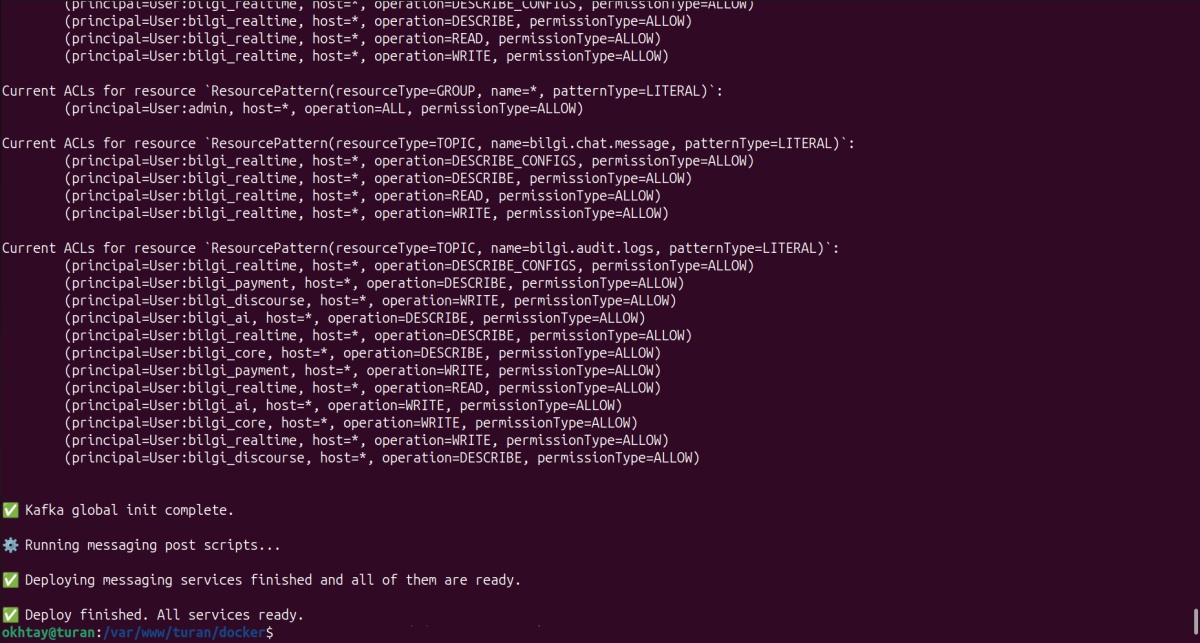
- Kafka authorization verification
- TLS configuration validation
- certificate and CA verification
- filesystem permission checks
- infrastructure health checks
- SQLite integrity and foreign-key validation
This follows a broader TuranOrdo principle:
Provisioning creates infrastructure; verification establishes that the infrastructure is actually usable and correctly secured.
🛡️ Security Principles
The security model can therefore be summarized as:
- Secure by default
- Least privilege
- Explicit resource ownership
- Dedicated application identities
- Controlled public exposure
- Private encrypted connectivity where required
- Explicit TLS trust domains
- TLS-protected infrastructure communication
- TLS-protected application-to-application communication
- Externally trusted certificates for public production edge traffic
- Locally trusted certificates for local development
- Internal CA for TuranOrdo-managed service communication
- Externalized and protected secrets
- Filesystem-level protection
- Registry-driven authorization
- Shared infrastructure without shared ownership
- Fail-fast security validation
- Deterministic security configuration
- Defense in depth
Security is consequently not a separate layer added after deployment.
It is embedded into TuranOrdo's networking, identity, authorization, TLS trust, provisioning, infrastructure ownership, configuration, and verification model.
🚀 Deterministic Initialization + Verification
One of TuranOrdo's core design principles is that container startup does not equal infrastructure readiness.
A service is considered operational only after its required infrastructure state has been created, configured, and verified.
For example:
Container Started
       ↓
Service Available
       ↓
Resource Initialized
       ↓
Credentials / Roles Applied
       ↓
Permissions Verified
       ↓
Real Access Tested
       ↓
Health Checks Passed
       ↓
Operational State
This eliminates the common “it started, but it doesn't work” failure mode in which containers appear healthy from an orchestration perspective while required users, permissions, databases, queues, topics, TLS configuration, or application dependencies remain incorrectly configured.
TuranOrdo applies deterministic initialization and verification at both the platform and application levels.
⬢ Platform-Level Initialization
Platform infrastructure is provisioned and verified before dependent workloads are considered ready.
Examples include:
PostgreSQL
MySQL
MongoDB
Redis
RabbitMQ
Kafka
Nginx
Traefik
TLS
Secrets
Storage
Initialization may include:
- creating databases
- creating users and roles
- applying permissions
- creating messaging resources
- configuring TLS
- generating runtime configuration
- preparing filesystem ownership and permissions
- configuring routes
- creating required namespaces or resource mappings
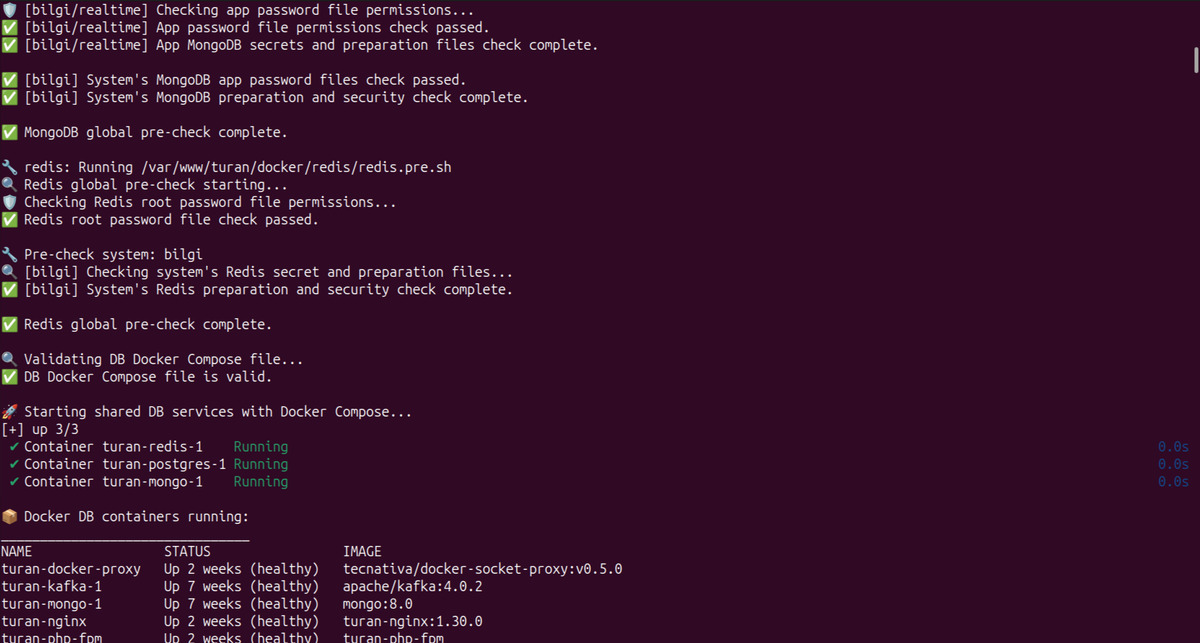
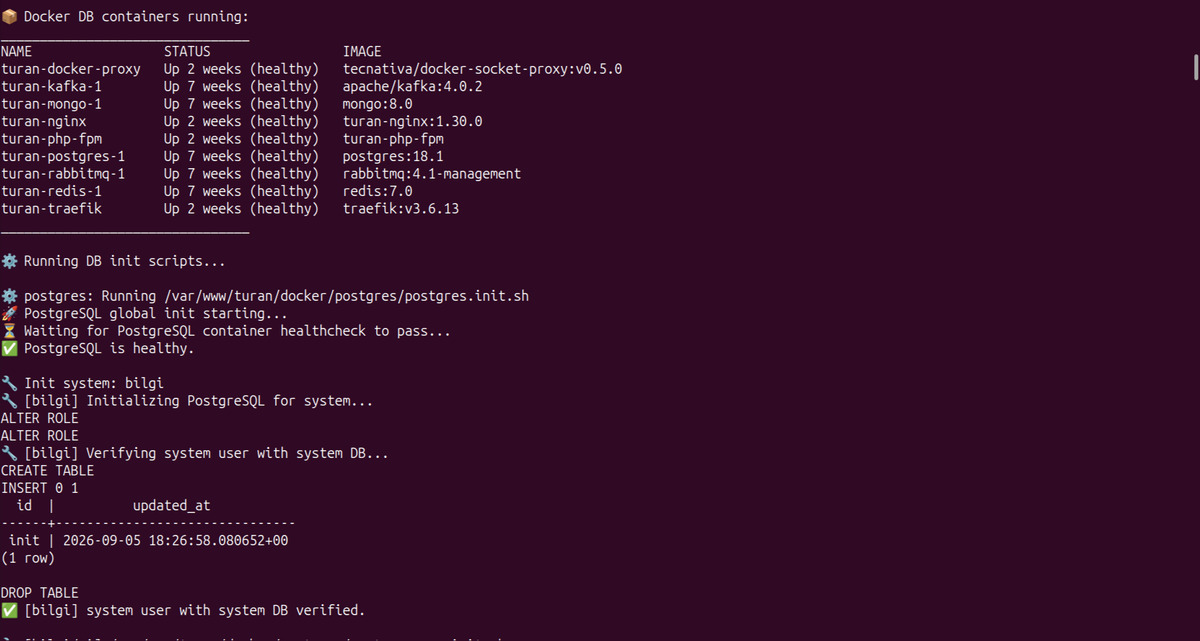
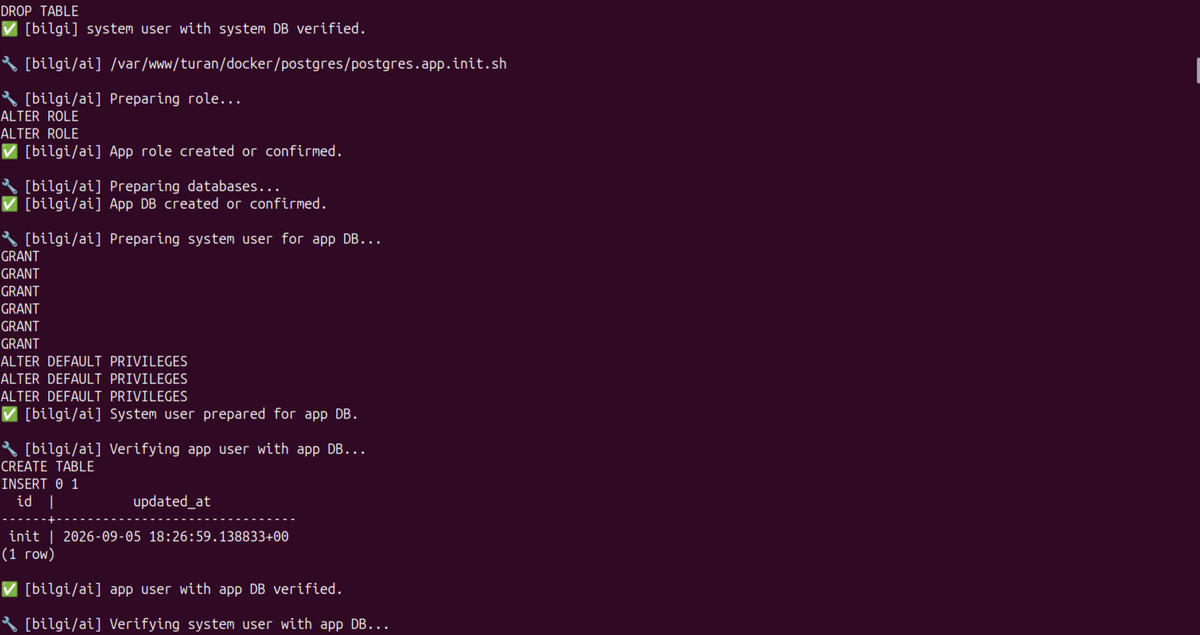
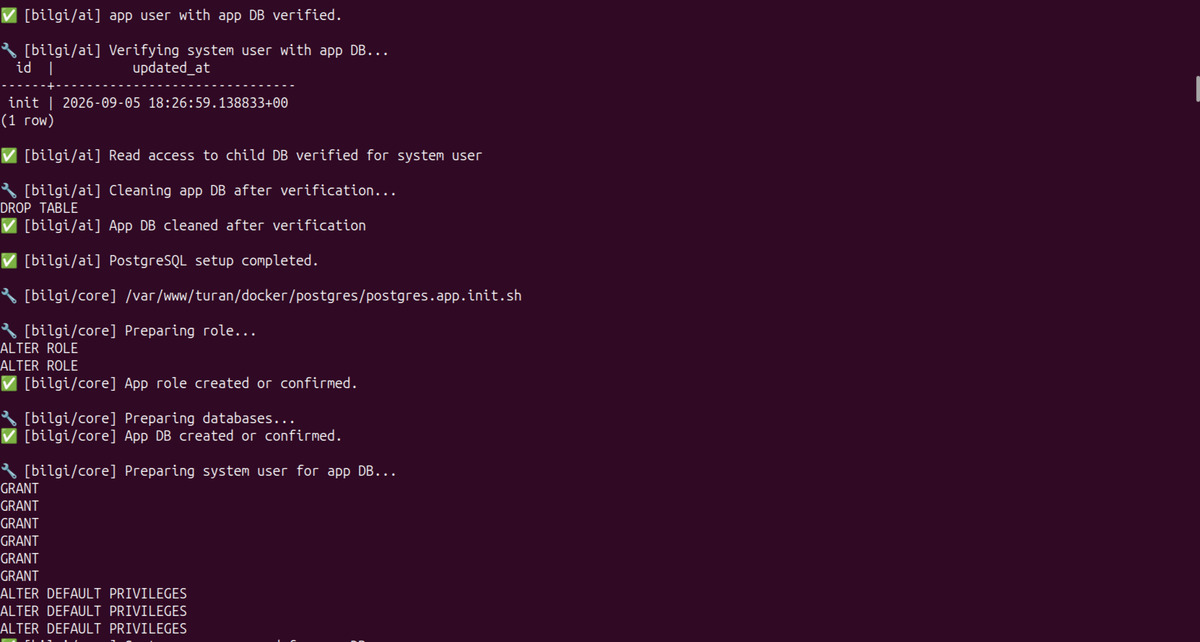
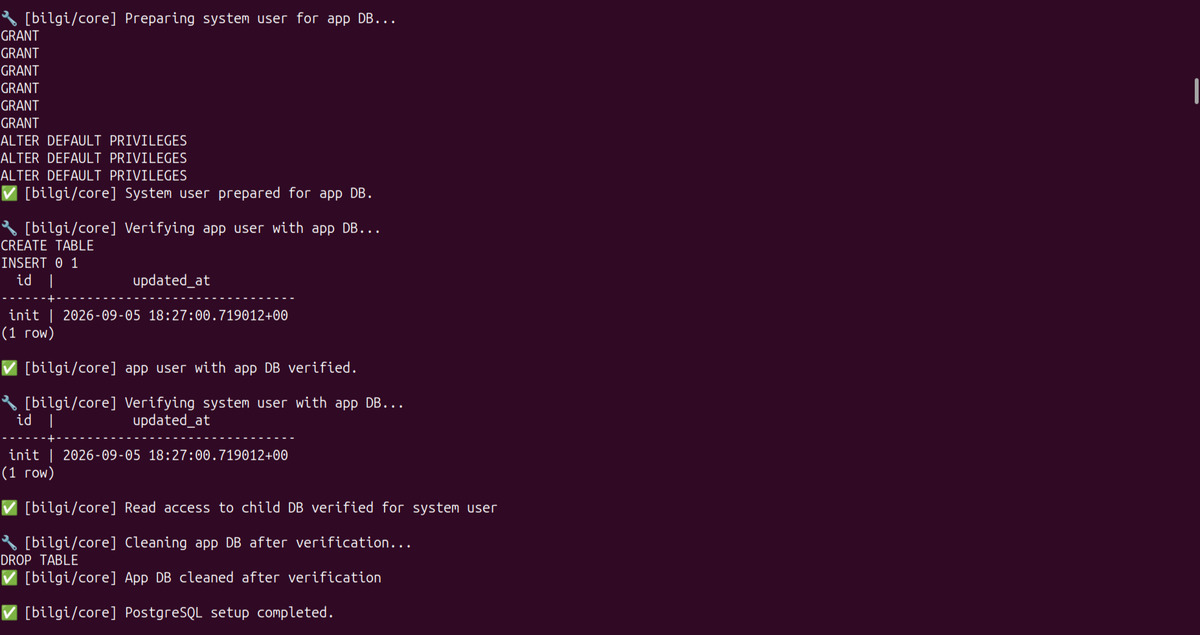
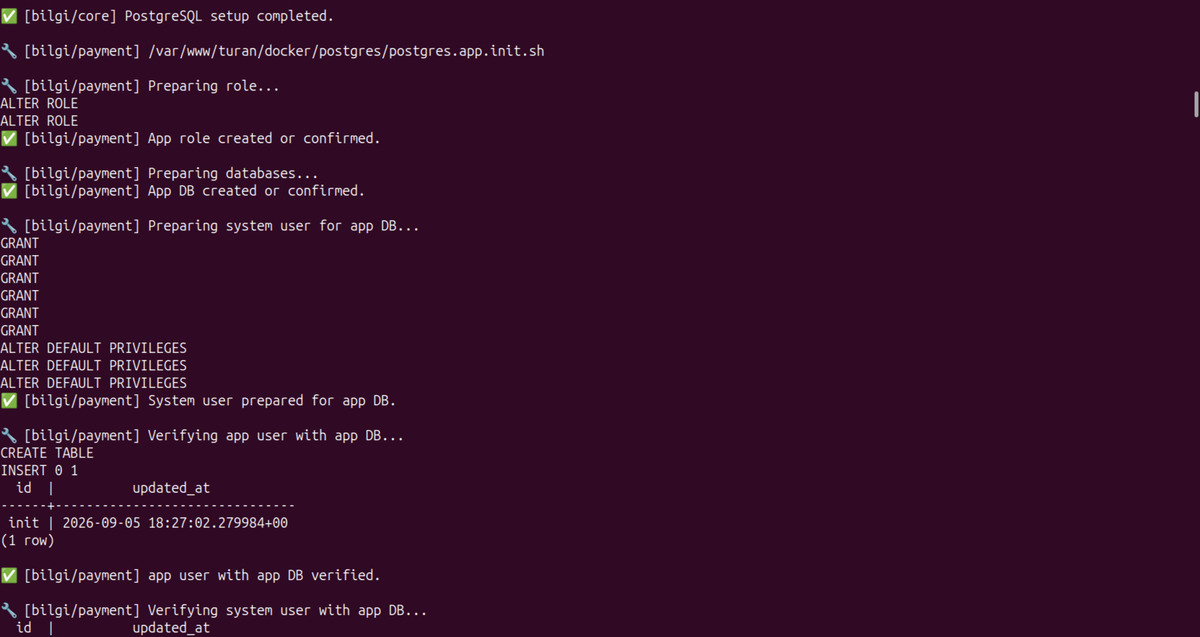
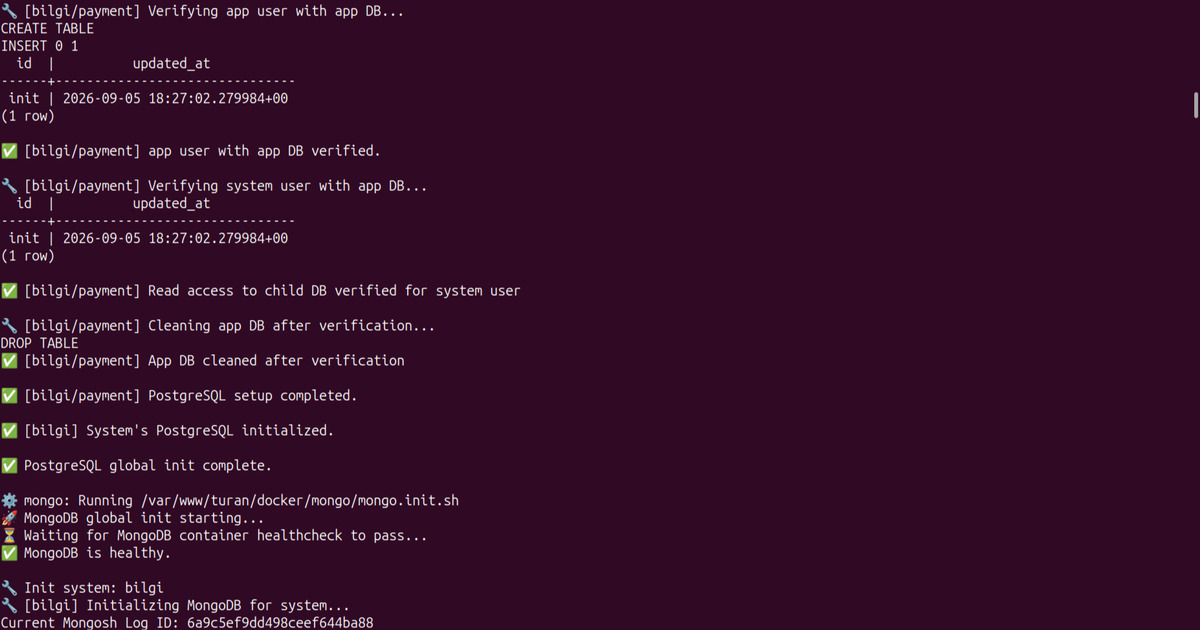
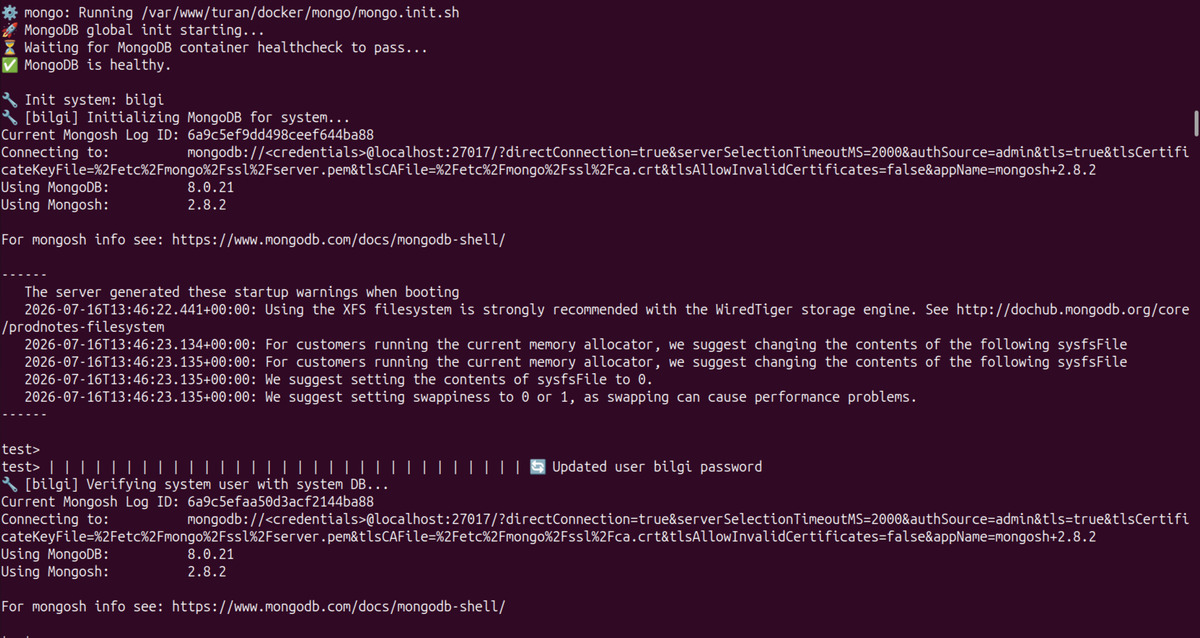
The initialization scripts perform create, update, verify, and fail-fast. The resulting state is then verified through actual operational checks rather than creation commands alone. This is enterprise-grade operational behavior.
🧩 Application-Level Initialization
Once platform infrastructure is available, applications initialize and verify their own runtime requirements.
The application deployment chain is:
Infrastructure Ready
        ↓
Application Dependencies Ready
        ↓
Database Migrations (and Seeding)
        ↓
Application Initialization
        ↓
Application Startup
        ↓
Application Health Verification
        ↓
Operational State
This allows infrastructure readiness and application readiness to remain separate concepts.
An application can therefore fail because its own migration, configuration, or dependency verification failed without incorrectly reporting the underlying infrastructure as unavailable.
The complete deployment chain is:
VPS
 ↓
Docker
 ↓
TuranOrdo infrastructure
 ↓
Infrastructure initialization
 ↓
Infrastructure verification
 ↓
Application initialization
 ↓
Application dependency verification
 ↓
Application runtime
 ↓
Application health verification
The result is stronger than relying on Docker Compose depends_on or container startup order alone.
🗂️ Registry-Based Resource Discovery
Initialization is driven by TuranOrdo's internal SQLite registry rather than relying on hardcoded infrastructure definitions scattered across individual application repositories.
Initialization scripts discover infrastructure requirements directly from the SQLite registry. Hence, the registry acts as the platform's control-plane state for relationships such as:
- System → Application ownership
- Application → Service relationships
- database ownership mappings
- Redis namespaces
- RabbitMQ vHosts, queues, exchanges, and permissions
- Kafka topics and access policies
- application runtime requirements
- host and traffic routes
- infrastructure configuration metadata
- migration history
The general flow is:
Application Requirements
        ↓
TuranOrdo Registry
        ↓
Resource Discovery
        ↓
Provisioning / Configuration
        ↓
Permission Generation
        ↓
Verification
        ↓
Reconciliation
This enables:
- independent application installation
- repeatable infrastructure provisioning
- dynamic permission generation
- consistent verification
- reduced configuration drift
- automated cleanup of resources no longer represented by the registry
New applications can therefore be introduced without requiring unrelated infrastructure definitions to be manually modified.
⚙ Orchestration System
TuranOrdo adds a script-driven lifecycle on top of Docker Compose.
Docker Compose remains responsible for container lifecycle and service orchestration, while TuranOrdo controls the broader infrastructure lifecycle:
Validate
   ↓
Prepare
   ↓
Compose Start
   ↓
Initialize
   ↓
Verify
   ↓
Reconcile / Finalize
This separation allows TuranOrdo to perform operations that container startup ordering alone cannot guarantee. This ensures deterministic deployment, predictable recovery, and repeatable production operations.
run.sh — Operational Entry Point
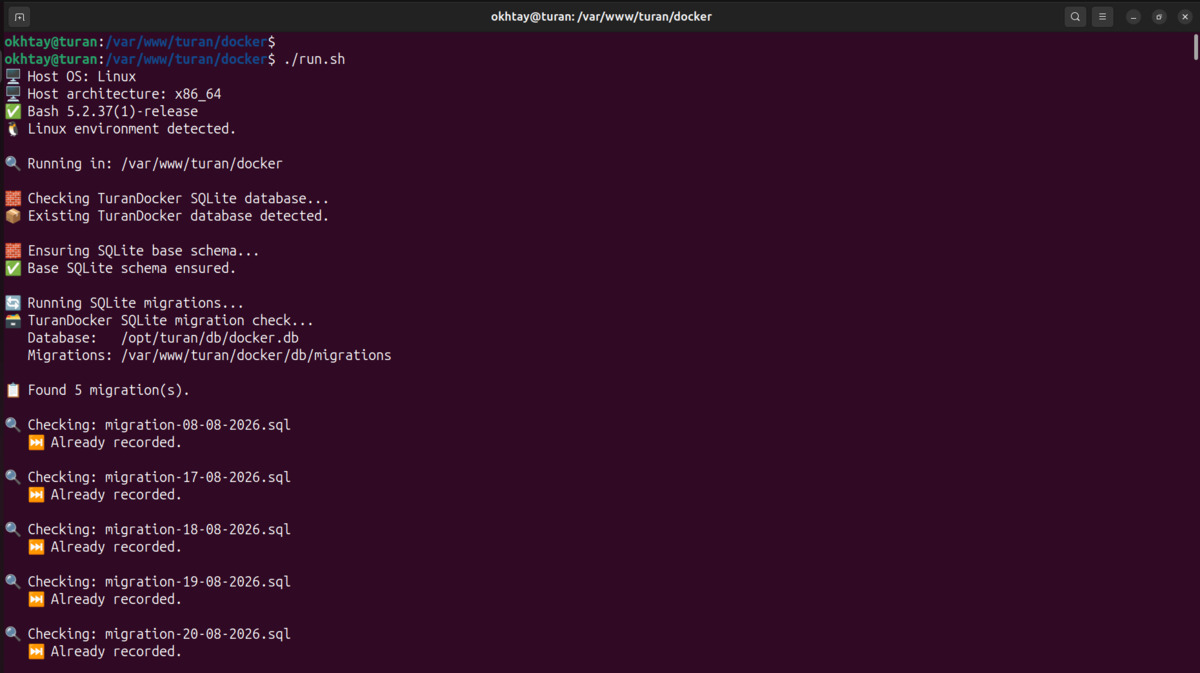
run.sh acts as the central operational entry point for the infrastructure lifecycle.
Depending on the deployment configuration, it coordinates:
- VPS and environment validation
- secret validation
- runtime directory preparation
- database startup and initialization
- messaging layer bootstrap
- storage layer initialization
- edge and traffic infrastructure
- observability infrastructure
- application deployment
This creates a consistent operational entry point while individual infrastructure layers retain their own initialization and verification logic.
🔄 Layer Lifecycle
Infrastructure components follow a common repeatable lifecycle:
Pre → Start → Init → Verify → Post
The lifecycle provides explicit boundaries between preparation, service startup, state initialization, verification, and finalization and ensures consistent deployment across all services.
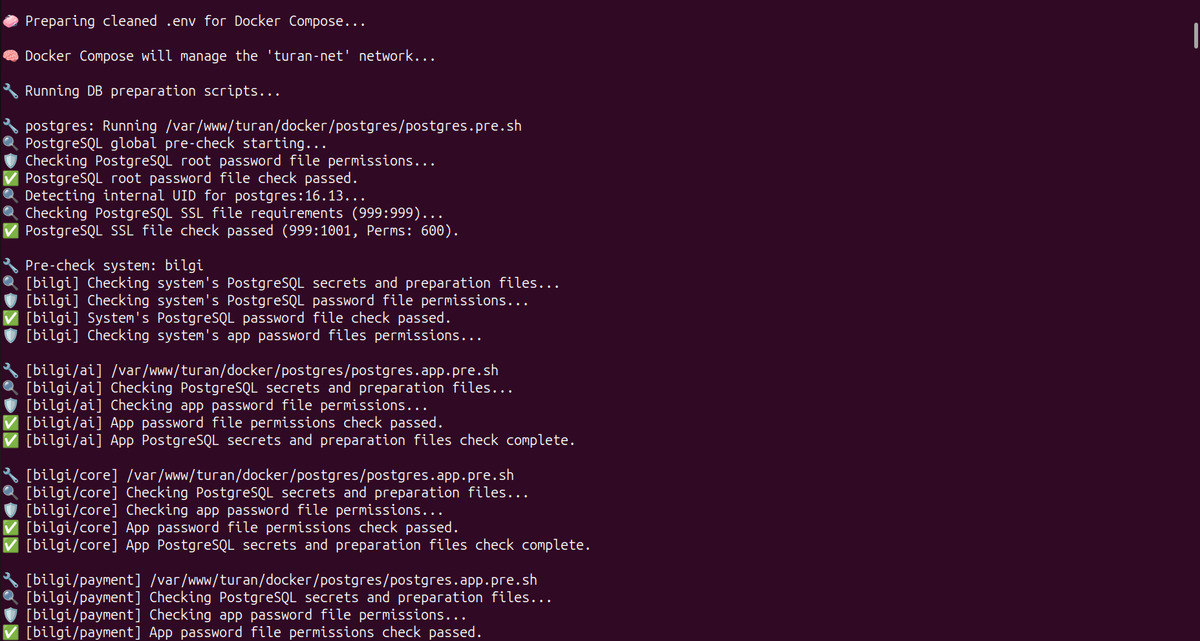
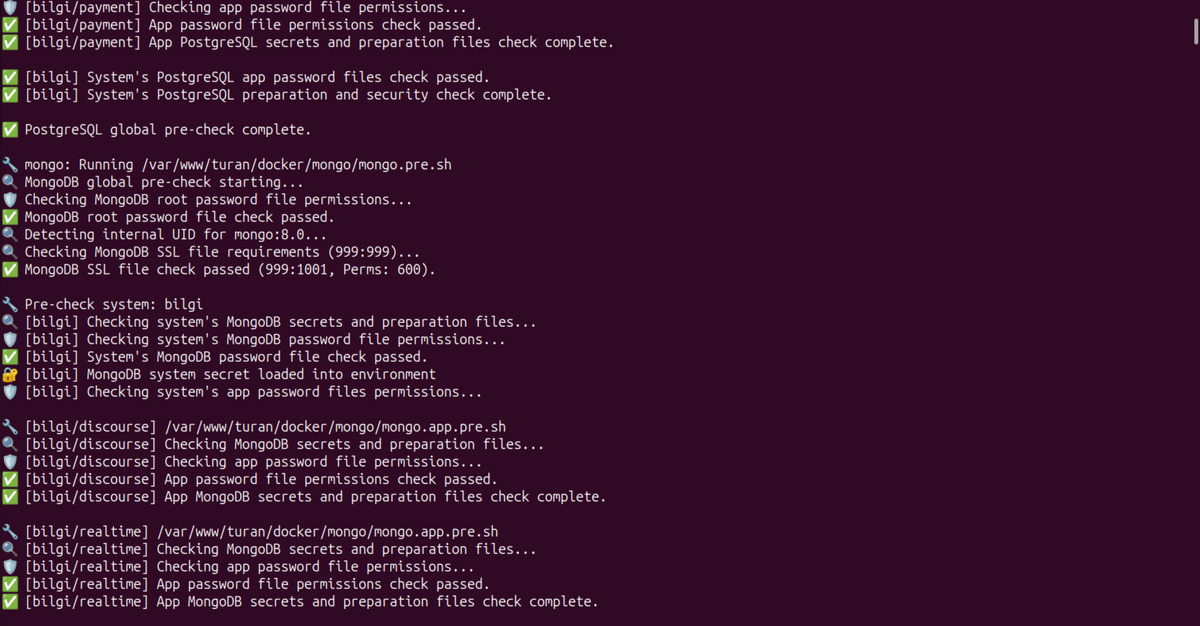
1. Pre Scripts (*.pre.sh)
Pre scripts execute before the relevant services are started.
Typical responsibilities include:
- validating required secrets
- checking file permissions
- preparing runtime directories
- generating dynamic configuration
- validating TLS material
- preparing service-specific runtime state
Examples include Kafka configuration generation and runtime path preparation.
2. Compose Start
Docker Compose starts the required services according to the deployment configuration.
This layer handles mechanisms such as:
- service startup
- dependency sequencing
- resource configuration
- restart policies
- health checks
However, a running or healthy container is not treated as proof that its application-level infrastructure state is correct.
3. Init Scripts (*.init.sh)
Initialization scripts establish the required persistent infrastructure state.
They are designed to be idempotent, allowing the same deployment procedures to be executed repeatedly without unnecessarily recreating or corrupting existing resources.
Examples include:
- PostgreSQL role and database creation
- MySQL user and database configuration
- MongoDB user and database initialization
- Redis namespace configuration
- RabbitMQ users, vHosts, queues, exchanges, and permissions
- Kafka users, topics, and ACLs
This guarantees deterministic state across deployments.
4. Verification
Verification performs real operational checks after initialization.
Depending on the resource, this may include:
- connection tests
- authentication tests
- read/write tests
- ownership validation
- permission validation
- messaging publish/consume tests
- TLS validation
- health checks
- filesystem permission checks
- registry integrity checks
For example, a MongoDB user is not considered correctly provisioned merely because the user creation command succeeded. The deployment can verify that the identity can authenticate and perform the operations it is supposed to perform such as read/write operations.
Similarly, RabbitMQ and Kafka resources can be verified using their actual authentication and authorization paths.
5. Post Scripts (*.post.sh)
Post scripts perform optional finalization operations such as:
- cleanup
- reporting
- synchronization
- deployment summaries
- operational notifications
- final state processing
🔁 Reconciliation and Drift Control
Initialization establishes the expected infrastructure state, while reconciliation helps maintain it over time.
The registry represents the desired ownership relationships:
Registry State
      ↓
Expected Resources
      ↓
Actual Infrastructure
      ↓
Comparison
      ↓
Reconcile Differences
This allows TuranOrdo to identify infrastructure resources that no longer correspond to registered applications or requirements and, where safe and explicitly supported, clean them up.
The objective is to prevent infrastructure from gradually diverging from the registry through manual changes, application removal, or repeated deployments.
🛡️ Fail-Fast Operational Behavior
TuranOrdo favors explicit failure over silently continuing with partially configured infrastructure.
If a required initialization or verification step fails, the deployment should stop rather than report a misleading successful state.
This is particularly important for:
- authentication failures
- missing permissions
- invalid TLS configuration
- missing secrets
- database connectivity problems
- messaging authorization failures
- inconsistent registry state
- failed health checks
The resulting deployment model is therefore:
Prepare
   ↓
Start
   ↓
Initialize
   ↓
Verify
   ↓
Operational
rather than:
Start Containers
      ↓
Assume Everything Works
🎯 Operational Principle
TuranOrdo treats infrastructure as verified state rather than running processes.
Docker Compose provides the container execution foundation. TuranOrdo adds deterministic initialization, registry-driven configuration, real access verification, reconciliation, and fail-fast operational behavior on top of that foundation.
This is a defining characteristic of the platform: infrastructure is not considered ready merely because it has started; it is ready when its declared state has been successfully established and verified.
🗄️ Database Layer
(docker-compose.db.yml)
The Database Layer provides the persistent storage foundation of TuranOrdo.
It is responsible for database provisioning, secure authentication, application-level ownership, deterministic initialization, health verification, and operational persistence.
Supported database and data services include:
- PostgreSQL
- MySQL
- MongoDB
- Redis
- Elasticsearch (optional)
- Kibana (optional administrative UI)
TuranOrdo treats these services as platform infrastructure rather than application-owned containers. Applications declare their requirements, while TuranOrdo provisions and verifies the required infrastructure resources.
🐘 PostgreSQL
PostgreSQL is used for:
- transactional workloads
- relational domain data
- strongly consistent business operations
- application-specific databases
- system-level metadata where required
PostgreSQL uses secure authentication and encrypted transport.
TuranOrdo supports the System DB + App DB ownership model:
System:
    bilgi

Databases:
    bilgi
    bilgi_core
    bilgi_payment
    bilgi_ai
Application identities are granted access according to database ownership rather than receiving unrestricted cluster-level privileges.
🐬 MySQL
MySQL is provided for:
- legacy compatibility
- traditional relational workloads
- existing systems requiring MySQL compatibility
- applications that cannot yet migrate to PostgreSQL
MySQL connections are configured with secure transport requirements and application-specific credentials.
The same system/app ownership model applies:
System DB
    ↓
Application DBs
    ↓
Application-specific permissions
🍃 MongoDB
MongoDB provides document-oriented persistence for workloads that benefit from flexible schemas and high-write patterns.
Typical use cases include:
- document storage
- event-heavy workloads
- realtime-oriented applications
- flexible domain models
TuranOrdo provisions separate application identities and databases according to registry ownership.
Example:
System:
    bilgi

Databases:
    bilgi
    bilgi_discourse
    bilgi_realtime
Application users are restricted to their assigned database wherever the MongoDB authorization model permits.
🧠 Redis
Redis provides high-speed infrastructure for:
- caching
- sessions
- queues
- pub/sub
- rate limiting
- coordination
- ephemeral application state
Redis is protected with authentication and persistent configuration where required.
Because Redis does not provide the same native per-application authorization model as PostgreSQL or MongoDB, TuranOrdo uses explicit application namespaces:
bilgi:core:*
bilgi:discourse:*
bilgi:realtime:*
bilgi:payment:*
bilgi:ai:*
This allows a shared Redis infrastructure service to remain compatible with application-level ownership boundaries.
🔎 Elasticsearch and Kibana
Elasticsearch is an optional infrastructure component for search, indexing, and log-oriented workloads.
Kibana is provided as an optional administrative and visualization interface for Elasticsearch.
These components are not mandatory dependencies of the core platform and can be enabled according to deployment requirements.
🔐 Database Security
Database security is integrated into the TuranOrdo provisioning model.
The database layer uses:
- TLS/SSL where supported and required
- secure authentication mechanisms
- externalized secrets
- application-specific credentials
- least-privilege permissions
- restricted network exposure
- health checks
- deterministic initialization
- post-initialization permission verification
Administrative database credentials are not used as application runtime credentials.
🧩 Registry-Driven Database Ownership
Database ownership is represented in the TuranOrdo infrastructure registry.
The registry allows TuranOrdo to associate:
System
    ↓
Application
    ↓
Database Resource
    ↓
Credentials / Permissions
This makes database provisioning reproducible and prevents application repositories from independently implementing infrastructure setup.
🔄 Deterministic Database Initialization
Database initialization is designed to be repeatable and idempotent.
The initialization process can:
- discover registered systems and applications
- determine required database resources
- create users and databases where required
- configure permissions
- configure secure transport
- verify connectivity
- verify application permissions
- report failures before dependent applications start
The objective is not simply to create databases, but to establish a known and verified database state.
🧪 Database Verification
Database readiness is validated through health checks and initialization verification.
Verification can include:
- service readiness
- authentication
- TLS configuration
- database existence
- user existence
- application-level permissions
- system-level permissions where applicable
- connectivity from the expected infrastructure network
This allows TuranOrdo to fail during infrastructure initialization rather than allowing incorrectly configured database access to surface later as an application runtime failure.
🛡️ Database Layer Guarantees
The Database Layer therefore provides:
- persistent storage
- application-level ownership
- least-privilege access
- secure authentication
- encrypted transport
- deterministic provisioning
- health verification
- reproducible initialization
- controlled network exposure
- registry-driven resource management
The result is a database layer that can be provisioned consistently across local development, VPS deployments, and future multi-node infrastructure environments.
🪣 Storage Layer
(docker-compose.stg.yml)
TuranOrdo provides a dedicated object-storage layer for applications that require S3-compatible persistent object storage.
🦩 MinIO
MinIO is provided as the platform's object-storage component.
It can be used for:
- user-uploaded files
- documents
- media
- application assets
- backups
- generated artifacts
- large binary objects
- S3-compatible application storage
The storage service is isolated from the database layer and accessed through the internal TuranOrdo network.
Application
     │
     ▼
   MinIO
     │
     ▼
Persistent Object Storage
The MinIO service is currently maintained as an optional Compose profile, allowing installations to enable object storage only when required.
👑 Storage Ownership
As with other infrastructure resources, future application-level object-storage ownership can be represented through the TuranOrdo registry.
This allows object-storage resources to follow the same:
System → App → Resource
ownership model used throughout the platform.
📨 Messaging Layer
(docker-compose.msg.yml)
The Messaging Layer provides asynchronous communication, event delivery, background processing, retry workflows, and event-driven integration across system applications.
TuranOrdo currently provides two messaging platforms by default:
- RabbitMQ
- Apache Kafka (KRaft mode)
These serve as the default messaging platforms, while Redpanda and NATS JetStream are prepared as optional extensions.
Both are managed as infrastructure services rather than independently provisioned by application repositories.
The messaging layer follows the same registry-driven model used throughout TuranOrdo:
Application Requirements
        ↓
Infrastructure Registry
        ↓
Messaging Resources
        ↓
Permissions
        ↓
Verification
        ↓
Reconciliation
🐇 RabbitMQ
RabbitMQ is primarily used for:
- background jobs
- command delivery
- asynchronous application tasks
- retry workflows
- delayed processing
- failure isolation
- application integration
TuranOrdo provides:
- TLS-secured communication
- per-system virtual hosts
- per-application runtime identities
- regex-based resource permissions
- registry-driven topology provisioning
- automatic topology reconciliation
- publish/consume verification
A typical system boundary is:
System: bilgi
    ↓
vHost: /bilgi
    ↓
Application-owned exchanges and queues
🏗️ RabbitMQ Topology Management
RabbitMQ topology is generated from registry metadata rather than manually maintained application infrastructure.
TuranOrdo can provision standardized, self-healing messaging topology including:
- exchanges
- queues
- dead-letter exchanges
- dead-letter queues
- retry queues
- bindings
- application permissions
A typical application topology can contain:
Application Exchange
    ↓
Application Queue
    ↓
Consumer


Failure
    ↓
Dead-Letter Exchange
    ↓
Dead-Letter Queue
Primary exchange is a direct exchange (e.g., bilgi.core) for normal message routing. A dead-letter exchange is a dedicated exchange (e.g., bilgi.core.dlx) for failed messages. Dead-letter queue permanently stores poison messages for operational inspection and recovery. Bindings use semantic and functional routing keys (e.g., user.account) to provide deterministic routing. Retry queues can use TTL and dead-letter routing to automatically retry transient failures and support deterministic retry workflows.
🧪 RabbitMQ End-to-End Verification
TuranOrdo does not consider RabbitMQ ready merely because the broker is running.
During initialization it can perform an isolated publish/consume verification using temporary resources.
The verification validates:
- exchange creation
- queue creation
- binding creation
- routing-key resolution
- publishing
- message delivery
- message consumption
Temporary verification resources are removed after successful validation.
This allows configuration and permission problems to be detected during infrastructure initialization.
🧹 RabbitMQ Reconciliation
RabbitMQ resources are reconciled against the infrastructure registry.
Resources that are no longer represented in the desired infrastructure state can be identified as orphaned and removed from the applicable application namespace.
This prevents long-term accumulation of:
- obsolete queues
- obsolete exchanges
- abandoned retry queues
- unused dead-letter resources
- resources left behind after application refactoring
The reconciliation process is designed to be deterministic and idempotent.
🏛 Apache Kafka
Kafka provides the event-streaming infrastructure of TuranOrdo.
Typical use cases include:
- domain events
- event propagation
- audit logs
- realtime event pipelines
- asynchronous integration
- distributed event-driven architectures
Kafka runs in KRaft mode, eliminating the need for ZooKeeper.
🔐 Kafka Security
Kafka uses:
- TLS encryption
- SCRAM authentication
- ACL-based authorization
- application-specific identities
- explicit topic ownership
- generated read/write policies
TuranOrdo therefore avoids a shared Kafka credential model.
Each application receives its own Kafka identity, while topic permissions are generated from registry metadata.
🗂️ Registry-Driven Kafka Topics
Kafka topics are infrastructure resources owned by applications.
The registry records information such as:
- System
- Application
- Topic
- Owner
- Read Policy
- Write Policy
- Enabled State
For example:
Topic:
    bilgi.notification.intent

Owner:
    bilgi_realtime

Read Policy:
    OWNER_ONLY

Write Policy:
    SYSTEM
TuranOrdo translates this metadata into Kafka topics, identities, and ACLs.
🔐 Kafka Read / Write Policies
TuranOrdo supports independent read and write policies.
OWNER_ONLY
Only the owning application can perform the corresponding operation.
SYSTEM
Registered Kafka-enabled applications inside the same system may perform the corresponding operation.
This allows system-wide events and application-private events to coexist within the same Kafka infrastructure without requiring a separate broker for every application.
⚙️ Automatic Kafka Provisioning
During initialization TuranOrdo can:
- generate or configure the Kafka cluster identity
- format and initialize storage
- generate runtime configuration based on pre-defined templates
- strictly validate SSL + permission before startup
- create SCRAM users
- create registered topics
- generate ACLs
- apply topic ownership policies
- reconcile obsolete topics
- verify authentication and authorization
This eliminates common Kafka pitfalls such as:
- inconsistent cluster IDs
- broken authentication setups
- permission misconfigurations
- orphaned and obsolete Kafka topics
- infrastructure drift between deployments
🧹 Kafka Topic Reconciliation
Kafka topics are reconciled against registry state.
Topics that are no longer registered can be identified as orphaned and removed from the applicable system namespace.
Internal Kafka topics, such as:
__consumer_offsets
are excluded from application-level cleanup.
This keeps the Kafka topology aligned with the declared infrastructure state.
🔮 Future Messaging Extensions
TuranOrdo is designed to support additional messaging technologies without changing the core infrastructure ownership model.
Two prepared extensions are:
- RedPanda — Kafka-compatible streaming infrastructure with lower operational overhead and resource requirements.
- NATS JetStream — lightweight messaging and persistence for high-performance service-to-service communication, event delivery, and distributed coordination.
Both are currently maintained as optional Compose profiles rather than default messaging services.
🛡️ Messaging Layer Guarantees
The Messaging Layer provides:
- secure asynchronous communication
- application-aware authorization
- registry-driven topology
- deterministic provisioning
- end-to-end verification
- automatic reconciliation
- application-specific identities
- controlled event ownership
- repeatable initialization
The result is a messaging infrastructure in which the broker topology is derived from the same infrastructure model that governs the rest of TuranOrdo.
🌐 Edge + Traffic Layer
(docker-compose.inf.yml)
The Edge + Traffic Layer provides the public entry point, host-based routing, TLS termination, and shared web infrastructure for applications running on TuranOrdo.
The architecture supports multiple application runtime models without requiring a separate infrastructure strategy for each application type.
The primary traffic flow is:
Internet
    ↓
Traefik
    ↓
Application Runtime
Depending on the application runtime, the final stage can be:
Traefik
    ↓
Application Container
or:
Traefik
    ↓
Shared Nginx
    ↓
Static Application
or:
Traefik
    ↓
Shared Nginx
    ↓
PHP-FPM
    ↓
PHP Application
This allows modern containerized services and traditional web applications to coexist within the same infrastructure model.
🚦 Traefik — Primary Edge Router
Traefik acts as the primary public ingress layer and secure front door of TuranOrdo.
It provides:
- HTTPS termination
- Let's Encrypt certificate management
- host-based routing
- domain routing
- middleware execution
- service discovery
- controlled application exposure
- centralized entry-point management
Typical public hosts may include:
ms.turanbilgi.com
core.turanbilgi.com
discourse.turanbilgi.com
realtime.turanbilgi.com
Public traffic is therefore centralized at the edge instead of exposing individual application containers directly to the Internet. Traefik ensures that public traffic enters the platform through a secure, centralized, and observable edge layer.
🧩 Registry-Driven Host Routing
Host routing is integrated with the TuranOrdo infrastructure registry.
An application can be associated with:
System
    ↓
Application
    ↓
Runtime
    ↓
Host Route
    ↓
Traffic Target
This allows the platform to maintain application-specific traffic configuration without requiring every application repository to independently configure the infrastructure edge.
📦 Containerized Application Runtime
Containerized applications follow the direct container-native pattern:
Traefik
    ↓
Application Container
This is suitable for:
- Node.js / Express services
- NestJS services
- FastAPI services
- Go services
- Python services
- FrankenPHP
- Other container-native workloads
The application owns its runtime container while Traefik provides the common ingress layer. This model is optimized for horizontal scalability, container-native deployment, service isolation, high-performance API workloads.
🗂️ Static Application Runtime
TuranOrdo also supports static applications without requiring a dedicated Nginx container for every application.
The runtime is:
Traefik
    ↓
Shared Nginx
    ↓
Static Application Files
This is suitable for:
- static websites
- landing pages
- frontend builds
- documentation sites
- generated web applications
The shared Nginx service acts as platform infrastructure.
Each static application retains its own:
- web root
- host route
- registry ownership
- filesystem permissions
- application configuration
Therefore:
Shared Nginx does not mean shared application ownership.
🐘 PHP Application Runtime
PHP applications use the same shared web infrastructure together with PHP-FPM:
Traefik
    ↓
Shared Nginx
    ↓
PHP-FPM
    ↓
PHP Application
This supports:
- legacy PHP applications
- Laravel applications
- Symfony applications
- traditional PHP websites
- CMS-based applications
- applications that do not require a dedicated PHP-FPM and Nginx container
The PHP runtime is therefore integrated into the same registry-driven application model as containerized and static applications.
🔮 Containerized PHP Runtime
TuranOrdo is designed to extend its PHP application model toward containerized PHP runtimes.
In this model, the shared Nginx infrastructure remains responsible for HTTP handling and edge integration, while each PHP application can run its own dedicated PHP-FPM container.
Traefik
    ↓
Shared Nginx
    ↓
Dedicated PHP-FPM Container
    ↓
Application
This preserves the benefits of centralized web infrastructure while providing stronger runtime isolation and independent lifecycle management for PHP applications.
This runtime model is a planned extension of the current php application type.
🧱 Shared Nginx Architecture
Nginx is a shared platform runtime, not an application-specific infrastructure requirement.
Instead of:
App A → Nginx A
App B → Nginx B
App C → Nginx C
TuranOrdo can provide:
     Shared Nginx
    /      |      \
App A    App B    App C
Host routes and application-specific configuration are maintained separately.
For PHP applications, the shared web layer can additionally route PHP requests toward PHP-FPM.
This significantly reduces infrastructure duplication for workloads that do not require a dedicated web-server container.
🔐 Web Runtime Security
Shared web infrastructure does not remove application-level security boundaries.
TuranOrdo maintains application-specific:
- filesystem ownership
- web roots
- host routes
- runtime configuration
- registry ownership
- permissions
Applications therefore share platform infrastructure while retaining separate resource ownership.
🔀 Runtime Selection
The application registry explicitly identifies the application runtime type.
Conceptually:
App
 ├── Runtime: containerized
 ├── Runtime: static
 └── Runtime: php
The runtime type determines which infrastructure path is generated.
containerized
    → Traefik → App Container

static
    → Traefik → Shared Nginx → Web Root

php
    → Traefik → Shared Nginx → PHP-FPM → Web Root
This makes runtime selection declarative rather than hardcoded into individual deployment scripts.
🧭 Optional API Gateways
TuranOrdo also includes optional support for additional API gateway technologies:
- KrakenD
- Kong
- APISIX
These components are profile-disabled unless explicitly required.
They provide a future path toward capabilities such as:
- API aggregation
- centralized authentication
- rate limiting
- API lifecycle management
- developer portals
- advanced traffic policies
- service mesh integration
Keeping them optional avoids introducing unnecessary operational complexity into deployments that only require Traefik.
🛡️ Edge Layer Guarantees
The Edge + Traffic Layer provides:
- centralized public ingress
- HTTPS termination
- automated certificate management
- registry-driven host routing
- multiple application runtime models
- shared Nginx infrastructure
- PHP-FPM integration
- static application support
- container-native application support
- controlled application exposure
- separation between shared infrastructure and application ownership
The result is a single edge architecture capable of serving modern microservices, static applications, and traditional PHP applications without requiring separate infrastructure platforms for each workload.
🛡️ Private Network Layer
(docker-compose.scr.yml)
TuranOrdo can provide an encrypted private network layer using WireGuard.
The VPN gateway creates a controlled private network for trusted infrastructure nodes and administrative clients.
                Public Internet
                      │
                      │ UDP 51820
                      ▼
              ┌───────────────┐
              │ WireGuard VPN │
              │    Gateway    │
              └───────┬───────┘
                      │
          Private encrypted network
                      │
      ┌───────────────┼───────────────┐
      │               │               │
  VPS / DR        Admin Node      Dev Node
The private network can provide controlled access to:
- infrastructure services
- management interfaces
- internal APIs
- disaster-recovery nodes
- administrative endpoints
- development environments
The default design keeps infrastructure services bound to private or localhost interfaces wherever possible, while WireGuard provides encrypted remote access without exposing those services directly to the public Internet.
The WireGuard gateway is currently maintained as an optional profile, allowing installations to enable the private network layer when required.
📊 Observability Layer
(docker-compose.obs.yml)
Production systems fail. TuranOrdo assumes that failure is normal—not exceptional. The Observability Layer exists to make failures visible, diagnosable, and recoverable. It provides monitoring, logs, tracing, alerting, and operational introspection across the entire platform.
📈 Metrics
Prometheus + Grafana
Prometheus and Grafana are used for:
- service health monitoring
- infrastructure visibility
- VPS resource analysis
- performance tracking
- operational dashboards
This provides real-time awareness of platform behavior.
📝 Logs
Loki + Logstash + Elasticsearch + Kibana
Loki, Logstash, Elasticsearch, and Kibana are used for:
- centralized log aggregation
- failure investigation
- production debugging
- historical operational visibility
- full-text log search
This removes the need to debug production issues by manually entering containers.
🔍 Distributed Tracing
Jaeger
Jaeger is used for:
- request flow tracing
- async failure debugging
- inter-service dependency visibility
- latency investigation
This is especially critical for event-driven microservice systems.
🐞 Error Tracking
GlitchTip
GlitchTip is used for:
- exception monitoring
- production error visibility
- Sentry-compatible workflows
- developer alerting
This ensures failures are surfaced immediately rather than discovered later.
🔄 Queue Monitoring
Bull Board
Bull Board is used for:
- background job inspection
- Redis queue visibility
- retry debugging
- failed job analysis
This is especially important for worker-heavy systems.
🧩 Application Layer
({app}/run.install.sh, {app}/docker-compose.yml)
The Application Layer contains the actual business applications, services, and workloads that run on top of the shared TuranOrdo infrastructure.
TuranOrdo provides the standardized infrastructure and runtime foundation required by applications, while applications remain responsible for their own business behavior, application code, data models, runtime processes and static application artifacts.
The fundamental boundary is:
Applications own business logic and application behavior. TuranOrdo owns the infrastructure capabilities and operational foundation on which applications run.
This separation allows applications to evolve independently while the underlying infrastructure remains standardized and reusable.
📚 Application Layer Documentation Structure
The detailed architecture of the application layer is organized into the following sections:
- 🎛️ Application Responsibilities
- 🚀 Application Deployment Model
- ⚙️ Application Runtime Types
- 🧱 Application Layer and Infrastructure Layer
- 🤝 Application → Platform Contract
- 🗂️ Registry-Driven Application Resources
- 🚰 Shared Infrastructure Consumption
- 🏋️ Application Workloads
- 🔑 Application Runtime Secrets
- 🚀 Application Initialization
- 🚚 Application Database Migrations
- 🩺 Application Health and Lifecycle
- 🪓 Build-Time and Runtime Separation
- 🎛️ Environment-Aware Deployment
- 💡 Application Examples
- 🚧 Ownership Boundary
- 🔮 Future Stateless Orchestration
- 📐 Application Layer design principle
🎛️ Application Responsibilities
Applications are responsible for:
- Business logic and domain behavior
- API endpoints and application protocols
- Domain models and application-level validation
- Application authentication and authorization
- Background workers and consumers
- Scheduled application jobs
- Event processing
- Database schemas
- Database migrations
- Application seed data
- Application configuration
- Application-level health endpoints
- Frontend source code and build processes
- Application runtime processes
TuranOrdo does not contain application business logic.
Instead, it provides the infrastructure required for that logic to execute reliably.
🚀 Application Deployment Model
An application is treated as a logical workload rather than necessarily being a single container.
A logical application may consist of multiple independently managed workloads, such as:
Application
├── API
├── Background Workers
├── Message Consumers
├── Scheduled Jobs
├── Realtime Process
└── Frontend / Static Artifacts
These workloads may use the same application image or different images depending on their runtime requirements.
For example, a backend application may expose an HTTP API while simultaneously running dedicated workers for:
- Kafka events
- RabbitMQ messages
- Outbox processing
- Scheduled tasks
- Realtime processing
Each workload can therefore have its own process lifecycle while remaining part of the same logical application.
⚙️ Application Runtime Types
TuranOrdo supports multiple application runtime models.
The Application Layer can host very different application types on the same TuranOrdo foundation, including containerized services, multi-workload applications, static applications, PHP applications, and applications exposed through multiple domains.
🚢 Containerized Applications
The application runs as one or more dedicated containers.
Internet
   │
   ▼
Traefik
   │
   ▼
Application Container
This is the primary model for Node.js, Python, Go, Java, and other container-native applications.
Applications may expose REST, GraphQL, WebSocket, gRPC, or other supported protocols depending on their implementation.
📄 Static Applications
Static applications are built into deployable artifacts and served through the shared Nginx runtime.
Application Source
    │
    ▼
Build
    │
    ▼
Static Artifacts
    │
    ▼
Shared Nginx
    │
    ▼
Traefik
    │
    ▼
Internet
This model is appropriate for applications such as:
- Next.js static exports
- Nuxt.js static exports
- React/Vite applications
- Vue.js/Vite applications
- Documentation sites
- Landing pages
- Other static web applications
The application owns its source code and build process, while TuranOrdo manages the runtime filesystem, shared Nginx configuration, routing, and TLS integration.
🐘 PHP Applications
PHP applications can run through the shared Nginx and PHP-FPM runtime.
Internet
   │
   ▼
Traefik
   │
   ▼
Shared Nginx
   │
   ▼
Shared PHP-FPM
   │
   ▼
PHP Application
The application provides its PHP source tree and expected public document root, while TuranOrdo manages the surrounding web runtime.
This allows traditional PHP applications to coexist with containerized and static applications on the same infrastructure platform.
🐘 Containerized PHP Applications — Future Extension
A future runtime model can isolate PHP-FPM into a dedicated application container:
Internet
   │
   ▼
Traefik
   │
   ▼
Shared Nginx
   │
   ▼
Dedicated PHP-FPM Container
   │
   ▼
PHP Application
This provides stronger runtime isolation while retaining the shared edge and Nginx architecture.
This model is an extension of the current PHP runtime rather than a requirement for existing PHP applications.
🧱 Application Layer and Infrastructure Layer
The overall relationship is therefore:
┌─────────────────────────────────────────────┐
│               Applications                  │
│                                             │
│  APIs • Workers • Consumers • Frontends     │
│  Business Logic • Schemas • Migrations      │
└──────────────────────┬──────────────────────┘
                       │
                Application Contract
                       │
                       ▼
┌─────────────────────────────────────────────┐
│                 TuranOrdo                   │
│                                             │
│ Runtime • Network • DB • Redis • Messaging  │
│ Storage • TLS • Routing • Observability     │
│ Secrets • Verification • Reconciliation     │
└─────────────────────────────────────────────┘
This separation makes it possible to change an application's implementation without redesigning the infrastructure platform, while infrastructure capabilities can evolve without forcing every application to implement its own infrastructure management.
🤝 Application → Platform Contract
Applications do not need to understand how TuranOrdo internally provisions infrastructure.
Instead, an application declares the capabilities it requires.
Conceptually:
Application Requirements
        │
        ▼
    TuranOrdo
        │
        ├── Database
        ├── Cache
        ├── Messaging
        ├── Storage
        ├── Networking
        ├── TLS
        └── Runtime
TuranOrdo then resolves, provisions, configures, and verifies those platform resources according to its registry and operational rules.
The application therefore consumes platform capabilities, rather than directly managing infrastructure implementation details.
For example, an application may require:
PostgreSQL
Redis
RabbitMQ
Kafka
Object Storage
HTTPS
The application should not need to know whether the PostgreSQL server was initialized by a particular shell script, whether a RabbitMQ permission was generated from a registry entry, or how a Traefik route was internally rendered. Those are platform implementation details.
Hence, an application is not required to package its own PostgreSQL, Redis, Kafka, RabbitMQ, TLS infrastructure, reverse proxy, or other shared platform components. Instead, applications consume these capabilities through a well-defined runtime contract. The application declares which platform services it needs and connects to them through the shared TuranOrdo environment.
Conceptually:
                         ┌──────────────────────────────┐
                         │      Client Applications     │
                         │                              │
                         │    Next.js / React / Vite    │
                         │   Static Web Applications    │
                         │   Mobile Web / Expo Assets   │
                         └──────────────┬───────────────┘
                                        │
                                        │ HTTP/HTTPS
                                        ▼
                         ┌──────────────────────────────┐
                         │       Shared Web Layer       │
                         │                              │
                         │       Traefik → Nginx        │
                         │   TLS / Routing / Headers    │
                         └──────────────┬───────────────┘
                                        │
                 ┌──────────────────────┼──────────────────────┐
                 │                      │                      │
                 ▼                      ▼                      ▼
    ┌────────────────┐        ┌────────────────┐     ┌────────────────┐
    │  Static Apps   │        │    PHP Apps    │     │  Node.js APIs  │
    │                │        │                │     │  Next.js apps  │
    │ Turan/Hub      │        │  Okhtay/Site   │     │                │
    │ Bilgi/User     │        │  Turan/Ordo    │     │ Bilgi/Core API │
    │ Bilgi/Admin    │        │                │     │ Bilgi/Site     │
    └────────────────┘        └─────┬──────────┘     └───────┬────────┘
                                    │                        │
            ┌───────────────────────┼────────────────────────┼────────────────┐
            │                       │                        │                │
            ▼                       ▼                        ▼                ▼
         MongoDB                PostgreSQL                 Redis        Message Brokers
                                                                        RabbitMQ / Kafka
🗂️ Registry-Driven Application Resources
Application infrastructure requirements are represented through TuranOrdo's registry.
The registry acts as the control-plane representation of the desired infrastructure state.
It can associate applications with resources such as:
- Databases
- Database users
- Redis namespaces
- RabbitMQ vHosts
- RabbitMQ queues and exchanges
- Kafka topics
- Kafka access policies
- Storage resources
- Runtime requirements
- Network routes
- Application-specific infrastructure configuration
This creates a clear relationship:
Application
     │
     │ declares/uses
     ▼
Registry
     │
     │ defines desired state
     ▼
TuranOrdo Infrastructure
The registry therefore provides a stable contract between application workloads and the infrastructure platform.
🚰 Shared Infrastructure Consumption
Applications consume shared infrastructure services rather than provisioning independent copies unnecessarily.
Typical shared platform services include:
- PostgreSQL
- MySQL
- MongoDB
- Redis
- RabbitMQ
- Apache Kafka
- Object storage
- Shared Nginx
- Traefik
- TLS infrastructure
- Private networking
- Observability infrastructure
Isolation is provided through ownership boundaries, credentials, namespaces, databases, vHosts, topics, ACLs, and other resource-level controls.
For example:
PostgreSQL
├── bilgi_core
├── bilgi_payment
└── bilgi_realtime

Redis
├── bilgi:core:*
├── bilgi:payment:*
└── bilgi:realtime:*

RabbitMQ
└── system-specific vHosts / permissions

Kafka
└── registry-controlled topics / ACLs
This allows multiple applications to share infrastructure without requiring every application to own an entire infrastructure stack.
🏋️ Application Workloads
A single application may expose several different workloads.
For example:
Bilgi/Core
├── REST API
├── GraphQL API
├── Kafka Outbox Worker
├── RabbitMQ Outbox Worker
├── User Event Worker
├── Admin Event Worker
├── User Account Worker
└── Admin Account Worker
Each workload can be independently started, stopped, scaled, monitored, and deployed while remaining part of the same logical application.
This model is particularly useful for microservice architectures and event-driven systems.
🔑 Application Runtime Secrets
Applications consume runtime secrets without embedding credentials in application images or source code.
TuranOrdo manages the infrastructure-side secret distribution, while applications consume the secrets they require.
A typical runtime model is:
TuranOrdo Secrets
        │
        ▼
/run/secrets/...
        │
        ▼
Application Runtime
Secrets may include:
- Database credentials
- Redis credentials
- RabbitMQ credentials
- Kafka credentials
- API credentials
- TLS-related credentials
- Application-specific secrets
The same application image can therefore be promoted between environments while environment-specific credentials remain outside the image.
🚀 Application Initialization
Application initialization is different from infrastructure initialization.
TuranOrdo initializes and verifies platform infrastructure such as databases, messaging systems, networking, and shared runtimes.
The application remains responsible for application-level initialization such as:
- Loading runtime configuration
- Constructing service URLs
- Waiting for required dependencies
- Running application database migrations
- Loading seed data when appropriate
- Registering application consumers
- Starting application workers
- Starting the main application process
For example:
Container Start
      │
      ▼
Load Runtime Secrets
      │
      ▼
Load Configuration
      │
      ▼
Validate Dependencies
      │
      ▼
Run Application Migrations
      │
      ▼
Start Application Process
Infrastructure readiness and application readiness are therefore separate concepts.
A database container being healthy does not necessarily mean that the application is ready to serve requests.
🚚 Application Database Migrations
Database schema ownership remains with the application.
The separation is:
TuranOrdo
├── Database Server
├── Database Instance
├── Credentials
├── TLS
└── Connectivity

Application
├── Schema
├── Migrations
├── Models
└── Seed Data
For example, TuranOrdo may create the PostgreSQL database and application user, while the application executes:
migration-001
migration-002
migration-003
...
This prevents infrastructure provisioning from becoming coupled to application-specific schema evolution.
🩺 Application Health and Lifecycle
Applications should expose an application-level health or readiness mechanism.
For example: GET /health
The application health check can verify the dependencies that are required for the workload to operate correctly.
A simplified model is:
Infrastructure Health
        │
        ▼
Application Dependency Health
        │
        ▼
Application Health
        │
        ▼
Traffic Eligible
This distinction is important because:
Infrastructure availability does not automatically mean application availability.
TuranOrdo can verify infrastructure resources, while application-specific health checks remain part of the application contract.
🪓 Build-Time and Runtime Separation
Application builds and application execution are separate concerns.
For static applications:
Build Phase
───────────
Source
  │
  ▼
Docker build
  │
  ▼
Static artifact


Runtime Phase
─────────────
Static artifact
  │
  ▼
Shared Nginx
  │
  ▼
Traefik
  │
  ▼
Internet
For containerized applications:
Build Phase
───────────
Source
  │
  ▼
Docker image
  │
  ▼
Versioned application image


Runtime Phase
─────────────
Application container
  │
  ├── shared network
  ├── runtime secrets
  ├── infrastructure dependencies
  └── health checks
Build dependencies do not need to remain in the production runtime when they are not required.
This separation makes application deployments deterministic, reduces runtime complexity and allows application artifacts to be promoted consistently between environments.
🎛️ Environment-Aware Deployment
The same logical application can be deployed into different environments while infrastructure behavior is controlled by environment-specific configuration.
Typical environments include:
Development
Local
Production
Compose files and environment-specific configuration can modify:
- Resource allocation
- Debugging
- Logging
- Domains
- TLS
- Service dependencies
- Runtime configuration
- Application replicas
- External integrations
The application remains logically the same while the runtime environment changes around it.
💡 Application Examples
The Application Layer can host very different application types on the same TuranOrdo foundation.
📚 Application Examples Structure
The examples of the application layer is organized into the following sections:
- 💡 Example: Bilgi/Core
- 💡 Example: Bilgi/Clients
- 💡 Example: Turan/Hub
- 💡 Example: Okhtay/Site
- 💡 Example: Turan/Ordo
- 💡 Application installation is declarative at the platform boundary
- 💡 Concrete TuranOrdo application examples
💡 Example: Bilgi/Core
For example, the Core application in Bilgi system provides a concrete example of how an application integrates with TuranOrdo.
It is a containerized Node.js application providing:
- REST APIs
- GraphQL APIs
- Authentication
- Business logic
- Application-level authorization
- Kafka-based event processing
- RabbitMQ-based integrations
- Background workers
The Bilgi/Core application consumes PostgreSQL, Redis, RabbitMQ, Kafka, and other platform services provided by TuranOrdo.
    ┌────────────────────────────────┐
    │          TuranOrdo             │
    │                                │
    │  PostgreSQL                    │
    │  Redis                         │
    │  RabbitMQ                      │
    │  Kafka                         │
    │  Nginx / Traefik               │
    │  Secrets / TLS                 │
    └──────────────┬─────────────────┘
                   │
               turan-net
                   │
    ┌──────────────┴─────────────────┐
    │        Bilgi/Core              │
    │                                │
    │  core-api                      │
    │  outbox-kafka outbox worker    │
    │  outbox-rabbitmq outbox worker │
    │  user-event event worker       │
    │  admin-event event worker      │
    │  user-account job worker       │
    │  admin-account job worker      │
    └────────────────────────────────┘
The application therefore consumes infrastructure as platform services instead of creating independent infrastructure instances.
This produces a clear separation:
┌──────────────────────────────────────────────────────┐
│                  Application Layer                   │
│                                                      │
│  APIs • Workers • Consumers • Scheduled Jobs         │
│  Business Logic • Domain Events • Application Data   │
└──────────────────────────┬───────────────────────────┘
                           │
                    turan-net / APIs
                           │
┌──────────────────────────▼───────────────────────────┐
│                 Infrastructure Layer                 │
│                                                      │
│ PostgreSQL • Redis • RabbitMQ • Kafka                │
│ Nginx • Traefik • TLS • Secrets • Observability      │
└──────────────────────────────────────────────────────┘
The application is built as a reusable Docker image:
turan-bilgi-core:latest
The same application image is used by multiple runtime processes.
For example:
core-api
worker-outbox-kafka
worker-outbox-rabbitmq
worker-user-event
worker-admin-event
worker-user-account
worker-admin-account
Each process has a different responsibility, but they share the same application codebase and image.
This allows the application to scale individual workloads independently.
For example:
                turan-bilgi-core image
                         │
        ┌────────────────┼────────────────┐
        │                │                │
    API process      Kafka workers    RabbitMQ workers
        │                │                │
    HTTP/API        Event processing   Async jobs
This is an important distinction from treating a microservice as a single container.
A logical application can consist of several independently managed runtime processes.
💡 Application-Specific Infrastructure Registration
Before starting Bilgi/Core, its installation process verifies that the required shared infrastructure is available.
The installation script registers/checks the application's requirements:
Bilgi/Core
   │
   ├── PostgreSQL
   ├── Redis
   ├── RabbitMQ
   │     ├── user.account
   │     └── admin.account
   │
   └── Kafka
         ├── user.event
         └── admin.event
The corresponding infrastructure scripts are responsible for ensuring that the required resources exist and are usable.
For example:
SYSTEM=bilgi \
APP=core \
CHECK_HEALTH=true \
bash "${INFRA_DIR}/postgres/postgres.system.app.sh"

SYSTEM=bilgi \
APP="core" \
CHECK_HEALTH="true" \
bash "${INFRA_DIR}/redis/redis.system.app.sh"

SYSTEM=bilgi \
APP=core \
QUEUES_STR=" user.account admin.account " \
CHECK_HEALTH=true \
bash "${INFRA_DIR}/rabbitmq/rabbitmq.system.app.sh"

SYSTEM=bilgi \
APP=core \
TOPICS_STR=" user.event admin.event " \
WRITE_OPEN_TOPICS_STR="" \
READ_OPEN_TOPICS_STR=" user.event admin.event " \
CHECK_HEALTH=true \
bash "${INFRA_DIR}/kafka/kafka.system.app.sh"
The application therefore does not need to manually create these shared resources.
Instead, it declares its requirements to the TuranOrdo platform.
The Application Layer can contain several different workload types.
💡 API services use TuranOrdo shared infrastructure
API services are long-running application processes that expose APIs or other application endpoints. They might belong to the same system like Bilgi or different systems.
Examples:
- Bilgi/Core Express.js API
- Bilgi/Discourse NestJS API
- Bilgi/Realtime NestJS API
- Bilgi/CMS Next.js API
- Bilgi/Payment NestJS API
- Bilgi/AI FastAPI API
- Okul/API Laravel/PHP-FPM API
For example, the Bilgi/Core application runs its API as:
Bilgi/Core API
    │
    ├── Express / Node.js
    ├── REST API
    ├── GraphQL
    ├── OpenAPI / Swagger
    ├── Authentication / Authorization
    └── Business Logic
The application listens internally on port 3000.
Traefik exposes the public API domain and routes requests to the application container:
Client
   │
   │ HTTPS
   ▼
Traefik
   │
   │ turan-bilgi-core router
   ▼
core-api:3000
The application therefore does not need to manage:
- public TLS certificates
- HTTPS termination
- public routing
- certificate renewal
- external ingress
- public IP routing
Those responsibilities remain centralized in TuranOrdo.
💡 Application workers use TuranOrdo shared infrastructure
An application is not necessarily represented by a single API container.
Modern applications frequently contain several independent workloads:
                       Bilgi/Core app
                          │
        ┌─────────────────┼──────────────────┐
        │                 │                  │
        ▼                 ▼                  ▼
     Core API        Outbox Workers       Event Workers
        │                 │                  │
        │          ┌──────┴──────┐      ┌────┴─────┐
        │          │             │      │          │
        ▼          ▼             ▼      ▼          ▼
      HTTP    Kafka Outbox   RabbitMQ  User      Admin
                             Outbox    Events    Events
The current Bilgi/Core deployment is a concrete example.
The Bilgi/Core workloads use the same application image but execute different processes.
For example:
core-api:
  image: turan-bilgi-core:latest

worker-outbox-kafka:
  image: turan-bilgi-core:latest
  command: npm run start:worker:outbox:kafka

worker-outbox-rabbitmq:
  image: turan-bilgi-core:latest
  command: npm run start:worker:outbox:rabbitmq
This is an important architectural property. TuranOrdo does not require an application to follow a particular microservice implementation. An application may deploy:
- one API process
- several workers
- scheduled jobs
- event consumers
- background processors
- multiple independently scalable services
while all of them remain application-owned workloads.
💡 Applications consume shared infrastructure
The Application Layer does not provision infrastructure independently.
Instead, application installation registers the resources that the application requires.
For example, the TuranBilgi Core installation declares:
PostgreSQL
Redis
RabbitMQ
Kafka
through:
run.install.sh
which calls the corresponding TuranOrdo infrastructure modules:
postgres.system.app.sh
redis.system.app.sh
rabbitmq.system.app.sh
kafka.system.app.sh
Conceptually:
TuranBilgi Core
       │
       ├── requires PostgreSQL
       ├── requires Redis
       ├── requires RabbitMQ
       └── requires Kafka
                │
                ▼
        TuranOrdo Infrastructure
The application therefore expresses what it needs, while TuranOrdo controls how that infrastructure is provided.
This separation is one of the central design principles of TuranOrdo.
💡 Shared application network
Application workloads connect to the common turan-net network.
For example:
networks:
  turan-net:
    external: true
This means the application does not need to create its own isolated infrastructure network for every dependency.
Instead:
                    turan-net
                        │
       ┌────────────────┼────────────────┐
       │                │                │
       ▼                ▼                ▼
   core-api          Redis          PostgreSQL
       │
       ├──────────────► RabbitMQ
       │
       └──────────────► Kafka
The shared network provides the application-to-infrastructure connectivity layer.
This also allows multiple applications belonging to the same TuranOrdo installation to communicate with shared platform services without embedding infrastructure-specific networking logic into every application.
💡 Runtime secrets are provided by TuranOrdo
Applications should not need to contain production credentials inside:
source code
Git repositories
Docker images
.env files committed to source control
For example, the Bilgi/Core API receives Docker secrets such as:
postgres_bilgi_core_password
redis_root_password
rabbitmq_bilgi_core_password
kafka_bilgi_core_password
jwt_client_secret
jwt_access_secret
jwt_refresh_secret
jwt_csrf_secret
jwt_service_secret
These originate from the TuranOrdo secret store:
/opt/turan/secrets/
and are mounted into the container through Docker Secrets.
The application's entrypoint then converts the required secrets into runtime configuration.
For example:
Docker Secret
     │
     ▼
/run/secrets/postgres_bilgi_core_password
     │
     ▼
Application Entrypoint
     │
     ▼
POSTGRES_PASSWORD
     │
     ▼
DATABASE_URL
     │
     ▼
Application
This allows the same application image to run in different environments without baking environment-specific credentials into the image.
💡 The Application Entrypoint establishes the runtime contract
The Bilgi/Core application's entrypoint.sh is an important example of the boundary between the application and the infrastructure.
Before starting the application process, it can:
load required secrets
    ↓
construct connection URLs
    ↓
wait for required infrastructure
    ↓
validate PostgreSQL connectivity
    ↓
validate Redis connectivity
    ↓
validate RabbitMQ TLS connectivity
    ↓
validate Kafka connectivity
    ↓
optionally run database migrations
    ↓
optionally run seed operations
    ↓
finally start the requested application process
Conceptually:
Container starts
      │
      ▼
Load runtime secrets
      │
      ▼
Build connection configuration
      │
      ▼
Wait for required dependencies
      │
      ▼
Run migrations if enabled
      │
      ▼
Start application process
The important point is that this logic is runtime initialization, not infrastructure provisioning.
The actual PostgreSQL, Redis, RabbitMQ, and Kafka services remain owned by the TuranOrdo infrastructure layer.
💡 Database migrations are application-owned
Although PostgreSQL itself belongs to the infrastructure layer, the database schema belongs to the application.
This distinction is important. For Bilgi/Core:
TuranOrdo
    │
    └── provides PostgreSQL
             │
             ▼
         Bilgi/Core
             │
             ├── Prisma schema
             ├── migrations
             └── seed
against the PostgreSQL instance provided by TuranOrdo.
This keeps infrastructure and application ownership separate:
    Responsibility	          Owner
   -------------------------------------------
    PostgreSQL server             TuranOrdo
    PostgreSQL TLS	          TuranOrdo
    PostgreSQL credentials	  TuranOrdo
    Database/schema	          Application
    Prisma schema	          Application
    Prisma migrations             Application
    Application seed              Application
💡 Application health and lifecycle
Application containers can define their own health checks.
For example, Bilgi/Core API exposes:
/health
and Docker verifies that endpoint before considering the container healthy.
The deployment scripts can then wait for:
starting
    ↓
healthy
or fail when the application becomes:
unhealthy
This creates a deployment lifecycle of:
Build
  ↓
Start
  ↓
Initialize
  ↓
Dependency checks
  ↓
Application health check
  ↓
Healthy
The application therefore participates in the operational model without having to implement the infrastructure orchestration itself.
💡 Example: Bilgi/Clients
Client applications may include:
- Public web application
- User application
- Administrative application
- Mobile-facing services
Depending on the application, these can run as containerized Next.js applications or be deployed as static artifacts.
💡 Static applications are also Application Layer workloads
Not every application needs a running backend container.
The TuranBilgi client applications demonstrate another application model.
The current client platform contains:
site
user
admin
mobile
These applications have different runtime characteristics.
💡 Next.js application
Next.js application: The site application runs as a production Next.js container.
Browser
   │
   ▼
Traefik
   │
   ▼
Next.js site container
💡 Static applications
The user, admin, and mobile web applications are built into static artifacts.
Their production deployment is different:
Source
   │
   ▼
Docker build
   │
   ▼
Static build image
   │
   ▼
/artifact/user
/artifact/admin
/artifact/mobile
   │
   ▼
run.extract.static.sh
   │
   ▼
/opt/turan/runtime/nginx/html/bilgi/{app}
   │
   ▼
Shared Nginx
   │
   ▼
Traefik
   │
   ▼
Public HTTPS
This means a static application does not need to remain alive as a Docker container after its build artifact has been installed into the shared web runtime.
That is a significant distinction in TuranOrdo.
The platform supports both Containerized Application and Built Application Artifact as first-class application deployment models.
💡 Static application installation
The TuranBilgi client installation demonstrates the complete static deployment pipeline.
For example:
apps/user
apps/admin
apps/mobile
       │
       ▼
Docker build
       │
       ▼
turan-bilgi-static-build:{BUILD_TAG}
       │
       ▼
run.extract.static.sh
       │
       ▼
/tmp/turan-bilgi-static/{app}
       │
       ▼
/opt/turan/runtime/nginx/html/bilgi/{app}
       │
       ├── Nginx registration
       │
       ▼
/opt/turan/runtime/traefik/dynamic/bilgi.{app}.yml
       │
       └── Traefik file provider registration
The static application therefore becomes part of the shared Nginx web runtime.
TuranOrdo owns:
artifact installation
runtime filesystem location
ownership and permissions
Nginx registration
Traefik registration
TLS configuration
domain routing
The application owns:
source code
build configuration
application assets
generated static artifact
💡 Environment-aware application deployment
The Application Layer also determines how an application behaves in different environments.
The Application should distinguishes between the following environments:
development
local
production
but these environments do not necessarily use identical runtime models.
For example, the TuranBilgi client deployment maps:
development
    │
    └── development containers
        └── source mounted into containers

local PC
    │
    ├── production-style Next.js container
    └── static applications installed into Nginx

production
    │
    ├── production Next.js container
    └── static applications installed into Nginx
The development environment therefore optimizes for developer feedback and source-code iteration, while local and production environments more closely reproduce the deployed runtime architecture.
This is implemented through Compose overrides such as:
docker-compose.yml
docker-compose.dev.yml
docker-compose.local.yml
docker-compose.build.yml
The application repository remains responsible for defining its application-specific behavior, while TuranOrdo provides the common infrastructure underneath it.
💡 Example: Turan/Hub
A static web application can be built into static artifacts and served through the shared Nginx runtime.
💡 Nginx and Traefik registration is part of application deployment
An application installation in TuranOrdo is therefore more than:
docker compose up
The application must be integrated with the shared web layer when it exposes HTTP traffic.
For example, the Hub installation performs:
- 1. Prepare application files
- 2. Register application with Nginx
- 3. Register application with Traefik
The PHP application follows the same pattern:
- 1. Validate source
- 2. Install runtime files
- 3. Register Nginx configuration
- 4. Register Traefik routing
This creates a consistent deployment contract:
Non-containerized Application
     │
     ├── Runtime files/process
     │
     ├── Nginx registration
     │
     └── Traefik registration
             │
             ▼
       Shared Web Layer
Consequently, application developers do not need to manually maintain separate Nginx and TLS infrastructure for every application.
💡 Example: Okhtay/Site
A PHP application can run through the shared Nginx + PHP-FPM runtime without requiring a separate Nginx installation for the application.
💡 PHP applications use the same application contract
TuranOrdo is not restricted to Node.js or Python applications.
The Okhtay website provides a concrete PHP example.
Its installation process:
PHP Source
    │
    ▼
Validate public/index.php
    │
    ▼
Copy application to:
    /opt/turan/runtime/nginx/php/okhtay/site
    │
    ▼
Set nginx-runtime ownership
    │
    ▼
Set runtime permissions
    │
    ▼
Register PHP application with Nginx
    │
    ▼
Register route with Traefik
    │
    ▼
  HTTPS
The important architectural point is that the application does not need to install its own:
Nginx
PHP-FPM
TLS termination
Traefik
TuranOrdo provides the shared runtime and ingress.
The PHP application only needs to provide a valid application structure, such as:
        public/
            index.php
This demonstrates that the Application Layer is technology-agnostic.
It can host:
Node.js
PHP
Next.js
React/Vite static applications
other containerized workloads such as Go or Python
without changing the fundamental infrastructure architecture.
💡 Example: Turan/Ordo
Turan/Ordo introduction portal is a special Application Layer example because a single logical application is exposed through multiple domains, with each domain mapped to a different application entrypoint or resource.
Unlike a simple application with one domain and one backend, Turan/Ordo provides several public endpoints through the same PHP application and shared web infrastructure.
Note: Despite the similar names, Turan/Ordo is simply a PHP based portal application hosted on the platform, not the TuranOrdo infrastructure platform itself.
The current deployment uses:
System:
    turan

Application:
    ordo

Runtime:
    PHP

Primary Domain:
    {primary-domain}.com

Canonical Domain:
    www.{primary-domain}.com

Additional Domains:
    apps.{primary-domain}.com
    infra.{primary-domain}.com
    intro.{primary-domain}.com
The application is therefore represented as a single logical workload:
            Turan/Ordo
                 │
     ┌───────────┼────────────┐─────────────┐
     │           │            │             │
     ▼           ▼            ▼             ▼
   Main        Apps         Intro         Infra
  Website      Portal       Portal        Portal
     │           │            │             │
     ▼           ▼            ▼             ▼
 index.php    apps.php    intro.pdf     infra.php
The deployment validates the application structure before installing it.
For example:
public/
├── index.php
├── apps.php
├── infra.php
└── intro.pdf
The application is then installed into the shared PHP runtime:
Turan/Ordo source
        │
        ▼
/opt/turan/runtime/nginx/php/turan/ordo
        │
        ▼
    Shared Nginx
        │
        ▼
    Traefik
The important architectural characteristic is that one logical application can have multiple externally accessible routes.
The Nginx layer maps each hostname to its corresponding application entrypoint:
Host                             Entry Point
────────────────────────────────────────────
{primary-domain}.com             /index.php
www.{primary-domain}.com         /index.php
apps.{primary-domain}.com        /apps.php
infra.{primary-domain}.com       /infra.php
intro.{primary-domain}.com       /intro.pdf
Conceptually:
                     Internet
                        │
                        ▼
                     Traefik
                        │
            ┌───────────┴───────────┐
            │                       │
      HTTPS / TLS              Domain Routing
            │                       │
            └───────────┬───────────┘
                        │
                        ▼
                   Shared Nginx
                        │
      ┌─────────────────┼──────────────────┐
      │                 │                  │
      ▼                 ▼                  ▼
 {primary-domain}.com   apps.{primary-domain}.com  ...
      │                 │                  │
      ▼                 ▼                  ▼
  index.php          apps.php           infra.php
      │                 │                  │
      └─────────────────┴──────────────────┐
                                           ▼
                                  PHP-FPM / PHP Runtime
                                           │
                                           ▼
                                  Turan/Ordo Application
This deployment also demonstrates that the canonical domain and additional application domains can be managed independently from the application code.
For example:
DOMAIN={primary-domain}.com

CANONICAL_DOMAIN=www.{primary-domain}.com

APPS_DOMAIN=apps.{primary-domain}.com

INFRA_DOMAIN=infra.{primary-domain}.com

INTRO_DOMAIN=intro.{primary-domain}.com

NGINX_HOST_ROUTES="$DOMAIN|/index.php"

if [[ "$CANONICAL_DOMAIN" != "$DOMAIN" ]]; then
    NGINX_HOST_ROUTES+="
$CANONICAL_DOMAIN|/index.php"
fi

NGINX_HOST_ROUTES+="
$APPS_DOMAIN|/apps.php
$INFRA_DOMAIN|/infra.php
$INTRO_DOMAIN|/intro.pdf"

SERVER_NAME="$DOMAIN"

if [[ "$CANONICAL_DOMAIN" != "$DOMAIN" ]]; then
    SERVER_NAME+=" $CANONICAL_DOMAIN"
fi

SERVER_NAME+=" $APPS_DOMAIN $INFRA_DOMAIN $INTRO_DOMAIN"

SYSTEM="$SYSTEM" \
APP="$APP" \
APP_TYPE="php" \
SERVER_NAME="$SERVER_NAME" \
INDEX="index.php" \
GZIP="1" \
NGINX_HOST_ROUTES="$NGINX_HOST_ROUTES" \
bash "${INFRA_DIR}/nginx/nginx.system.app.sh"

REDIRECT_DOMAINS=""

if [[ "$DOMAIN" != "$CANONICAL_DOMAIN" ]]; then
    REDIRECT_DOMAINS="$DOMAIN"
fi

SYSTEM="$SYSTEM" \
APP="$APP" \
APP_TYPE="php" \
ROUTER_NAME="turan-ordo" \
CANONICAL_DOMAIN="$CANONICAL_DOMAIN" \
REDIRECT_DOMAINS="$REDIRECT_DOMAINS" \
ROUTE_DOMAINS="$APPS_DOMAIN $INFRA_DOMAIN $INTRO_DOMAIN" \
ENTRYPOINT="$ENTRYPOINT" \
TLS="$TLS" \
SSL_REDIRECT="$SSL_REDIRECT" \
CERT_RESOLVER="$CERT_RESOLVER" \
MIDDLEWARES="vps-ip" \
BACKEND_TYPE="nginx" \
BACKEND_TARGET="turan-nginx" \
BACKEND_PORT="80" \
bash "$INFRA_DIR/traefik/traefik.system.app.sh"
The primary domain can therefore redirect to the canonical domain while the additional domains remain independently routable.
Traefik handles:
- HTTPS entrypoints
- TLS certificates
- canonical-domain redirection
- domain-based routing
- middleware
- connection to the shared Nginx backend
Nginx handles:
- hostname registration
- PHP application routing
- mapping hosts to application entrypoints
- serving the PHP application and static resources
The application itself owns:
- index.php
- apps.php
- infra.php
- intro.pdf
- PHP application logic
- application resources and configuration
This produces a clean ownership boundary:
Application
    │
    ├── index.php
    ├── apps.php
    ├── infra.php
    └── intro.pdf
             │
             ▼
       TuranOrdo Web Runtime
             │
       ┌─────┴─────┐
       ▼           ▼
    Nginx       Traefik
       │           │
       │       TLS / Routing
       │
       └─────── Shared Runtime
💡 Why Turan/Ordo is architecturally important
Turan/Ordo application demonstrates that the TuranOrdo Application Layer does not impose a one-application/one-domain or one-application/one-container model.
A logical application may have:
- One domain
- Multiple domains
- Multiple subdomains
- Multiple entrypoints
- Multiple application processes
- Multiple static resources
- Multiple runtime workloads
For Turan/Ordo application, these different public interfaces are still part of the same logical application:
Turan/Ordo application
    │
    ├── {primary-domain}.com
    │       └── index.php
    │
    ├── www.{primary-domain}.com
    │       └── index.php
    │
    ├── apps.{primary-domain}.com
    │       └── apps.php
    │
    ├── infra.{primary-domain}.com
    │       └── infra.php
    │
    └── intro.{primary-domain}.com
            └── intro.pdf
This is a useful example of the broader TuranOrdo principle:
An application is a logical business or product boundary; its domains, routes, processes, and runtime resources are implementation details of that application.
TuranOrdo therefore manages the infrastructure required to expose these interfaces without requiring each application to deploy and maintain its own independent Nginx, TLS termination, or ingress infrastructure.
💡 Application installation is declarative at the platform boundary
A major characteristic of TuranOrdo is that applications integrate with the platform through a small number of explicit parameters.
For example:
SYSTEM
APP
APP_TYPE
DOMAIN
ROUTER_NAME
ENTRYPOINT
TLS
CERT_RESOLVER
BACKEND_TYPE
BACKEND_TARGET
BACKEND_PORT
For a static application:
SYSTEM=bilgi
APP=user
APP_TYPE=static
BACKEND_TYPE=nginx
BACKEND_TARGET=turan-nginx
BACKEND_PORT=80
For the PHP application:
SYSTEM=okhtay
APP=site
APP_TYPE=php
BACKEND_TYPE=nginx
BACKEND_TARGET=turan-nginx
BACKEND_PORT=80
For a containerized API:
Bilgi/Core API
    │
    └── Traefik service
            │
            └── core-api:3000
This gives TuranOrdo a consistent platform abstraction even though the underlying applications can be completely different.
💡 Concrete TuranOrdo application examples
The current platform already demonstrates several application models.
Example A — TuranBilgi Core Microservice

Application:
    Bilgi/Core

Runtime:
    Node.js / TypeScript

Workloads:
    core-api
    Kafka outbox worker
    RabbitMQ outbox worker
    User event worker
    Admin event worker
    User account worker
    Admin account worker

Dependencies:
    PostgreSQL
    Redis
    RabbitMQ
    Kafka

Ingress:
    Traefik

Internal web backend:
    core-api:3000
This is a containerized service-oriented application.
_________________________________________________

Example B — TuranBilgi Client Applications

Application:
    Bilgi/Clients

Applications:
    site
    user
    admin
    mobile

Runtime models:
    Next.js container
    Static artifacts

Infrastructure:
    Shared Nginx
    Traefik
This is a hybrid frontend application platform.
_________________________________________________

Example C — Turan Hub Page

Application:
    Turan/Hub

Type:
    Static

Deployment:
    Static files → shared Nginx

Ingress:
    Traefik → Nginx

TLS:
    TuranOrdo
This is a static web application.
_________________________________________________

Example D — Okhtay Website

Application:
    Okhtay/Site

Type:
    PHP

Runtime:
    Shared Nginx + PHP-FPM

Deployment:
    Application files → PHP runtime directory

Ingress:
    Traefik → Nginx

TLS:
    TuranOrdo
This is a shared PHP runtime application.
_________________________________________________

Example E — Turan Ordo Portals

Application:
    Turan/Ordo

System:
    turan

Type:
    PHP

Runtime:
    Shared Nginx + PHP-FPM

Primary domain:
    {primary-domain}.com

Canonical domain:
    www.{primary-domain}.com

Additional domains:
    apps.{primary-domain}.com
    infra.{primary-domain}.com
    intro.{primary-domain}.com

Application entrypoints:
    /index.php
    /apps.php
    /infra.php
    /intro.pdf

Ingress:
    Traefik → Shared Nginx

TLS:
    TuranOrdo
This is a multi-domain, multi-entrypoint PHP application.
Unlike a simple application with a single domain, Turan/Ordo application exposes several application interfaces through the same logical application and shared runtime:
Turan/Ordo application
     │
     ├── {primary-domain}.com
     │       └── /index.php
     │
     ├── www.{primary-domain}.com
     │       └── /index.php
     │
     ├── apps.{primary-domain}.com
     │       └── /apps.php
     │
     ├── infra.{primary-domain}.com
     │       └── /infra.php
     │
     └── intro.{primary-domain}.com
             └── /intro.pdf
The deployment therefore demonstrates that TuranOrdo does not impose a one-to-one relationship between:
Application ↔ Domain
or:
Application ↔ Runtime Process
A logical application can expose multiple domains, routes, and entrypoints while remaining a single application from the platform's ownership perspective.
TuranOrdo manages:
- Domain and route registration
- TLS certificates
- HTTPS entrypoints
- Canonical-domain redirection
- Shared Nginx configuration
- PHP-FPM runtime integration
- Traefik routing
- Runtime filesystem and permissions
The application owns:
- PHP source code
- Application entrypoints
- Application logic
- Application resources
- Application-specific content
Turan/Ordo therefore provides a concrete example of the multi-domain application model supported by the Application Layer.
These examples demonstrate that TuranOrdo is not tied to a single programming language, runtime, deployment model, or domain structure.
The same infrastructure platform can host:
Containerized applications
        │
        ├── APIs
        ├── Workers
        └── Event consumers

Hybrid frontend applications
        │
        ├── Next.js containers
        └── Static artifacts

Static applications
        │
        └── Shared Nginx

PHP applications
        │
        └── Shared Nginx + PHP-FPM

Multi-domain applications
        │
        ├── Multiple domains
        ├── Multiple routes
        └── Multiple application entrypoints
The common principle is that applications remain application-owned, while TuranOrdo provides the standardized runtime, networking, ingress, TLS, stateful infrastructure, secrets, and operational foundation required to run them.
🚧 Ownership Boundary
The application/platform ownership boundary can be summarized as follows:
Application Owns                    TuranOrdo Owns
------------------------------------------------------------------
Business logic                      Database servers
API implementation                  Database credentials
Domain models                       Redis
Application workers                 RabbitMQ
Event processing                    Kafka
Frontend source                     Network
Frontend builds                     TLS
Database schema                     Traefik
Database migrations                 Shared Nginx
Seed data                           Runtime filesystem
Application health logic            Infrastructure secrets
Application processes               Observability infrastructure
Application configuration           Infrastructure lifecycle
The application registration and resource requirements form the contract between the two sides.
The Application Layer is easiest to understand by separating ownership.
 Concern                        Application     TuranOrdo
-------------------------------------------------------------
 Business logic                  ✓

 API implementation              ✓

 Worker implementation           ✓

 Frontend source                 ✓

 Build configuration             ✓

 Database schema                 ✓

 Database migrations             ✓

 Application seed                ✓

 PostgreSQL server                                 ✓

 Redis server                                      ✓

 RabbitMQ                                          ✓

 Kafka                                             ✓

 Docker network                                    ✓

 Runtime secrets                                   ✓

 TLS certificates                                  ✓

 Public ingress                                    ✓

 Traefik                                           ✓

 Shared Nginx                                      ✓

 Runtime filesystem conventions                    ✓

 Application registration        ✓ shared contract

 Application health endpoint     ✓

 Container lifecycle             ✓ shared
The goal is not to hide infrastructure from applications.
The goal is to standardize the boundary between applications and infrastructure.
🔮 Future Stateless Orchestration
The Application Layer is intentionally designed so that stateless workloads can eventually be moved to higher-level orchestration platforms.
Future extensions may include:
TuranOrdo
     │
     ├── Stateful Infrastructure
     │
     └── Stateless Application Workloads
                │
                ├── Docker Swarm
                │
                └── TuranTulpar
In such an architecture, TuranOrdo can continue providing standardized stateful infrastructure while Docker Swarm or TuranTulpar manages the scheduling and scaling of stateless application workloads.
This preserves the separation between:
- application orchestration
- stateful infrastructure
- networking
- security
- operational control
These orchestration capabilities are future extensions and do not change the current Docker Compose-based operating model.
📐 Application Layer design principle
The Application Layer follows one central principle:
Applications should declare what they need and implement what they own; TuranOrdo should provide and verify the infrastructure capabilities required to run them.
This prevents application code from becoming coupled to infrastructure implementation details and allows TuranOrdo to function as a reusable infrastructure operating layer across different applications, technologies, environments, and deployment models.
┌───────────────────────────────────────────────────────────┐
│                    APPLICATION LAYER                      │
│                                                           │
│  Business Logic                                           │
│  APIs                                                     │
│  Workers                                                  │
│  Frontends                                                │
│  Static Artifacts                                         │
│  Database Schemas                                         │
│  Migrations                                               │
│  Application Configuration                                │
│                                                           │
└───────────────────────────┬───────────────────────────────┘
                            │
                     Platform Contract
                            │
┌───────────────────────────▼───────────────────────────────┐
│                   TURANORDO PLATFORM                      │
│                                                           │
│  Networking                                               │
│  Secrets                                                  │
│  PostgreSQL                                               │
│  Redis                                                    │
│  RabbitMQ                                                 │
│  Kafka                                                    │
│  Nginx                                                    │
│  Traefik                                                  │
│  TLS                                                      │
│  Runtime filesystem                                       │
│  Health / lifecycle                                       │
│  Observability                                            │
│                                                           │
└───────────────────────────────────────────────────────────┘
The key idea:
TuranOrdo is therefore not another application framework and does not attempt to dictate whether an application must be:
a monolith
a modular monolith
a microservice system
a Node.js application
a Python application
a PHP application
a Next.js application
a static frontend
an API + worker architecture
Instead, TuranOrdo provides a common production runtime contract that allows all of these application architectures to coexist on the same infrastructure.
This is what makes the Application Layer the bridge between application architecture and platform infrastructure.
🧠 Why This Architecture Matters
Most Docker projects are containers first and architecture later. TuranOrdo is the opposite: architecture first and containers second. It is not simply “Docker Compose”. It is an infrastructure operating model. It creates a clean separation between Infrastructure Platform vs Business Applications which makes the system:
- easier to maintain
- easier to scale
- easier to debug
- safer to operate
- easier to deploy repeatedly
- simpler to onboard new services
- more predictable in production and during recovery
- less risky in production
- less dependent on individual application repositories
This is a major reason why TuranOrdo behaves like a platform—not merely a Docker project. It is not just a deployment setup—it’s an infrastructure blueprint.
It demonstrates:
- Real-world DevOps discipline
- Deep understanding of distributed systems
- Strong focus on security and correctness
- Ability to design scalable, maintainable environments
TuranOrdo provides:
-
Isolation
System + App level -
Security
TLS + Secrets + Least Privilege -
Reliability
Health checks + deterministic verification -
Scalability
Add new systems safely -
Observability
Metrics + Logs + Tracing + Error tracking -
Operational Discipline
Production-first infrastructure behavior
The concrete deployments demonstrate that TuranOrdo provides more than container orchestration.
A typical application can be deployed as:
                Application
                     │
      ┌──────────────┼──────────────┐
      │              │              │
      ▼              ▼              ▼
     API          Workers       Static/Web
      │              │              │
      └──────────────┼──────────────┘
                     │
                 turan-net
                     │
      ┌──────────────┼──────────────┐
      ▼              ▼              ▼
  PostgreSQL       Redis      Kafka/RabbitMQ
                     │
                     ▼
             TuranOrdo Platform
The application remains focused on business functionality while the platform provides consistent operational capabilities.
The result is a platform model in which:
Applications are workloads running on TuranOrdo, not infrastructure projects that happen to use Docker.
In One Sentence:
TuranOrdo is a secure, isolated, production-grade infrastructure operating system for multi-domain
microservice platforms built entirely on Docker Compose.
🔮 Future Extensions & Evolution Roadmap
TuranOrdo is designed as an extensible infrastructure platform. The current architecture establishes the core foundations for secure single-node and VPS-based production deployments, while several planned extensions will expand the platform toward multi-node scalability, disaster recovery, high availability, Kubernetes orchestration, additional data-processing capabilities, and AI infrastructure.
These extensions preserve the same fundamental TuranOrdo principles:
- System → Application → Resource ownership
- least-privilege access
- registry-driven infrastructure
- deterministic provisioning
- secure private networking
- explicit stateful/stateless separation
- automated verification and reconciliation
📚 Future Extensions Documentation Structure
The detailed documentation of future extensions are organized into the following sections:
- 💾 Automated Backup and Restore
- 🌍 Disaster Recovery with Independent Asynchronous Replication
- 🐝 Docker Swarm Extension
- ☸️ TuranTulpar Integration
- 🔐 Service Connectivity, Identity, and mTLS
- 🔄 Synchronous Stateful Replication Within the Primary Region
- ⚡ OpenFaaS and Serverless Workloads
- 📊 ClickHouse and Additional Data Infrastructure
- 🤖 AI Infrastructure and Model Runtime
- 🌐 Remote API and Event Gateway
- 🧭 Evolution Strategy
💾 Automated Backup and Restore
A foundational future extension of TuranOrdo is an automated backup and restore subsystem for persistent state managed by the platform.
While replication provides resilience against infrastructure failures, it does not replace independent backups. Replication can propagate accidental deletions, corrupted data, invalid migrations, or other logical failures to replicas. Backups therefore provide a separate recovery mechanism for restoring data to a known historical state.
The planned backup subsystem will periodically create application- and infrastructure-aware backups from stateful services such as:
PostgreSQL
MySQL
MongoDB
Redis
RabbitMQ
Kafka
and other persistent infrastructure components where reliable backup and restore procedures are technically appropriate.
The conceptual architecture is:
                     TuranOrdo
                         │
              Backup Scheduler / Manager
                         │
        ┌────────────────┼────────────────┐
        │                │                │
   PostgreSQL         MongoDB          Redis
        │                │                │
        ├────────────────┼────────────────┤
        │                │                │
     RabbitMQ          Kafka        Other Stateful
                                      Services
                         │
                         ▼
                  Backup Repository
                         │
                 ┌───────┴───────┐
                 │               │
              MinIO          External /
           Object Storage    Offline Storage
The backup system should be designed around the same TuranOrdo principles used by the rest of the platform:
- registry-driven ownership
- deterministic execution
- least-privilege access
- encrypted transport
- secure credential handling
- application-aware backup procedures
- automated verification
- explicit retention policies
- auditable backup metadata
Backup Scope
Backups should cover both the data itself and the metadata required to understand how that data belongs to the TuranOrdo environment.
For example:
System
  └── Application
        └── Stateful Resource
              ├── Database
              ├── Database User
              ├── Message Queue
              ├── Kafka Topic
              ├── Redis Namespace
              └── Backup Metadata
This allows backups to remain associated with their original System → Application → Resource ownership model.
The backup subsystem should support service-specific backup mechanisms rather than treating every stateful service as a generic filesystem snapshot.
For example:
PostgreSQL
    └── Logical / physical database backup

MySQL
    └── Database backup

MongoDB
    └── MongoDB-aware dump / backup

Redis
    └── Persistent dataset backup

RabbitMQ
    └── Definitions / topology + persistent message data
       where the selected recovery strategy supports it

Kafka
    └── Topic data / persistent log recovery strategy
       appropriate to the deployment
The exact backup mechanism will depend on the stateful service and the required recovery characteristics. TuranOrdo should therefore avoid presenting all services as having identical backup semantics.
Backup Retention
The backup subsystem should support configurable retention policies.
For example:
Hourly
   │
   ├── Short-term retention
   │
Daily
   │
   ├── Medium-term retention
   │
Weekly
   │
   └── Long-term retention
Retention policies should be configurable per environment, System, Application, or resource where appropriate.
Older backups can be automatically expired according to the configured policy.
Backup Storage
Backup artifacts should be stored independently from the primary stateful service whenever possible.
A future TuranOrdo deployment may use:
Primary Stateful Infrastructure
            │
            ▼
       Backup Manager
            │
            ▼
       MinIO / S3 Storage
            │
       ┌────┴────┐
       │         │
    Local      Remote
   Backup      Backup
   Storage     Storage
MinIO can provide S3-compatible backup storage within TuranOrdo-managed infrastructure, while external S3-compatible or dedicated storage can be used when additional geographic or infrastructure isolation is required.
The long-term architecture should support keeping backups outside the failure domain of the primary VPS whenever possible.
Backup Security
Backup data may contain the complete persistent state of production applications and must therefore be treated as highly sensitive infrastructure data.
The backup subsystem should provide:
- encrypted transport
- restricted backup credentials
- filesystem permissions appropriate to backup artifacts
- access control for backup repositories
- separation between application credentials and backup credentials
- protection against unauthorized deletion
- secure handling of encryption keys where encryption at rest is enabled
Backup credentials and encryption material should remain outside application source code and version-controlled configuration.
Backup Verification
Creating a backup file is not sufficient to guarantee recoverability.
The backup subsystem should therefore verify that backup operations completed successfully and that the resulting artifacts are usable.
A future verification pipeline may follow:
Backup
  │
  ▼
Integrity Check
  │
  ▼
Artifact Verification
  │
  ▼
Restore Test
  │
  ▼
Recovery Validation
  │
  ▼
Backup Marked Recoverable
Where practical, TuranOrdo should periodically perform automated restore tests in an isolated environment.
This provides evidence that backups are not only being created but can actually be used for recovery.
Backup and Disaster Recovery
Backups and disaster recovery replication serve complementary purposes:
                Stateful Production
                       │
          ┌────────────┴────────────┐
          │                         │
      Backups                  Replication
          │                         │
   Historical Recovery       Fast DR Recovery
          │                         │
   Logical Failures        Infrastructure Failure
   Accidental Deletion     VPS / Region Failure
   Corruption              Primary Outage
   Bad Migration
A future TuranOrdo production architecture should therefore combine:
Primary Stateful Infrastructure
          │
          ├── Periodic Backups
          │       └── Independent Backup Storage
          │
          └── Asynchronous Replication
                  └── Independent DR Infrastructure
The two mechanisms provide different recovery capabilities and should not be treated as interchangeable.
The backup subsystem is therefore intended to become the first layer of persistent-state resilience in TuranOrdo, establishing a foundation for the subsequent multi-region disaster-recovery architecture.
🌍 Disaster Recovery with Independent Asynchronous Replication
A planned disaster-recovery architecture will provide one-way asynchronous replication from the primary VPS region to independent VPS infrastructure located in geographically separate regions.
The primary production environment will remain authoritative:
                Primary Region
                Germany / EU
                     │
         ┌───────────┴───────────┐
         │                       │
   Primary Database         Primary Broker
         │                       │
         │  One-way Async Replication
         │                       │
         ▼                       ▼
   ┌─────────────┐         ┌─────────────┐
   │ DR VPS      │         │ DR VPS      │
   │ Region A    │         │ Region B    │
   └─────────────┘         └─────────────┘
The replicated infrastructure may include:
PostgreSQL
MySQL
MongoDB
Kafka
RabbitMQ
other stateful infrastructure where replication is technically appropriate
The DR replicas will be:
- independent of the primary VPS cluster
- geographically separated from the primary region
- continuously or periodically synchronized
- read-only under normal operating conditions
- used primarily for disaster recovery
- promoted only through an explicit disaster-recovery procedure
The objective is to protect production state against:
- VPS failure
- storage failure
- regional outages
- infrastructure corruption
- accidental destructive operations
- catastrophic deployment failures
The DR architecture is intentionally asynchronous and independent from the primary environment. It is therefore not intended to provide zero-RPO high availability for normal operations. Its primary purpose is to provide an independent recovery path when the primary infrastructure becomes unavailable.
🐝 Docker Swarm Extension
TuranOrdo is planned to support Docker Swarm as an optional multi-node orchestration extension.
The purpose of this extension is to provide horizontal scalability and workload distribution for stateless services.
Conceptually:
                  TuranOrdo
                      │
              Docker Swarm Cluster
                      │
        ┌─────────────┼─────────────┐
        │             │             │
     Node 1         Node 2        Node 3
        │             │             │
     API/App       API/App       API/App
The Swarm extension will primarily target:
Node.js services
NestJS services
FastAPI services
Go services
Python services
other stateless application workloads
Stateful infrastructure will remain under TuranOrdo's dedicated infrastructure management rather than being automatically distributed through Swarm.
This separation is intentional:
Docker Swarm
     │
     └── Stateless application services

TuranOrdo Stateful Infrastructure
     │
     ├── PostgreSQL
     ├── MySQL
     ├── MongoDB
     ├── Redis
     ├── RabbitMQ
     └── Kafka
Applications running in Swarm will therefore continue to consume stateful infrastructure through the same TuranOrdo networking, authentication, and ownership model.
☸️ TuranTulpar Integration
TuranOrdo is also designed to integrate with TuranTulpar, the K3s-based Kubernetes platform used for deploying and orchestrating stateless system applications.
The architectural responsibility is intentionally separated:
                TuranTulpar
                     │
              Kubernetes / K3s
                     │
      ┌──────────────┼──────────────┐
      │              │              │
   App Pod        App Pod        App Pod
      │              │              │
      └──────────────┼──────────────┘
                     │
                     ▼
                 TuranOrdo
                     │
    ┌────────────────┼────────────────┐
    │                │                │
PostgreSQL        RabbitMQ          Kafka
MongoDB           Redis             Storage
TuranTulpar will primarily provide:
Kubernetes-based deployment
horizontal autoscaling
self-healing
pod scheduling
rolling deployments
stateless workload orchestration
TuranOrdo will continue to provide the underlying stateful infrastructure services.
Therefore TuranTulpar orchestrates stateless application workloads, while TuranOrdo provides the stateful infrastructure consumed by those workloads.
Kubernetes-managed applications will still connect to TuranOrdo infrastructure for services such as:
PostgreSQL
MySQL
MongoDB
Redis
RabbitMQ
Kafka
object storage
This separation also allows TuranTulpar to use cloud-managed infrastructure in environments where TuranOrdo-managed stateful infrastructure is not appropriate.
The resulting architecture supports two infrastructure models:
TuranTulpar
       │
       ├── TuranOrdo Stateful Infrastructure
       │
       └── Cloud-Managed Stateful Infrastructure
This keeps the Kubernetes layer focused on orchestration rather than forcing it to become the owner of every stateful infrastructure component.
🔐 Service Connectivity, Identity, and mTLS
TuranOrdo progressively provides secure service-to-service connectivity for managed applications.
The current architecture already provides private service networking through the shared Docker network, internal application-level TLS, and application-level authentication through service credentials and JWT-based service authentication.
The architecture is designed to evolve toward stronger cryptographic service identity, mutual TLS, automated certificate management, communication policies, and managed service connectivity as deployments become multi-node or otherwise more complex.
These mechanisms address different security boundaries:
Private Network
      │
      └── Network connectivity and isolation

Internal TLS
      │
      └── Encrypted transport and server identity

Service Authentication
      │
      └── Application identity and authorization

    mTLS
      │
      └── Mutual cryptographic service identity

Communication Policies
      │
      └── Which services may communicate and how
For small single-node deployments, the existing model may remain sufficient.
As deployments become larger or span multiple nodes, however, managing service identity, service discovery, encrypted service-to-service communication, certificate rotation, and communication policies manually can become increasingly complex.
A future TuranOrdo service-connectivity layer may therefore provide:
- service discovery
- service identity
- encrypted service-to-service communication
- mutual TLS (mTLS)
- automated certificate issuance and rotation
- service-to-service authorization policies
- traffic observability
- controlled communication between services
- connectivity across multiple infrastructure nodes
- integration with disaster-recovery and multi-region architectures
Internal TLS and the TuranOrdo Internal PKI
Internal application TLS is already part of the TuranOrdo security model.
TuranOrdo maintains a separate internal PKI for certificates used by TuranOrdo-managed services.
For example:
         Turan Internal CA
                │
  ┌─────────────┼─────────────┐
  │             │             │
Core           CMS            AI
  │
  ├── PostgreSQL
  ├── MongoDB
  ├── Redis
  ├── RabbitMQ
  └── Kafka
These certificates belong to the internal service trust domain.
They are separate from the certificates used by Traefik for browser-facing or externally exposed domains.
The edge trust model is:
Public / External Client
│
│ Public / Edge TLS
│
▼
Traefik
while the internal service trust model is:
Application / Infrastructure Service
│
│ Internal TLS
│
▼
TuranOrdo-managed Service
Internal service certificates are issued from the TuranOrdo Internal CA and may later be extended to support client certificates for mTLS.
The TuranOrdo Internal CA is therefore not intended to replace publicly trusted Certificate Authorities for production browser-facing domains.
Service Identity and mTLS
The current internal TLS model primarily provides server-side TLS:
Client
│
│ TLS
▼
Server
This provides:
- encrypted transport
- server authentication
- certificate-based verification of the destination service
It does not, by itself, provide cryptographic identity for the calling service.
A future mTLS model can extend the same internal PKI:
Client
│
│ mTLS
▼
Server
where both sides present certificates issued by the TuranOrdo Internal CA.
This provides:
Client Certificate
+
Server Certificate
+
CA Verification
↓
Mutual Cryptographic Service Identity
Application-level authentication and authorization remain separate controls.
For example:
CMS
│
├── mTLS
│ └── "This is the legitimate Core service."
│
└── Service JWT
└── "This is the CMS service and it is allowed to perform X."
This separation allows TuranOrdo to strengthen transport-level service identity without coupling cryptographic identity to application authorization semantics.
Conceptual Architecture
The future service-connectivity architecture would therefore look like:
TuranOrdo
│
Service Connectivity
│
┌────────────────┼────────────────┐
│ │ │
Service Identity Service Discovery mTLS
│ │ │
└────────────────┼────────────────┘
│
┌────────────┼────────────┐
│ │ │
Core CMS Discourse
│ │ │
└────────────┼────────────┘
│
Secure Service Connectivity
The underlying implementation does not need to be a service mesh.
TuranOrdo should expose the capability of secure service connectivity while allowing the implementation to evolve independently.
Native and Mesh-Based Connectivity
The service-connectivity architecture should support multiple implementation levels rather than requiring every TuranOrdo deployment to run a service mesh.
A possible evolution is:
Level 1
Docker Compose
│
├── Private Docker Network
├── Internal TLS where required
└── Service Authentication
Level 2
Advanced Service Connectivity
│
├── Service Discovery
├── Service Identity
├── mTLS
└── Communication Policies
Level 3
Service Mesh
│
├── Automated mTLS
├── Identity Management
├── Traffic Policies
├── Observability
└── Multi-node Connectivity
This allows simple deployments to remain operationally lightweight while providing a migration path for larger installations.
Service Mesh Integration
For larger TuranOrdo deployments, a service mesh may eventually provide the underlying implementation of the service-connectivity layer.
One possible implementation is Consul Connect, which provides service discovery, service identity, encrypted service-to-service communication, and mTLS through a service-mesh architecture.
TuranOrdo should not, however, make Consul Connect a mandatory architectural dependency.
Instead, the platform should expose a capability-oriented abstraction:
TuranOrdo
│
├── Network
├── Ingress
├── Secrets
├── Databases
├── Messaging
├── Service Discovery
├── Service Connectivity
│ │
│ ├── Native
│ │
│ └── Mesh
│ │
│ └── Provider
│ ├── Consul Connect
│ └── Future Providers
│
├── Observability
└── Disaster Recovery
This preserves the TuranOrdo principle of avoiding unnecessary infrastructure lock-in.
Relationship with Application Authentication
A service mesh does not replace application-level authentication.
For example:
CMS
│
│ Service JWT
▼
Core
provides application-level service authentication and authorization.
A service-connectivity layer may additionally provide:
CMS
│
│ mTLS
▼
Core
which establishes cryptographic service identity and encrypts the transport.
The two mechanisms therefore provide defense in depth:
CMS → Core
│
┌──────────┴──────────┐
│ │
mTLS Service JWT
│ │
Transport Identity Application Identity
│ │
└──────────┬──────────┘
│
Authorization
This separation allows TuranOrdo to preserve application-level security even when the underlying connectivity implementation changes.
Relationship with Event-Driven Architecture
Service connectivity is not intended to replace TuranOrdo's event-driven architecture.
Hence, in event-driven systems such as TuranBilgi, applications should continue to use asynchronous messaging for operations that do not require an immediate response:
Service A
│
│ Event
▼
Kafka / RabbitMQ
│
├── Service B
├── Service C
└── Worker
Synchronous communication remains appropriate when a service requires an immediate authoritative response or transactional coordination:
Service A
│
│ HTTPS / mTLS
│ Service Authentication
▼
Service B
A service mesh can secure and manage both types of service connectivity where supported, but its primary value is particularly apparent for large numbers of service-to-service connections.
Multi-Node and Cross-Region Connectivity
The need for managed service connectivity becomes more significant as TuranOrdo expands beyond a single Docker host.
For example:
Primary Region
│
┌────────────┴────────────┐
│ │
Node 1 Node 2
│ │
Core API CMS
│ │
└──── Secure Service ────┘
Connectivity
│
│
Private / Secure
Connectivity
│
▼
DR Region
A future implementation may provide secure service identity and encrypted communication across infrastructure boundaries without requiring individual applications to implement certificate management themselves.
This becomes particularly useful when TuranOrdo supports:
- multiple VPS nodes
- Docker Swarm deployments
- distributed application workloads
- hybrid infrastructure
- geographically separated infrastructure
- future Kubernetes environments
The TuranOrdo Internal PKI provides the foundation for internal certificate-based service identity, while the service-connectivity layer may later automate how those identities are discovered, issued, rotated, and enforced across nodes.
TuranTulpar Integration
Service connectivity should remain conceptually independent from the application orchestrator.
TuranOrdo may provide the underlying infrastructure and connectivity capabilities, while TuranTulpar may use a Kubernetes-native implementation where appropriate.
For example:
Turan Platform
│
┌──────────────┴──────────────┐
│ │
TuranOrdo TuranTulpar
│ │
Service Connectivity Kubernetes Service
│ Connectivity / Mesh
│ │
└──────────────┬──────────────┘
│
Secure Application
Communication
A future TuranTulpar deployment may therefore use a Kubernetes-oriented service mesh such as Istio, while TuranOrdo's non-Kubernetes environments may use a different implementation.
The architectural capability remains the same:
Service Discovery Service Identity mTLS Authorization Traffic Management Observability
Only the implementation changes.
Evolution Strategy
Service connectivity should therefore be introduced progressively rather than making a service mesh mandatory for every TuranOrdo deployment.
The intended evolution is:
Single Node
│
├── Docker Network
├── Internal TLS where required
├── Service Authentication
└── Direct Service Communication
│
▼
Multi-Node
│
├── Service Discovery
├── Service Identity
└── mTLS
│
▼
Large Distributed Deployment
│
├── Service Mesh
├── Traffic Policies
├── Observability
└── Automated Certificate Management
│
▼
TuranTulpar
│
└── Kubernetes-native Service Connectivity
The objective is not to introduce a service mesh for its own sake.
The objective is to provide TuranOrdo deployments with a scalable path from simple private networking toward managed service identity, encrypted service-to-service communication, and policy-driven connectivity as system complexity increases.
The underlying internal PKI provides the foundation for cryptographic service identity, while higher-level service-connectivity mechanisms can progressively automate discovery, certificate lifecycle, authorization policies, and traffic management.
This preserves TuranOrdo's core philosophy:
Simple by default
│
▼
Explicit capabilities
│
▼
Progressive complexity
│
▼
Advanced infrastructure when justified
🔄 Synchronous Stateful Replication Within the Primary Region
A future high-availability architecture will introduce synchronous replication for stateful services within the primary VPS region.
Unlike the geographically distributed DR architecture, this model is intended for high availability between multiple VPS nodes located within the same region.
The preferred architecture is based on a private local network between VPS infrastructure or, where available, private networking within the same data-center environment.
Primary Region
Germany
│
Private Local Network
│
┌───────────────┼───────────────┐
│ │ │
VPS Node 1 VPS Node 2 VPS Node 3
│ │ │
└──────────── Stateful ─────────┘
Replication
The private network is intended to avoid relying on the public Internet for intra-region replication.
Potential targets include:
PostgreSQL MySQL MongoDB Kafka RabbitMQ other stateful services where synchronous replication is technically and operationally appropriate
The objective is to provide:
- higher availability
- lower recovery time
- protection against individual VPS failure
- stronger intra-region resilience
- controlled replication latency
This architecture is complementary to the asynchronous multi-region disaster-recovery model:
Primary Region
│
├── Synchronous replication
│ └── Local VPS / data-center nodes
│
└── Asynchronous replication
└── Independent remote DR regions
The synchronous model provides local high availability, while asynchronous replication provides geographically independent disaster recovery.
⚡ OpenFaaS and Serverless Workloads
TuranOrdo may also add OpenFaaS support as an optional compute extension.
This would allow applications to deploy event-driven or short-lived functions without requiring every workload to run as a permanently active service.
Potential use cases include:
- background functions
- event processing
- scheduled tasks
- lightweight APIs
- image/file processing
- asynchronous jobs
- infrastructure automation
The functions would continue to consume TuranOrdo infrastructure resources through the existing security and ownership model.
For example:
Event / HTTP Request
│
▼
OpenFaaS
│
▼
Function
│
├── PostgreSQL
├── Redis
├── Kafka
├── RabbitMQ
└── MinIO
📊 ClickHouse and Additional Data Infrastructure
TuranOrdo may also expand its stateful infrastructure portfolio with ClickHouse and other specialized data platforms.
ClickHouse would provide an analytical data-processing layer for workloads such as:
- high-volume analytics
- observability data
- event analytics
- time-series-oriented workloads
- large-scale reporting
- audit-log analysis
- operational dashboards
A possible future architecture is:
Applications
│
├── Transactional Data
│ └── PostgreSQL / MySQL / MongoDB
│
├── Operational Messaging
│ └── RabbitMQ / NATS
│
├── Event Streaming
│ └── Kafka / RedPanda
│
├── Object Storage
│ └── MinIO
│
└── Analytical Data
└── ClickHouse
Additional infrastructure technologies may be introduced in the future when they provide a clear architectural benefit without weakening the platform's ownership, security, and operational model.
🤖 AI Infrastructure and Model Runtime
As self-hosted AI workloads become increasingly relevant to application platforms, TuranOrdo may provide AI infrastructure as a first-class platform capability.
The objective is not to turn TuranOrdo into an AI application framework. Instead, TuranOrdo should provide the underlying infrastructure required to run AI inference workloads reliably on self-hosted VPS or dedicated infrastructure.
AI infrastructure introduces several concerns that are different from traditional stateful infrastructure:
AI Infrastructure
│
┌───────────────────┼───────────────────┐
│ │ │
Compute Inference Storage
│ │ │
CPU / Accelerator Runtime / Models Artifacts
│
┌─────┴──────────────────────────┐
│ │
CPU Accelerator
│
┌──────────────┼──────────────┐
│ │ │
NVIDIA AMD Intel/Apple
│ │ │
CUDA ROCm XPU / Metal
The distinction between these components is important.
An inference engine such as Ollama or vLLM is primarily a compute/runtime service. Model weights and other model artifacts represent persistent data, while CPU and accelerator resources represent infrastructure capacity. Accelerators may include GPUs and other hardware supported through vendor-specific or cross-platform compute runtimes.
TuranOrdo should therefore avoid treating the entire AI stack as a single generic stateful resource.
These infrastructure concerns can be further decomposed into the following components:
AI Infrastructure
│
├── Compute
│ ├── CPU
│ └── Accelerator
│ ├── NVIDIA → CUDA
│ ├── AMD → ROCm
│ ├── Intel → XPU / oneAPI
│ └── Apple → Metal / MPS
│
├── Inference
│ ├── Ollama
│ ├── vLLM
│ ├── llama.cpp
│ └── Future Runtimes
│
├── Model Artifacts
│ ├── LLM Weights
│ ├── Embedding Models
│ ├── Rerankers
│ └── Other Model Artifacts
│
└── Storage
├── Local NVMe
├── Object Storage
└── Model Cache
AI Infrastructure Responsibilities
A future AI infrastructure layer may provide:
- inference engine lifecycle management
- model artifact and model-cache management
- CPU and accelerator resource allocation
- hardware-acceleration runtime preparation
- vendor-specific accelerator support such as CUDA, ROCm, Metal/MPS, Intel XPU, and future providers
- model download and availability management
- inference endpoint configuration
- model health verification
- secure service-to-service connectivity
- resource and capacity monitoring
- optional shared or dedicated inference environments
- integration with object storage for large model artifacts
- integration with TuranTulpar for accelerator-aware workload orchestration
The underlying implementation should remain replaceable where practical.
For example, TuranOrdo should avoid making the application architecture depend directly on Ollama-specific concepts when the application only requires an inference capability.
Instead, applications should be able to express an infrastructure requirement such as:
AI Inference
│
├── Model: LLM
├── Model: Embedding
├── Accelerator: Required
└── Memory: ≥ 24 GB
TuranOrdo can then determine which supported inference runtime and infrastructure configuration should provide that capability.
Shared and Dedicated AI Infrastructure
Different workloads may require different deployment models.
A shared inference environment may serve multiple applications. This model can avoid duplicating large inference runtimes and model artifacts across applications.
However, some workloads may require dedicated infrastructure because of:
- GPU or VRAM requirements
- model isolation
- predictable performance
- security boundaries
- incompatible runtime requirements
- independent scaling
- workload-specific model versions
TuranOrdo should therefore support both shared and application-specific AI infrastructure where operationally justified.
Application and AI Infrastructure Separation
AI application logic should remain separate from the underlying inference infrastructure.
For example:
Application
│
│ AI API
▼
AI Application Service
│
│ Inference Request
▼
AI Infrastructure
│
├── Inference Runtime
├── Model
└── GPU / CPU
An application such as a FastAPI-based AI service may therefore implement application-specific concerns such as:
- prompt processing
- business rules
- retrieval-augmented generation
- document processing
- agent workflows
- application-specific model selection
- response transformation
while TuranOrdo manages the infrastructure required to execute the underlying models.
This preserves the same separation of responsibilities used elsewhere in the platform:
Application Layer
│
▼
Application Services
│
│ Inference Request
▼
TuranOrdo Infrastructure
│
├── Compute
├── Inference Runtime
├── Model Artifacts
├── Storage
└── Networking
Model Artifact Management
Model weights can be significantly larger than ordinary application artifacts and should therefore be managed separately from application container images where appropriate.
A future TuranOrdo model-artifact subsystem may provide:
Model Repository
│
┌────────────┼────────────┐
│ │ │
LLM Models Embeddings Rerankers
│ │ │
└────────────┼────────────┘
│
Model Storage
│
┌───────────┴───────────┐
│ │
Local Cache Object Storage
│ │
▼ ▼
Inference Runtime Backup / Archive
Model artifacts should not necessarily be treated like transactional application data.
Unlike PostgreSQL or MongoDB state, model weights are generally reproducible from their original model source and version. Consequently, disaster-recovery strategies should distinguish between:
Transactional State
│
└── Requires reliable backup / replication
Model Artifacts
│
├── Reproducible
├── Versioned
├── Cacheable
└── Recoverable from an authoritative source
Large model artifacts may therefore be restored from an object repository or re-downloaded rather than being replicated using the same mechanisms used for transactional databases.
Accelerator-Aware Infrastructure
AI inference may require hardware acceleration that is not available on every VPS node.
A future TuranOrdo deployment may therefore distinguish between general-purpose and AI-capable nodes:
TuranOrdo Infrastructure
│
┌────┴─────────────┐
│ │
General AI / Accelerator
Nodes Nodes
│
┌───────┼────────┐
│ │ │
GPU Runtime Inference
│
┌───────┼───────────────┐
│ │ │ │
CUDA ROCm XPU Metal/MPS
The application service itself does not necessarily need direct access to the GPU.
For example, a lightweight AI API can run on a CPU-based application node while sending inference requests to a dedicated GPU node:
CPU Node
│
│ Secure Inference Request
▼
GPU Node
│
├── Inference Runtime
├── Model
└── GPU
This allows compute-intensive model execution to remain independently scalable from the application layer.
AI Health and Verification
Traditional container health checks are insufficient for some AI workloads.
A future AI infrastructure layer may therefore verify AI services at multiple levels:
L0
Process Alive
│
▼
L1
Inference API Responding
│
▼
L2
Required Model Available
│
▼
L3
Accelerator / VRAM / Compute Available
│
▼
L4
Functional Inference Test
This distinction is important because an inference process can be running while the required model is unavailable, unloaded, incompatible with the available hardware, or unable to perform an actual inference request.
TuranOrdo should therefore prefer capability-aware verification rather than treating a running container as sufficient evidence that an AI service is operational.
Service Connectivity and AI Infrastructure
AI inference endpoints should follow the same service-connectivity principles used by other TuranOrdo infrastructure.
For example:
AI Application
│
│ Service Authentication
│ mTLS where enabled
▼
Inference Runtime
│
▼
Model
The inference runtime should not need to be exposed publicly merely because an application consumes it.
In larger deployments, the future TuranOrdo service-connectivity layer may provide service discovery, service identity, mTLS, and communication policies for AI workloads in the same way it does for ordinary application services.
TuranTulpar Integration
AI infrastructure should also integrate naturally with TuranTulpar as accelerator-enabled Kubernetes workloads become necessary.
The responsibilities may evolve toward:
Turan Platform
│
┌──────────────┴──────────────┐
│ │
TuranOrdo TuranTulpar
│ │
AI Infrastructure AI Workloads
│ │
┌──────┼──────┐ Accelerator-Aware Scheduling
│ │ │ Scaling
Compute Inference Storage Self-Healing
│ │
└──────────────┬──────────────┘
│
AI Application
TuranOrdo can provide the underlying infrastructure capabilities, including accelerator-capable nodes, hardware runtime preparation, networking, storage, and supporting services. TuranTulpar can then orchestrate AI workloads across those nodes when Kubernetes-level scheduling, scaling, and self-healing are required.
This preserves the same architectural separation used for ordinary workloads:
TuranTulpar
│
└── Workload Orchestration
TuranOrdo
│
├── Infrastructure
├── Networking
├── Secrets
├── Storage
├── AI Infrastructure
└── Hardware Resources
AI Infrastructure Evolution
AI support should be introduced progressively rather than making an inference runtime mandatory for every TuranOrdo installation.
A possible evolution is:
Basic Deployment
│
└── CPU-based AI workloads
│
▼
Self-Hosted Inference
│
├── Inference Runtime
├── Model Management
└── Secure Connectivity
│
▼
Accelerated AI Infrastructure
│
├── Accelerator-capable Nodes
├── Vendor Runtime / Backend
├── VRAM / Memory-aware Resource Management
└── Model Caching
│
▼
Distributed AI Infrastructure
│
├── Multiple Inference Nodes
├── Model Distribution
├── Capacity Management
└── Advanced Observability
│
▼
TuranTulpar
│
└── Accelerator-aware AI Workload Orchestration
The objective is not to turn TuranOrdo into an AI application platform.
The objective is to make AI compute a first-class infrastructure capability when self-hosted inference becomes operationally useful, while keeping application-level AI logic outside the infrastructure layer.
Application
│
│ requires
▼
AI Inference Capability
│
│ provided by
▼
Inference Runtime
│
├── Ollama
├── vLLM
├── llama.cpp
└── Future Runtimes
This preserves TuranOrdo's broader architectural principle:
Infrastructure Capability
│
▼
Application Requirement
│
▼
Implementation Provider
Inference engines such as Ollama, vLLM, llama.cpp, or future alternatives should therefore remain implementation choices behind the infrastructure capability whenever practical.
TuranOrdo should manage AI infrastructure, not become an AI application framework.
🌐 Remote API and Event Gateway
As TuranOrdo evolves beyond host-local infrastructure management, it may provide a secure remote control-plane interface for programmatic administration and automation.
The objective is not to expose the Docker API or TuranOrdo's internal infrastructure services directly. Instead, TuranOrdo should provide a dedicated REST API and Server-Sent Events (SSE) interface through a tightly controlled private access path.
The intended architecture is:
Remote API Client
│
│
WireGuard
│
▼
┌─────────────────────┐
│ Caddy │
│ │
│ WireGuard Address │
│ Private CA / mTLS │
└──────────┬──────────┘
│
Internal Docker
Network
│
▼
┌─────────────────────┐
│ TuranOrdo API │
│ │
│ REST API │
│ SSE Event Stream │
└──────────┬──────────┘
│
▼
TuranOrdo Control Plane
│
┌──────────────┼──────────────┐
│ │ │
Systems Apps Resources
The TuranOrdo API container should not be directly exposed to the public network.
Instead, the API should be reachable only through the dedicated Caddy gateway on an internal Docker network. Caddy should listen on the private WireGuard address rather than on the public network interface.
This creates a layered access model:
Remote Client
│
▼
WireGuard
│
▼
Caddy
│
├── mTLS
├── Private CA validation
└── Request forwarding
│
▼
Internal Docker Network
│
▼
TuranOrdo API
WireGuard provides the private network boundary, while mTLS provides cryptographic client identity and encrypted transport. API-level authorization remains responsible for determining which operations an authenticated client is permitted to perform.
Control-Plane Isolation
The TuranOrdo API is a control-plane component and should therefore have a stronger exposure boundary than ordinary application APIs.
The intended network model is:
Public Network
│
X
│
└── TuranOrdo API
WireGuard Private Network
│
▼
Caddy
│
│ mTLS
▼
Internal Docker Network
│
▼
TuranOrdo API
The API container should:
- have no public port binding
- not be directly reachable through the public Traefik edge
- not expose the Docker daemon socket to remote clients
- communicate with Caddy through an internal Docker network
- authenticate and authorize API operations independently of the network boundary
- use the TuranOrdo private CA for mTLS where remote API access is enabled
This follows the broader TuranOrdo security principle that private network access does not by itself establish application-level trust.
REST API
The REST API should expose TuranOrdo's infrastructure capabilities as resources and operations rather than exposing internal implementation details.
For example:
GET /api/v1/systems
GET /api/v1/apps
GET /api/v1/resources
GET /api/v1/systems/{system}
GET /api/v1/apps/{system}/{app}
POST /api/v1/deployments
POST /api/v1/operations/{id}/cancel
GET /api/v1/operations/{id}
GET /api/v1/health
GET /api/v1/capabilities
The exact resource model may evolve as the TuranOrdo registry and control plane become more capable.
The API should expose capabilities rather than mirror internal shell scripts or Docker Compose commands directly.
CLI and API Capability Parity
The TuranOrdo CLI should remain the native administrative interface, but remote API clients should be able to access the same underlying infrastructure capabilities where remote operation is meaningful.
The architecture should therefore avoid implementing CLI and API operations independently:
TuranOrdo Capability Layer
│
┌─────────┴─────────┐
│ │
CLI REST API
│ │
└─────────┬─────────┘
│
▼
TuranOrdo Core
│
▼
Infrastructure
For example, a native CLI command such as:
turan app list
may correspond to:
GET /api/v1/apps
while:
turan deploy bilgi core
may correspond to a deployment operation exposed through the API.
The API should therefore represent TuranOrdo's native capabilities rather than becoming a separate management system.
The long-term objective is to make all applicable TuranOrdo CLI-native capabilities available to programmatic clients without duplicating the underlying infrastructure logic.
Asynchronous Operations
Many infrastructure operations are inherently asynchronous.
Deployment, provisioning, migration, backup, restore, reconciliation, certificate management, and infrastructure verification may require multiple steps and may take significantly longer than a normal HTTP request.
The API should therefore model long-running operations explicitly.
For example:
POST /api/v1/deployments
│
▼
operation_id
│
▼
Operation State
│
├── pending
├── running
├── completed
├── failed
└── cancelled
This prevents long-running infrastructure operations from being represented as unnecessarily long-lived synchronous HTTP requests.
Server-Sent Events
Server-Sent Events provide a lightweight mechanism for streaming infrastructure events from TuranOrdo to connected API clients.
A client may subscribe to:
GET /api/v1/events
and receive events such as:
operation.started operation.progress deployment.started deployment.progress container.started health.check resource.created resource.updated reconciliation.started reconciliation.completed operation.completed operation.failed
For example:
Client
│
│ POST /api/v1/deployments
▼
TuranOrdo API
│
└── operation_id
│
▼
SSE Stream
│
├── deployment.started
├── resource.validated
├── container.created
├── health.check
├── connectivity.check
└── deployment.completed
SSE should therefore provide event streaming rather than requiring clients to repeatedly poll the API for operation state.
The event model can later be extended to support filtering by:
- operation
- system
- application
- resource
- event type
- infrastructure domain
API as a Control-Plane Interface
The remote API should be treated as an interface to TuranOrdo's control plane rather than as another application workload.
The control plane can be represented as:
TuranOrdo
│
Control Plane
│
┌────────────────┼────────────────┐
│ │ │
Registry Operations Events
│ │ │
└────────────────┼────────────────┘
│
┌─────────┴─────────┐
│ │
CLI REST/SSE
The internal infrastructure registry remains the source of TuranOrdo's infrastructure metadata and desired operational state.
The API should invoke the same core capabilities used by the native CLI rather than manipulating infrastructure state independently.
Security Model
Remote API access should use defense in depth:
WireGuard
│
└── Private network boundary
│
▼
Caddy
│
└── mTLS / Private CA
│
▼
TuranOrdo API
│
└── API Authorization
Each layer has a distinct responsibility:
- WireGuard — provides private network reachability.
- Caddy — provides the dedicated API gateway and controlled ingress.
- Private CA / mTLS — establishes cryptographic client identity and protects transport.
- API authorization — determines which operations the authenticated client may perform.
- TuranOrdo registry and ownership model — determines the resources and infrastructure state affected by operations.
A valid client certificate should therefore not automatically imply unrestricted administrative access.
Caddy as the API Gateway
Caddy should remain deliberately narrow in responsibility.
Its role is to:
- listen on the WireGuard interface/address
- terminate and validate mTLS
- use the TuranOrdo private CA
- forward authorized requests to the internal API container
- support long-lived SSE connections
- avoid exposing the API directly to the public network
The TuranOrdo API should remain independent of Caddy as an implementation detail.
The architecture should therefore preserve the capability abstraction:
Remote API Capability
│
▼
Secure Gateway
│
├── Caddy
└── Future Gateway
│
▼
TuranOrdo Control Plane
Caddy is consequently a possible implementation of the secure gateway rather than a fundamental dependency of the API model.
Relationship with the Existing Private Network Layer
The Remote API and Event Gateway builds on the existing TuranOrdo Private Network Layer.
WireGuard already provides a mechanism for encrypted connectivity between trusted infrastructure nodes and administrative clients. The remote API adds a dedicated application-level control-plane interface on top of that private network.
The resulting model is:
Private Network Layer
│
└── WireGuard
│
▼
Remote API Layer
│
├── Caddy
├── mTLS
├── REST
└── SSE
│
▼
TuranOrdo Control Plane
This keeps private networking and API security as separate concerns while allowing them to work together as a defense-in-depth system.
Remote API Evolution
The capability should be introduced progressively.
A possible evolution is:
Host-Local TuranOrdo
│
└── Native CLI
│
▼
Secure Remote Access
│
├── WireGuard
├── Caddy
└── mTLS
│
▼
REST + SSE API
│
▼
Remote CLI / API Clients
│
▼
Multi-Node Control
│
▼
TuranTulpar Integration
The objective is not to turn TuranOrdo into a generic remote execution system.
The objective is to provide a secure, capability-oriented control-plane interface through which native TuranOrdo operations can be consumed by remote CLIs, automation systems, dashboards, and future management tools.
This preserves the broader TuranOrdo principle:
Infrastructure Capability
│
├── Native CLI
└── Remote API
│
└── Event Stream
The CLI and API are therefore different interfaces to the same infrastructure operating model rather than separate control systems.
🧭 Evolution Strategy
These extensions are not intended to turn TuranOrdo into a single monolithic orchestration system.
Instead, the platform follows a deliberate separation of responsibilities between infrastructure management, application orchestration, service connectivity, and externally managed services:
Turan Platform
│
┌─────────────────────┼─────────────────────┐
│ │ │
TuranOrdo TuranTulpar Cloud Services
│ │ │
│ │ │
Infrastructure Stateless Apps Managed Infra
Management Orchestration
│ │ │
├── Stateful Infra │ Managed DB
├── Networking │ Managed MQ
├── Secrets │ Managed Storage
├── Service │
│ Connectivity │
├── Backups │
├── DR │
└── HA │
│ │
└──────────────┬──────┘
│
Secure Service
Connectivity
│
┌─────────┴─────────┐
│ │
Native Connectivity Service Mesh
│ │
└─────────┬─────────┘
│
Shared Ownership
Model
TuranOrdo therefore provides more than stateful infrastructure alone. It establishes the infrastructure foundation on which applications can operate, including networking, secrets, stateful resources, resilience mechanisms, and, as deployments grow, managed service connectivity.
TuranTulpar remains focused primarily on application orchestration and the lifecycle of stateless workloads, while cloud services remain an optional source of externally managed infrastructure.
The long-term objective is to allow startups and engineering teams to operate production infrastructure on their own VPS or dedicated infrastructure without making a hyperscale cloud provider a mandatory dependency, while still allowing TuranOrdo and TuranTulpar to integrate with cloud-managed services when that is operationally or economically preferable.
The architecture therefore evolves from a reliable single-node infrastructure platform toward a self-hosted, multi-node, highly available, disaster-resilient infrastructure platform with progressively stronger service connectivity capabilities.
This evolution preserves a clear distinction between:
- stateless application orchestration
- stateful infrastructure management
- service discovery and connectivity
- service identity and authentication
- encrypted service-to-service communication
- local high availability
- geographically independent disaster recovery
- private infrastructure and administrative networking
- application-level security and ownership
- externally managed cloud infrastructure
The complexity of each capability should remain proportional to the deployment's requirements:
Single Node
│
├── Docker Networking
├── Secrets
├── Stateful Infrastructure
└── Application Authentication
│
▼
Multi-Node
│
├── Service Discovery
├── Service Identity
├── mTLS
├── High Availability
└── Disaster Recovery
│
▼
Large Distributed Deployment
│
├── Service Mesh
├── Traffic Management
├── Advanced Observability
├── AI Infrastructure
└── Automated Connectivity Management
│
▼
TuranTulpar
│
├── Kubernetes Orchestration
├── Kubernetes-native Connectivity
└── Accelerator-aware AI Workloads
TuranOrdo should therefore follow a progressive complexity model:
Simple by default
│
▼
Explicit infrastructure capabilities
│
▼
Progressive security and connectivity
│
▼
Advanced distributed infrastructure
│
▼
Kubernetes-scale infrastructure integration
The purpose of this evolution is not to introduce additional infrastructure technologies merely because they are available. Each extension should address a concrete operational requirement and provide measurable value in reliability, security, maintainability, or scalability.
TuranOrdo will prioritize strengthening its existing Docker-based infrastructure, improving the security and lifecycle management of stateful services, and progressively developing the networking, resilience, observability, and automation capabilities required for dependable production infrastructure.
Alternative container engines, virtualization technologies, and other execution models may be evaluated when concrete operational or customer requirements justify their implementation and maintenance costs. They are not prerequisites for TuranOrdo's evolution, and architectural flexibility should not become a reason to introduce unnecessary complexity.
All extensions should preserve TuranOrdo's core principles:
- System → Application → Resource ownership
- least-privilege access
- registry-driven infrastructure
- deterministic provisioning
- secure connectivity
- explicit stateful/stateless separation
- automated verification and reconciliation
- infrastructure portability where practically valuable
- avoidance of unnecessary vendor lock-in
🌍 Disaster Recovery Without Hyperscaler Lock-In
TuranOrdo is designed to provide a path toward production-grade disaster recovery without making a hyperscale cloud provider a mandatory dependency.
The architecture separates persistent-state protection into complementary layers:
Stateful Production
│
┌────────────┴────────────┐
│ │
Backup & Restore Replication
│ │
Historical Recovery Disaster Recovery
│ │
Logical Failures Infrastructure Failure
Accidental Deletion VPS Failure
Data Corruption Regional Failure
Bad Migrations
The first layer is automated backup and restore. Stateful services such as PostgreSQL, MySQL, MongoDB, Redis, RabbitMQ, and Kafka can be backed up using service-appropriate mechanisms and stored independently from the primary infrastructure.
The second layer is geographically independent asynchronous replication. Future TuranOrdo deployments can replicate applicable stateful services from a primary VPS or region to independent DR infrastructure located in another region.
The third layer is local high availability, where technically and operationally appropriate, through synchronous replication between stateful nodes within the primary region.
Together, these mechanisms provide a layered resilience model:
Primary Region
│
├── Periodic Backups
│ └── Independent Backup Storage
│
├── Synchronous Replication
│ └── Local HA Nodes
│
└── Asynchronous Replication
└── Independent Remote DR
The objective is not to reproduce every capability of a hyperscale cloud platform. Instead, TuranOrdo focuses on providing the infrastructure capabilities required by many startups and engineering teams through independently operated VPS or dedicated infrastructure.
This approach can reduce infrastructure cost while maintaining clear ownership of:
- infrastructure
- application resources
- persistent data
- credentials
- networking
- backup policies
- disaster-recovery procedures
- deployment lifecycle
The architecture also avoids treating disaster recovery as a single mechanism. Backups, replication, and high availability solve different failure scenarios and therefore complement one another.
A future TuranOrdo deployment may therefore operate entirely on self-managed infrastructure while still supporting integration with external or cloud-managed storage, databases, messaging systems, or other services when operational or economic requirements justify them.
The long-term objective is to provide a practical self-hosted infrastructure model in which hyperscale cloud providers are an option rather than a prerequisite for production resilience.
As the platform evolves, the same registry-driven, security-oriented, and deterministic architecture can be extended with automated backup management, geographically distributed disaster recovery, local high availability, multi-node stateless orchestration, and additional infrastructure services without fundamentally changing the application's ownership and connectivity model.
For many startups and small to medium-sized businesses, this approach can provide the level of resilience and data protection they need without relying on expensive hyperscaler platforms (AWS, Google Cloud, Azure, etc.) solely for backup and disaster recovery.
🔑 Key Takeaways
TuranOrdo provides:
-
Application / Infrastructure Separation
Business logic remains independent from shared platform infrastructure and infrastructure lifecycle management. -
Strong System and Application Isolation
Systems (domains) and applications (services) receive explicitly scoped resources, identities, credentials, namespaces, hosts, and permissions. -
Unified Connectivity
Applications communicate through a common turan-net network while infrastructure services remain isolated from unnecessary public exposure. -
Controlled Infrastructure Consumption
Applications receive only the stateful resources, credentials, and permissions required by their registered runtime requirements. -
Registry-Driven Infrastructure
Systems, applications, infrastructure resources, ownership relationships, runtime requirements, routes, messaging resources, and access policies are represented through the TuranOrdo registry. -
Declarative Infrastructure Operations
Infrastructure bindings, database users, messaging topologies, permissions, and runtime configuration are derived from registered application requirements rather than relying on manual provisioning, and applications externalize all platform dependencies into a standardized runtime contract. -
Deterministic and Idempotent Provisioning
Infrastructure initialization is organized into explicit lifecycle phases and designed to be safely repeatable. -
Automated Verification and Reconciliation
Database connectivity, authentication, messaging authorization, topology, TLS configuration, filesystem permissions, health checks, and registry relationships can be verified and reconciled after provisioning. -
Secure-by-Default Architecture
Public exposure is restricted to required application endpoints through Traefik, while infrastructure services use controlled bindings, encrypted transport, dedicated identities, least-privilege permissions, and externally managed secrets. -
Private Infrastructure Networking
WireGuard-based private networking provides an additional security layer for trusted infrastructure nodes, administration, and future multi-node replication scenarios. -
Shared Web Infrastructure with Runtime Isolation
Static and PHP applications can use shared Nginx infrastructure while maintaining separate application roots, host routes, configuration, ownership, and filesystem boundaries. -
Multiple Application Runtime Models
Containerized services, static applications, and PHP applications can use different runtime architectures without changing the underlying ownership and security model. -
Independent Runtime Workloads
APIs, workers, consumers, scheduled jobs, and other application processes can be independently deployed and scaled according to workload requirements. -
Secure Runtime Secrets
Credentials, certificates, and private keys are managed outside application source code and images and injected into infrastructure and workloads at runtime. -
Persistent Infrastructure Foundation
PostgreSQL, MySQL, MongoDB, Redis, RabbitMQ, Kafka, and optional services such as Elasticsearch and MinIO provide a reusable stateful infrastructure layer for applications. -
Object Storage Support
MinIO provides an S3-compatible object-storage foundation for application uploads, media, documents, artifacts, and backup storage. -
Production-Oriented Operations
Health checks, fail-fast behavior, deterministic initialization, idempotency, verification, reconciliation, and controlled cleanup are treated as first-class operational concerns. -
Environment-Aware Deployment
Development, local, and production environments can follow the same architectural model while using environment-specific configuration and infrastructure sizing. -
Backup and Recovery Foundation
The architecture is designed to support automated, service-aware backups with configurable retention, independent backup storage, integrity verification, and restore testing. -
Designed for Disaster Recovery and High Availability
The architecture provides a foundation for geographically independent asynchronous disaster recovery and, where technically appropriate, synchronous replication between stateful nodes within the primary region. -
Stateless / Stateful Separation
Docker Swarm and TuranTulpar can be used to orchestrate stateless application workloads while TuranOrdo remains responsible for the underlying stateful infrastructure. -
Designed for Event-Driven Systems
RabbitMQ and Kafka provide complementary messaging capabilities, while optional future integrations such as RedPanda and NATS JetStream can extend the messaging architecture. -
Extensible Infrastructure Model
Additional stateful and compute technologies can be introduced without changing the fundamental System → Application → Resource ownership model.
In One Sentence
TuranOrdo is a secure, isolated, registry-driven infrastructure operating model for production-oriented systems built on Docker Compose, where applications own business logic and TuranOrdo provides the standardized runtime, connectivity, stateful infrastructure, security, verification, and operational foundation required to run them reliably and evolve toward backup, disaster recovery, high availability, and multi-node orchestration.
🎯 Use Cases
TuranOrdo is designed for infrastructure scenarios such as:
- Microservices platforms
- Event-driven architectures
- Real-time systems using Kafka, WebSocket services, and asynchronous messaging
- Secure VPS and dedicated-server deployments
- Self-hosted SaaS platforms
- Multi-service enterprise applications
- API-first backend platforms
- Production workloads requiring controlled infrastructure ownership
- Applications requiring PostgreSQL, MySQL, MongoDB, Redis, RabbitMQ, Kafka, and object storage
- Systems requiring registry-driven infrastructure provisioning and reconciliation
- Startups seeking production infrastructure without mandatory hyperscaler dependency
- Stateless workloads deployed alongside TuranOrdo-managed stateful infrastructure
- Development and testing environments that use the same architectural model as production
- Future multi-node deployments using Docker Swarm or TuranTulpar
- Infrastructure requiring automated backup, disaster recovery, and high-availability capabilities
📜 Licensing
TuranOrdo is sold as a perpetual license: pay once and use it forever. There are no annual or monthly fees, because managed cloud services should stay optional, never mandatory. TuranOrdo still runs well on cloud compute and network if you choose.
Price (effective October 2026)
- 10,000 EUR once, per buyer identity (a person or a company)
- Includes one Turan Cluster (one primary VPS plus any number of HA, DR and Swarm nodes), one similar staging cluster, and 5 developer PCs
- Additional Turan Cluster: 5,000 EUR (its staging cluster included)
- Additional 5 developer PCs: 2,000 EUR
- Taxes extra. List prices may rise for new licenses; existing licensees keep add-on prices from their purchase date.
What you get
- All future general updates and upgrades of the TuranOrdo main stream
- Delivery through a private GitHub repository, plus your own private repository of the version you run
- Full readable source, which you may modify for your own use
- Hosting of your own systems and your own clients' systems on your cluster, with no charge per node or per hosted app
What you do
- Apply updates yourself using the public documentation. Backups, restore tests, security and operations are your responsibility.
Optional services, 50 EUR/hour
- Consultation, delegated updates and upgrades, application deployment, and custom development. Custom work that proves generally useful may be merged into the main stream, after which it is free for every licensee.
Not included
- TuranTulpar integration, a separate product with its own pricing.
Status
Capabilities listed on this page as in progress or planned (backup, DR, HA, Swarm) are included as they are released. No delivery dates are promised.
The price is modest by design: it exists to fund the continued development of TuranOrdo as an independent infrastructure project.
[TuranOrdo Full License Terms]
📈 Investment & Future Development
TuranOrdo is currently an independently developed infrastructure technology project and is not presently offered as a separate investment vehicle or securities offering.
The project is part of a broader technology ecosystem under development, including TuranOrdo, TuranTulpar, TuranBilgi, TuranPazar, TuranOkul, and future Turan products. These names represent product and technology brands rather than separate legal entities.
Investment Model
As the Turan technology ecosystem matures, future development may be supported through external investment at the company level rather than through direct investment in individual Turan products.
The anticipated structure is:
Future Operating Company
│
┌────────────────┼────────────────┐
│ │ │
TuranOrdo TuranBilgi TuranTulpar
│ │ │
└────────────────┼────────────────┘
│
Future Turan Products
Under this model, investors would invest in the legal entity that owns and develops the relevant intellectual property, products, and commercial activities. Investment capital would then be allocated across the Turan product portfolio according to the company's development priorities.
This approach allows infrastructure technology and business applications to evolve together while maintaining a clear corporate and intellectual-property structure.
Potential Funding Stages
Future financing may follow a staged model depending on product maturity and market validation:
1. Founder-funded development
Initial development and technical validation may continue through founder resources and internally generated revenue.
2. Angel / Pre-Seed Investment
Once the technology and products demonstrate sufficient validation, external investors may provide early-stage capital to accelerate engineering, productization, infrastructure development, and initial commercialization.
3. Seed Investment
Following evidence of external users, product-market fit, recurring revenue, or other meaningful commercial traction, institutional or venture investors may participate in a larger financing round.
4. Growth Investment
As individual Turan products or the broader ecosystem achieve significant market adoption, later-stage investment may support international expansion, additional engineering teams, cloud and infrastructure integrations, sales, and enterprise capabilities.
Possible Investment Instruments
Depending on the jurisdiction, investor profile, company structure, and stage of development, future financing could potentially use instruments such as:
- Equity investment through a capital increase
- Convertible instruments
- SAFE-style agreements where legally appropriate
- Strategic corporate investment
- Venture capital investment
- Angel investment
- Qualified-investor / venture-capital structures
- Other financing instruments permitted by the applicable jurisdiction
The final structure would be determined at the time of financing with qualified legal, tax, and corporate advisors.
Use of Investment Capital
Future investment would primarily be directed toward extending and commercializing the Turan technology ecosystem, including:
- TuranOrdo infrastructure capabilities
- TuranTulpar and container orchestration
- High availability and disaster recovery
- Multi-region infrastructure
- Security and compliance
- Developer and administration tooling
- Cloud and bare-metal integrations
- Observability and operational automation
- TuranBilgi and other business applications
- AI and data infrastructure
- Product development and engineering
- Documentation and developer ecosystem
- Sales, customer acquisition, and international expansion
Investment Philosophy
The objective is not simply to build a larger infrastructure codebase.
Investment should accelerate the transformation of the Turan technology stack into reliable, reusable, commercially valuable products.
The long-term vision is to allow infrastructure technology developed initially to support Turan's own distributed applications to become a reusable foundation for other organizations.
Internal Development
│
▼
TuranOrdo
│
▼
TuranBilgi
│
▼
Real-world validation
│
▼
Product maturation
│
▼
External adoption
│
▼
Commercial platform
│
▼
International scale
Important Notice
This section describes a potential future financing and development model only. It does not constitute an offer, solicitation, recommendation, or invitation to purchase securities, shares, tokens, or other financial instruments.
No investment is currently being solicited through this documentation.
Any future investment opportunity would be offered only through an appropriately established legal entity and in accordance with the applicable laws and regulations of the relevant jurisdiction.
Potential investors should conduct their own legal, financial, technical, and commercial due diligence and obtain independent professional advice before making any investment decision.
📷 TuranOrdo in Action
The following screenshots demonstrate a partial execution of TuranOrdo on a VPS using a single command:
./run.sh